Division of Applied Life Sciences, Graduate School of Agriculture, Kyoto University, Sakyo-ku, Kyoto, Japan.
Japan Society for the Promotion of Science, Sakyo-ku, Kyoto, Japan.
Sci Rep. 2017 May 18;7(1):2095. doi: 10.1038/s41598-017-02013-7.
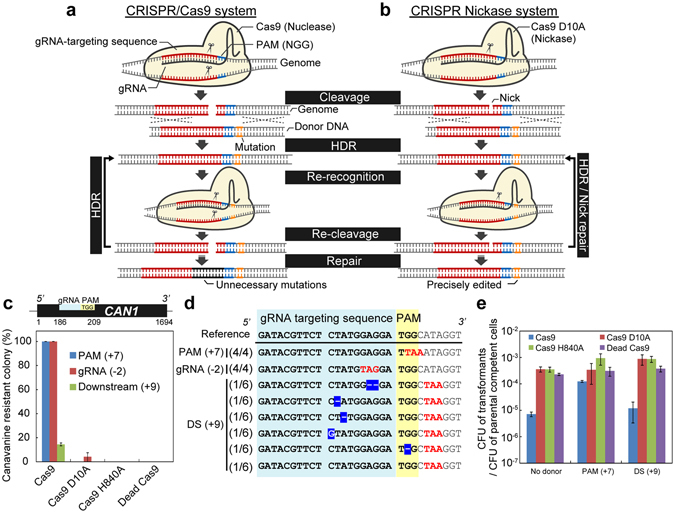
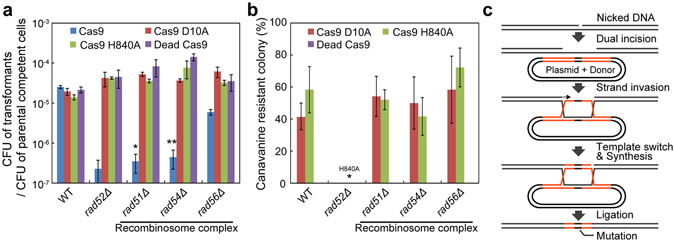
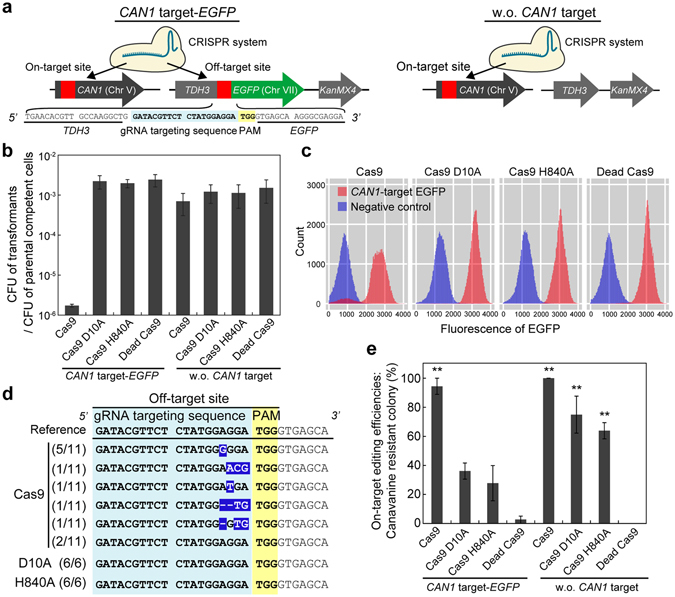
The CRISPR/Cas9 system has been applied to efficient genome editing in many eukaryotic cells. However, the bases that can be edited by this system have been limited to those within the protospacer adjacent motif (PAM) and guide RNA-targeting sequences. In this study, we developed a genome-wide base editing technology, "CRISPR Nickase system" that utilizes a single Cas9 nickase. This system was free from the limitation of editable bases that was observed in the CRISPR/Cas9 system, and was able to precisely edit bases up to 53 bp from the nicking site. In addition, this system showed no off-target editing, in contrast to the CRISPR/Cas9 system. Coupling the CRISPR Nickase system with yeast gap repair cloning enabled the construction of yeast mutants within only five days. The CRISPR Nickase system provides a versatile and powerful technology for rapid, site-specific, and precise base editing in yeast.
CRISPR/Cas9 系统已被应用于许多真核细胞中的高效基因组编辑。然而,该系统可编辑的碱基一直局限于原间隔邻近基序 (PAM) 和向导 RNA 靶向序列内的碱基。在本研究中,我们开发了一种全基因组碱基编辑技术,“CRISPR 核酸酶系统”,该系统利用单个 Cas9 核酸酶。该系统不受 CRISPR/Cas9 系统中观察到的可编辑碱基的限制,能够精确编辑距离切口位点 53bp 的碱基。此外,与 CRISPR/Cas9 系统相比,该系统没有脱靶编辑。将 CRISPR 核酸酶系统与酵母缺口修复克隆相结合,仅用五天时间就构建了酵母突变体。CRISPR 核酸酶系统为酵母中的快速、定点、精确碱基编辑提供了一种通用且强大的技术。