Family Medicine and Community Health and Quantitative Health Sciences, University of Massachusetts Medical School, 55 Lake Ave North, Worcester, MA, 01655, USA.
Academic Support Services, University of Massachusetts Boston, 100 Morrissey Blvd, Boston, MA, 02125, USA.
J Racial Ethn Health Disparities. 2018 Apr;5(2):342-350. doi: 10.1007/s40615-017-0376-7. Epub 2017 May 19.
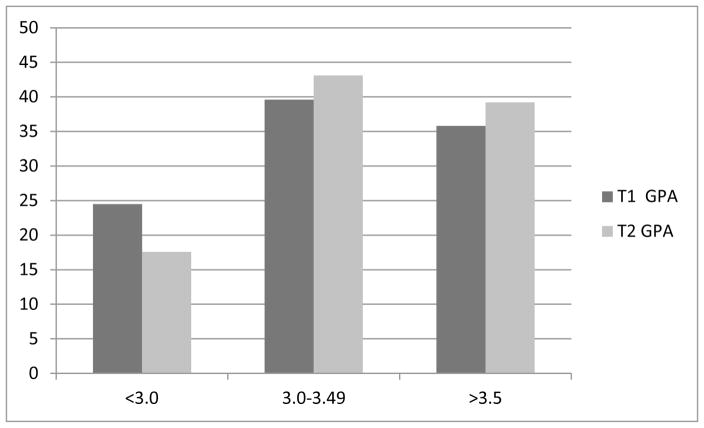
Despite attempts to increase enrollment of under-represented minorities (URMs: primarily Black/African American, Hispanic/Latino, and Native American students) in health professional programs, limited progress has been made. Compelling reasons to rectify this situation include equity for URMs, better prepared health professionals when programs are diverse, better quality and access to health care for UMR populations, and the need for diverse talent to tackle difficult questions in health science and health care delivery. However, many students who initiate traditional "pipeline" programs designed to link URMs to professional schools in health professions and the sciences, do not complete them. In addition, program requirements often restrict entry to highly qualified students while not expanding opportunities for promising, but potentially less well-prepared candidates. The current study describes innovations in an undergraduate pipeline program, the Health Equity Scholars Program (HESP) designed to address barriers URMs experience in more traditional programs, and provides evaluative outcomes and qualitative feedback from participants. A primary outcome was timely college graduation. Eighty percent (80%) of participants, both transfer students and first time students, so far achieved this outcome, with 91% on track, compared to the campus average of 42% for all first time students and 58-67% for transfers. Grade point averages also improved (p = 0.056) after program participation. Graduates (94%) were working in health care/human services positions and three were in health-related graduate programs. Creating a more flexible program that admits a broader range of URMs has potential to expand the numbers of URM students interested and prepared to make a contribution to health equity research and clinical care.
尽管为增加代表性不足的少数群体(主要是黑/African American、西班牙裔/Latino 和美国原住民学生)在健康专业计划中的入学人数做出了种种努力,但进展有限。纠正这种情况的原因包括少数族裔的公平待遇、多样化的项目中更有准备的卫生专业人员、为少数族裔人口提供更好的医疗保健质量和机会、以及解决卫生科学和医疗保健服务提供中的难题需要多样化的人才。然而,许多开始传统的“管道”计划的学生,这些计划旨在将少数族裔与健康专业和科学领域的专业学校联系起来,但他们没有完成这些计划。此外,项目要求通常限制了合格学生的入学机会,而没有为有前途但可能准备不充分的候选人扩大机会。本研究描述了本科管道计划——卫生公平学者计划(HESP)的创新,该计划旨在解决少数族裔在更传统计划中所面临的障碍,并提供参与者的评估结果和定性反馈。一个主要结果是及时完成大学学业。到目前为止,80%的参与者(转学生和新生)都实现了这一目标,其中 91%的人在正轨上,而校园内所有新生的平均比例为 42%,转学生的比例为 58-67%。在参与该项目后,平均绩点也有所提高(p=0.056)。毕业生(94%)在医疗保健/人类服务岗位工作,有 3 人在与健康相关的研究生课程中。创建一个更灵活的项目,招收更多的少数族裔,有可能扩大对健康公平研究和临床护理有兴趣并准备做出贡献的少数族裔学生人数。