Dai Mingjia, Cohen Bernard, Cho Catherine, Shin Susan, Yakushin Sergei B
Department of Neurology, Icahn School of Medicine at Mount Sinai, New York, NY, USA.
Department of Neurology, NYU Langone Medical Center, New York, NY, USA.
Front Neurol. 2017 May 5;8:175. doi: 10.3389/fneur.2017.00175. eCollection 2017.
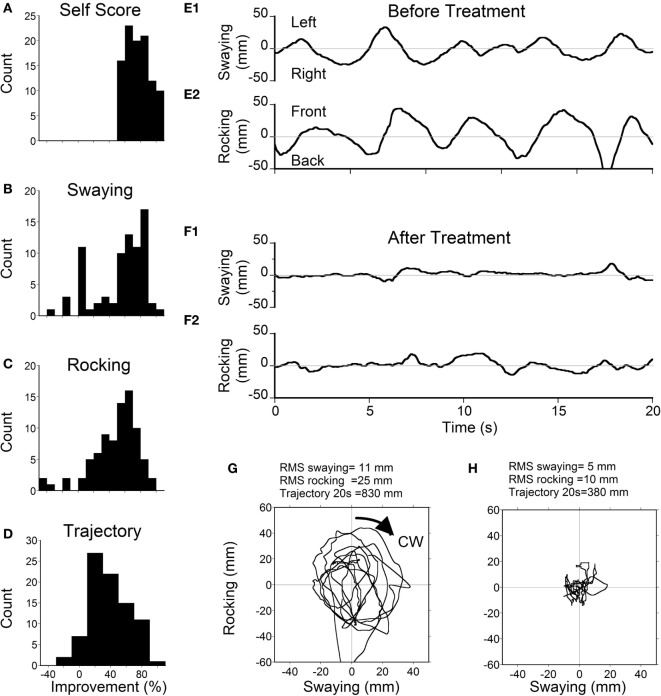
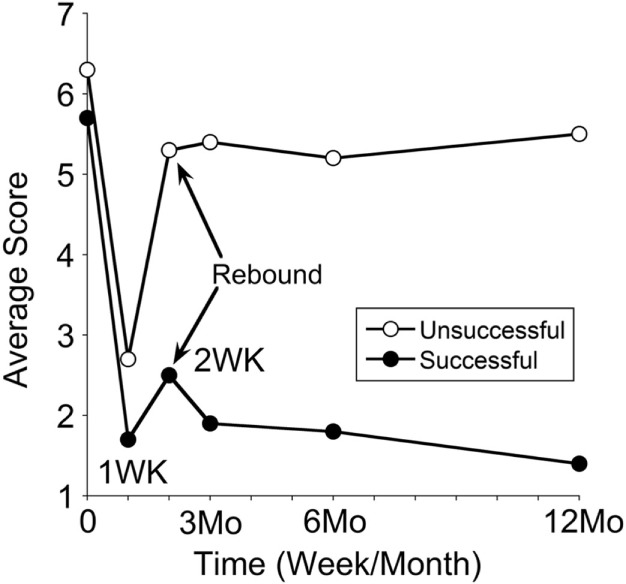
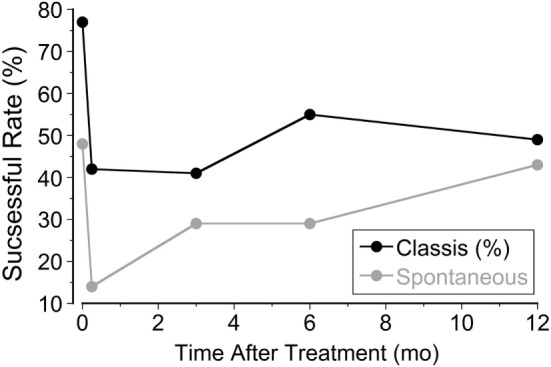
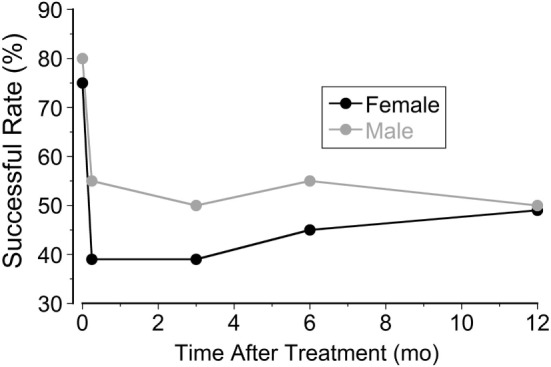
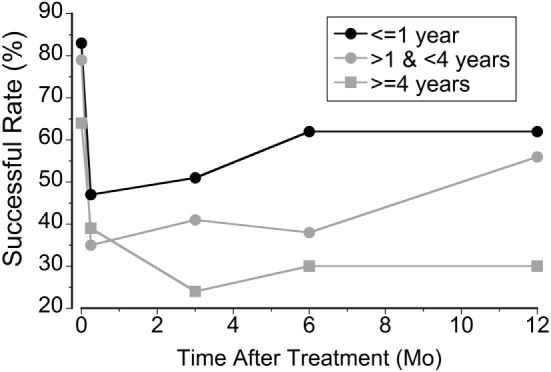
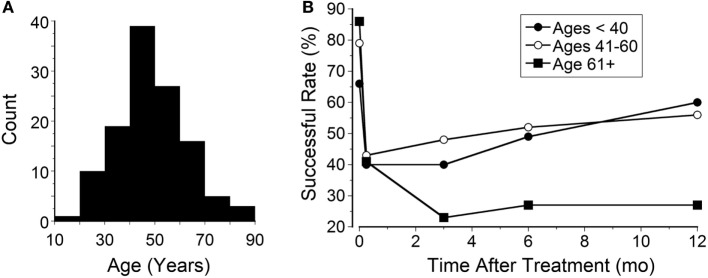
The mal de debarquement syndrome (MdDS) is a movement disorder, occurring predominantly in women, is most often induced by passive transport on water or in the air (classic MdDS), or can occur spontaneously. MdDS likely originates in the vestibular system and is unfamiliar to many physicians. The first successful treatment was devised by Dai et al. (1), and over 330 MdDS patients have now been treated. Here, we report the outcomes of 141 patients (122 females and 19 males) treated 1 year or more ago. We examine the patient's rocking frequency, body drifting, and nystagmus. The patients are then treated according to these findings for 4-5 days. During treatment, patients' heads were rolled while watching a rotating full-field visual surround (1). Their symptom severity after the initial treatment and at the follow-up was assessed using a subjective 10-point scale. Objective measures, taken before and at the end of the week of treatment, included static posturography. Significant improvement was a reduction in symptom severity by more than 50%. Objective measures were not possible during the follow-up because of the wide geographic distribution of the patients. The treatment group consisted of 120 classic and 21 spontaneous MdDS patients. The initial rate of significant improvement after a week of treatment was 78% in classic and 48% in spontaneous patients. One year later, significant improvement was maintained in 52% of classic and 48% of spontaneous subjects. There was complete remission of symptoms in 27% (32) of classic and 19% (4) of spontaneous patients. Although about half of them did not achieve a 50% improvement, most reported fewer and milder symptoms than before. The success of the treatment was generally inversely correlated with the duration of the MdDS symptoms and with the patients' ages. Prolonged travel by air or car on the way home most likely contributed to the symptomatic reversion from the initial successful treatment. Our results indicate that early diagnosis and treatment can significantly improve results, and the prevention of symptomatic reversion will increase the long-term benefit in this disabling disorder.
晕船后综合征(MdDS)是一种运动障碍,主要发生在女性中,最常见的诱发因素是水上或空中的被动运输(经典MdDS),也可能自发出现。MdDS可能起源于前庭系统,许多医生对其并不熟悉。首例成功的治疗方法由戴等人设计(1),目前已有超过330名MdDS患者接受了治疗。在此,我们报告1年或更早之前接受治疗的141例患者(122名女性和19名男性)的治疗结果。我们检查患者的摇晃频率、身体漂移和眼球震颤。然后根据这些检查结果对患者进行4至5天的治疗。治疗期间,患者在观看旋转的全视野视觉环绕物时转动头部(1)。使用主观的10分制量表评估初始治疗后及随访时患者的症状严重程度。治疗前和治疗结束时进行的客观测量包括静态姿势描记法。显著改善定义为症状严重程度降低超过50%。由于患者地理分布广泛,随访期间无法进行客观测量。治疗组包括120例经典型和21例自发型MdDS患者。治疗一周后,经典型患者的显著改善初始率为78%,自发型患者为48%。一年后,52%的经典型患者和48%的自发型患者保持显著改善。27%(32例)的经典型患者和19%(4例)的自发型患者症状完全缓解。虽然约一半患者未实现50%的改善,但大多数患者报告症状比以前减少且减轻。治疗的成功通常与MdDS症状持续时间及患者年龄呈负相关。回家途中长时间乘坐飞机或汽车很可能导致了初始成功治疗后症状的复发。我们的结果表明,早期诊断和治疗可显著改善治疗效果,预防症状复发将增加这种致残性疾病的长期益处。