Haynes Andrew, Linden Matthew D, Robey Elisa, Naylor Louise H, Cox Kay L, Lautenschlager Nicola T, Green Daniel J
School of Sport Science, Exercise and Health, University of Western Australia, Crawley, Western Australia, Australia.
School of Pathology and Laboratory Medicine, University of Western Australia, Crawley, Western Australia.
Physiol Rep. 2017 May;5(10):e13189. doi: 10.14814/phy2.13189.
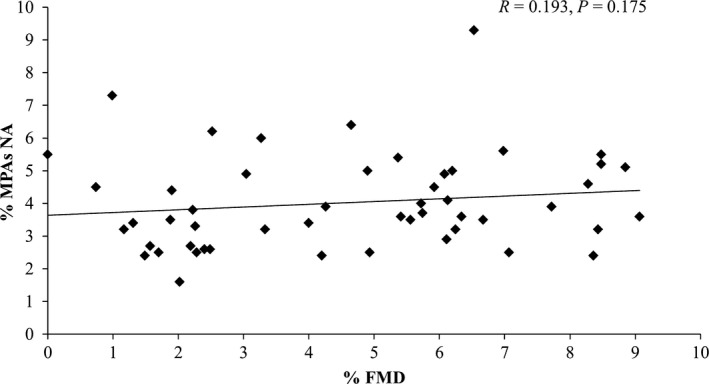
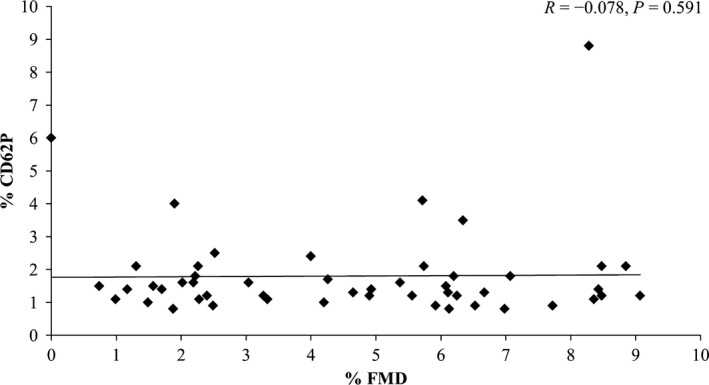
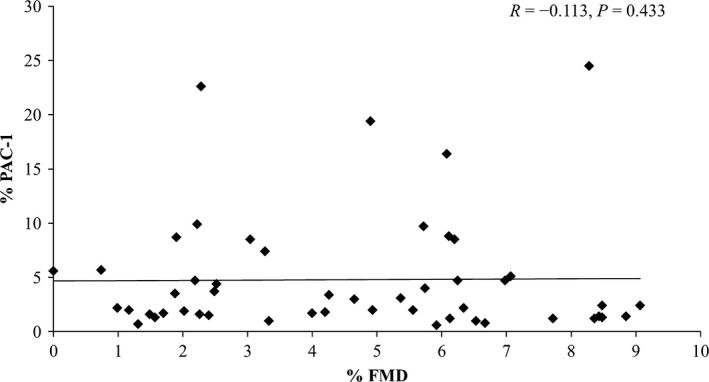
Low-grade inflammation, endothelial dysfunction, and platelet hyper-reactivity to agonists are associated with an increased risk of cardiovascular events. In vitro and animal studies infer an inverse mechanistic relationship between platelet activation and the production of endothelium-derived nitric oxide and prostacyclin. This concept is supported by evidence of an inverse relationship between endothelial function and platelet activation in high-risk cardiac patients. The aim of this study was to investigate what relationship, if any, exists between platelet and endothelial function in healthy, middle-aged, and elderly adults. In 51 participants (18 male, 33 post menopausal female), endothelial function was assessed by flow-mediated dilation (FMD). Platelet function was assessed by flow cytometric determination of glycoprotein IIb/IIIa activation (measured by PAC-1 binding), granule exocytosis (measured by surface P-selectin expression), and monocyte-platelet aggregates (MPAs), with and without stimulation by canonical platelet agonists adenosine diphosphate (ADP), arachidonic acid (AA), and collagen. Correlation analysis indicated there was no significant (all => 0.05) relationship between FMD and any marker of in vivo platelet activation (MPAs =0.193, PAC-1 = -0.113, anti-CD62P = -0.078) or inducible platelet activation by ADP (MPA = -0.128, anti-CD62P = -0.237), AA (MPA = -0.122, PAC-1 = -0.045, anti-CD62P = -0.142), or collagen (MPA =0.136, PAC-1 =0.174, anti-CD62P = -0.077). Our findings contrast with two previous studies performed in high-risk cardiac patients, which reported inverse relationships between platelet activation and endothelial function, suggesting that some compensatory redundancy may exist in the relationship between platelet and endothelial function in preclinical populations.
低度炎症、内皮功能障碍以及血小板对激动剂的高反应性与心血管事件风险增加相关。体外和动物研究推断血小板活化与内皮源性一氧化氮和前列环素生成之间存在反向机制关系。高危心脏病患者内皮功能与血小板活化之间存在反向关系的证据支持了这一概念。本研究的目的是调查健康的中年和老年成年人中血小板与内皮功能之间存在何种关系(若有关系的话)。在51名参与者(18名男性,33名绝经后女性)中,通过血流介导的血管舒张(FMD)评估内皮功能。通过流式细胞术测定糖蛋白IIb/IIIa活化(通过PAC-1结合测量)、颗粒胞吐作用(通过表面P-选择素表达测量)以及单核细胞-血小板聚集体(MPA)来评估血小板功能,有无经典血小板激动剂二磷酸腺苷(ADP)、花生四烯酸(AA)和胶原蛋白刺激。相关性分析表明,FMD与体内血小板活化的任何标志物(MPA = 0.193,PAC-1 = -0.113,抗CD62P = -0.078)或ADP诱导的血小板活化(MPA = -0.128,抗CD62P = -0.237)、AA(MPA = -0.122,PAC-1 = -0.045,抗CD62P = -0.142)或胶原蛋白(MPA = 0.136,PAC-1 = 0.174,抗CD62P = -0.077)之间均无显著(所有p值均>0.05)关系。我们的研究结果与之前在高危心脏病患者中进行的两项研究形成对比,后者报道了血小板活化与内皮功能之间的反向关系,这表明在临床前人群中血小板与内皮功能之间的关系可能存在一些代偿性冗余。