Derbie Awoke, Hailu Derese, Mekonnen Daniel, Abera Bayeh, Yitayew Gashaw
Department of Medical Microbiology, Immunology and Parasitology, College of Medicine and Health Sciences, Bahir Dar University, Bahir Dar, Ethiopia.
Bahir Dar Regional Health Research Laboratory Center, Bahir Dar, Ethiopia.
Pan Afr Med J. 2017 Mar 10;26:134. doi: 10.11604/pamj.2017.26.134.7827. eCollection 2017.
Antimicrobial resistance among bacteria that cause urinary tract infection (UTI) has been increasing since the introduction of chemotherapy. This study was aimed to assess the types of isolates from patients with UTI and to determine their current antimicrobial susceptibility profile.
A record based retrospective analysis of bacterial uropathogens processed in the period of January 2012 to December 2014 at Bahir Dar Health Research Laboratory Center (BRHRLC) was determined. According to standard microbiological procedures, midstream urine samples were collected and processed with conventional culture and biochemical tests. Isolates were tested against commonly used antibiotics by Kirby-Bauer disc diffusion methods. Chi-square test was calculated to compare the proportion of bacterial isolates between sex and age and statistical significance was set at p value < 0.05.
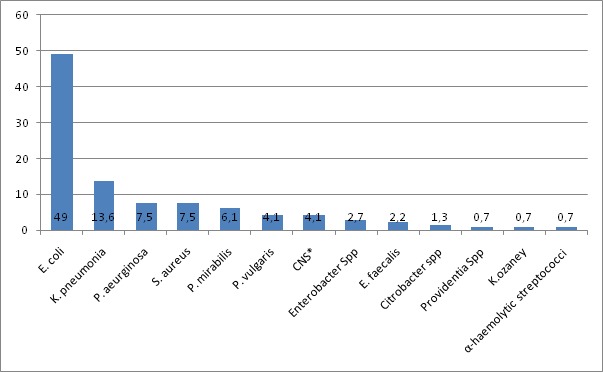
Out of 446 patients, female constituted at 299 (67%). Significant bacteriuria was reported on 30.5% (95% CI: 26.4-34.9%) cultures. Of these, 78% (95% CI: 71.0-84.7%) were from females. Age and sex were found associated with significant bacteriuria at p=0.046 and p=0.001 respectively. The most commonly identified isolates were , at 72 (49 %) followed by at 20 (13.6%) and at 11 (7.5%). The overall antimicrobial susceptibility profile showed that Trimetoprim-sulphamethoxazole, amoxicillin/clavulanate and ampicillin revealed high level of resistance, at 84(66.7%), 61(79.2%), 106(91.4% respectively. Conversely, 64.2-100% sensitivity rate was documented for ciprofloxacin, gentamycin and pepracillin.
UTI associated with multiple drug resistant bacteria is an important health concern of the study population. Therefore, ongoing surveillance of the types of uropathogens and their up-to-date antimicrobial resistance profile is crucial for better management of patients.
自化疗药物应用以来,引起尿路感染(UTI)的细菌的耐药性一直在增加。本研究旨在评估UTI患者的分离菌株类型,并确定其当前的抗菌药物敏感性概况。
对2012年1月至2014年12月期间在巴赫达尔健康研究实验室中心(BRHRLC)处理的细菌性尿路病原体进行基于记录的回顾性分析。根据标准微生物学程序,收集中段尿样本并通过常规培养和生化试验进行处理。采用 Kirby-Bauer 纸片扩散法对分离菌株进行常用抗生素测试。计算卡方检验以比较性别和年龄之间细菌分离株的比例,统计学显著性设定为 p 值<0.05。
在446例患者中,女性占299例(67%)。30.5%(95%CI:26.4 - 34.9%)的培养物报告有显著菌尿。其中,78%(95%CI:71.0 - 84.7%)来自女性。年龄和性别分别在 p = 0.046 和 p = 0.001 时与显著菌尿相关。最常见的分离菌株是 ,占72株(49%),其次是 ,占20株(13.6%), 占11株(7.5%)。总体抗菌药物敏感性概况显示,甲氧苄啶 - 磺胺甲恶唑、阿莫西林/克拉维酸和氨苄西林显示出高水平耐药,分别为84株(66.7%)、61株(79.2%)、106株(91.4%)。相反,环丙沙星、庆大霉素和哌拉西林的敏感率记录为64.2 - 100%。
与多重耐药细菌相关联的UTI是研究人群重要的健康问题。因此,持续监测尿路病原体类型及其最新的抗菌药物耐药性概况对于更好地管理患者至关重要。