Giltaij Hans Peter, Sterkenburg Paula Sophia, Schuengel Carlo
1 Department of Clinical Child and Family Studies, Faculty of Behavioural and Movement Sciences, Vrije Universiteit Amsterdam, The Netherlands.
2 EMGO+ Institute for Health and Care Research, Vrije Universiteit Amsterdam, The Netherlands.
Clin Child Psychol Psychiatry. 2017 Oct;22(4):603-619. doi: 10.1177/1359104517709049. Epub 2017 May 24.
A comprehensive approach is needed for diagnosing disordered attachment behavior due to the multifaceted nature of attachment. Differences between various indicators can pose a challenge for deciding on the proper diagnosis. This study assessed the convergence between clinical interview assessment and observation-based clinical diagnosis, and their linkages with inadequate care.
Participating children ( N = 55) had intelligence quotients (IQs) between 50 and 85 and were referred for psychiatric consultation. Data were obtained by structured review of medical records, the Disturbances of Attachment Interview (DAI), and the Clinical Observation of Attachment (COA) procedure.
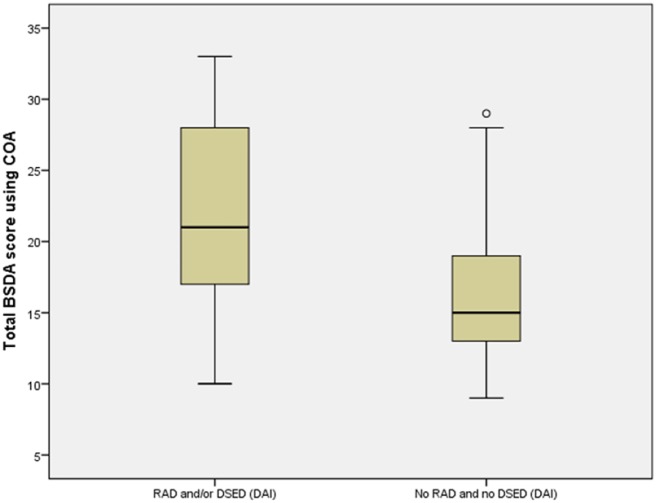
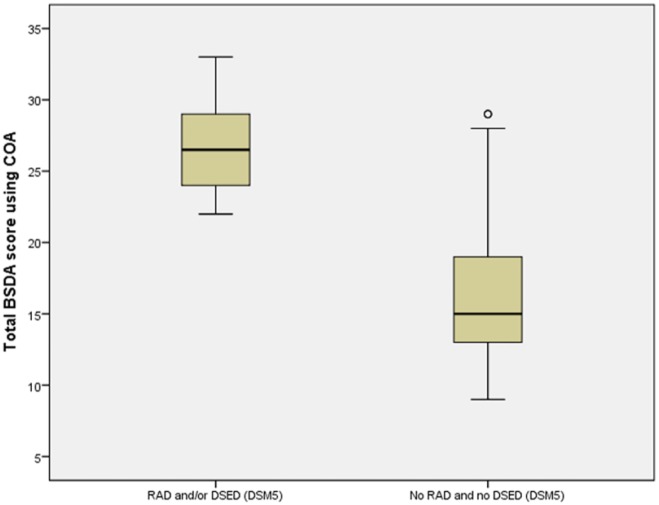
Of the 18 children identified using the DAI with Diagnostic and Statistical Manual of Mental Disorders-Fifth Edition (DSM-5) diagnosis of reactive attachment disorder (RAD) and/or disinhibited social engagement disorder (DSED), only 7 received a clinical DSM-5 diagnosis of RAD and/or DSED. Observed maladaptive attachment behavior in the COA was strongly associated with DAI scores and with clinical diagnosis of DSM-5 RAD and/or DSED. There was a significantly higher prevalence of extremes of insufficient care in children who were classified with RAD by DAI or DSM-5 and/or with DSED by DSM-5 compared to those with no attachment disorder.
Using structured observation and record assessment leads to more conservative identification of RAD or DSED than using the DAI.
由于依恋具有多面性,因此需要一种综合方法来诊断紊乱的依恋行为。各种指标之间的差异可能给做出正确诊断带来挑战。本研究评估了临床访谈评估与基于观察的临床诊断之间的一致性,以及它们与照料不足的联系。
参与研究的儿童(N = 55)智商在50至85之间,均被转介进行精神科咨询。数据通过对病历的结构化审查、依恋障碍访谈(DAI)和依恋临床观察(COA)程序获得。
在使用DAI并依据《精神疾病诊断与统计手册》第五版(DSM-5)诊断为反应性依恋障碍(RAD)和/或去抑制性社会参与障碍(DSED)的18名儿童中,只有7名获得了临床DSM-5诊断的RAD和/或DSED。在COA中观察到的适应不良依恋行为与DAI评分以及DSM-5诊断的RAD和/或DSED临床诊断密切相关。与无依恋障碍的儿童相比,通过DAI或DSM-5诊断为RAD和/或通过DSM-5诊断为DSED的儿童中,照料极度不足的患病率显著更高。
与使用DAI相比,采用结构化观察和记录评估对RAD或DSED的识别更为保守。