Yang Hao, Fu Jingyu, Zhao Youyun, Shi Huiping, Hu Hua, Wang Hongliang
Department of Laboratory Medicine, Huangshi Central Hospital, (Affiliated Hospital of Hubei Polytechnic University), Edong Healthcare Group, Huangshi, Hubei, China (mainland).
Hubei Key Laboratory of Kidney Disease Pathogenesis and Intervention, Huangshi, Hubei, China (mainland).
Med Sci Monit. 2017 May 27;23:2558-2564. doi: 10.12659/msm.902095.
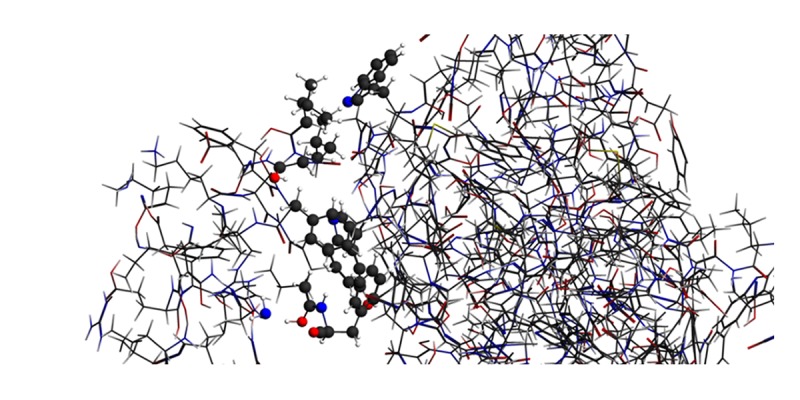
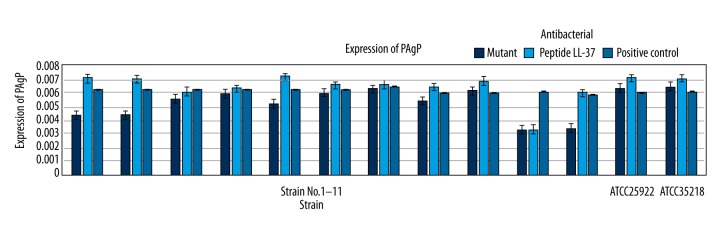
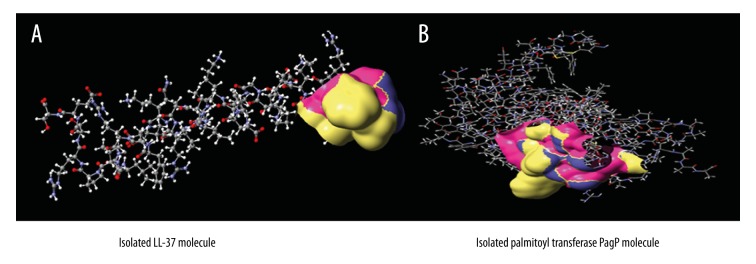
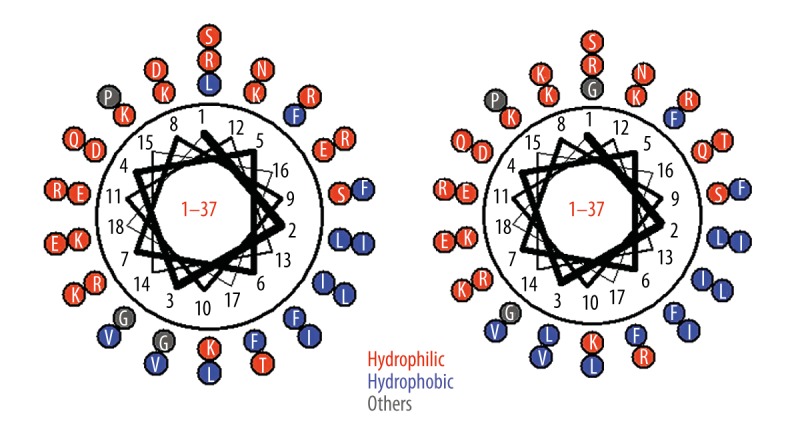
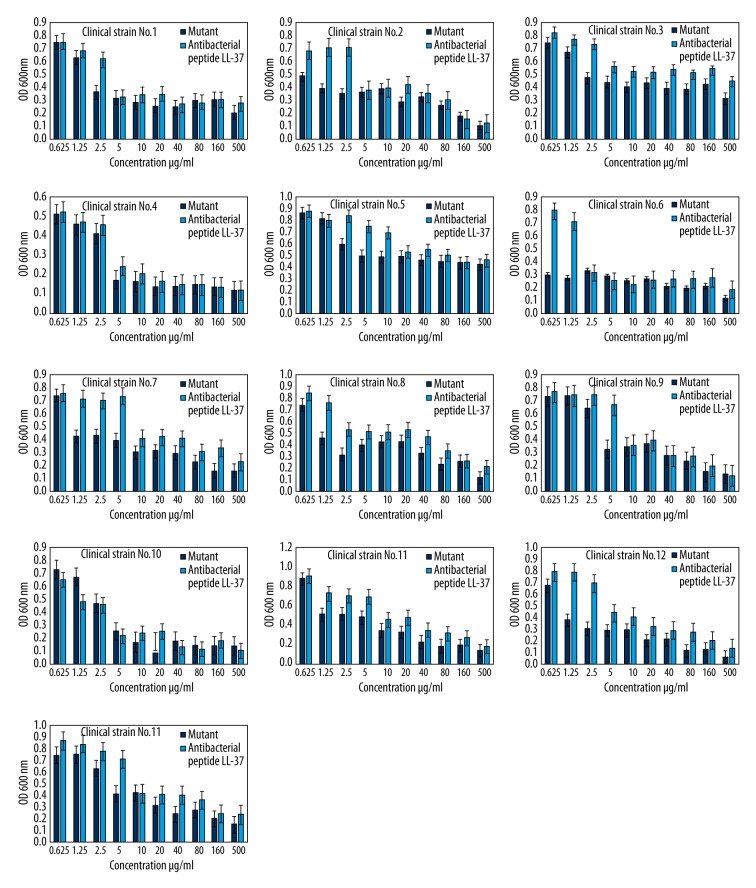
BACKGROUND The aim of this study was to investigate the antimicrobial property of peptide LL-37 sequences. MATERIAL AND METHODS Humanized antibacterial peptide LL-37 and the mutant were prepared by chemical synthesis. The physicochemical properties of antibacterial peptide LL-37 were analyzed by SWISS-MODEL online prediction tool. Molecular docking between antibacterial peptide LL-37 fragments and palmitoyl transferase PagP was made with Lamarckian genetic algorithm by AutoDock1.5.6. RESULTS The systems contacted each other at 8.75 picosec. After 20 picsec, the system had no trend of dissociation, and the bond energy of weak bond -C-O-H…NH2-CH2- was calculated. The hydrophobic groups were important factors that led to contact and merged the two parts. The contacted weak bond -C-O-H…NH2-CH2- was the bridge for contacting LL-37 with palmitoyl transferase PagP. The binding sites of antibacterial peptide LL-37 and palmitoyl transferase PagP mainly included LYS8, GLU11, LEU28, LYS12, PHE27, ILE13, and PHE6 of antibacterial peptide LL-37 and ARG94, TRP89, ASN65, SER3, GLU90, GLU90, ASN100, HIS102, and THR92 of palmitoyl transferase PagP. CONCLUSIONS Antibacterial peptide LL-37 had stronger antibacterial effect via inhibition of activity of PagP.
背景 本研究旨在探究肽LL-37序列的抗菌特性。
材料与方法 通过化学合成制备人源化抗菌肽LL-37及其突变体。利用SWISS-MODEL在线预测工具分析抗菌肽LL-37的理化性质。采用AutoDock1.5.6的拉马克遗传算法进行抗菌肽LL-37片段与棕榈酰转移酶PagP之间的分子对接。
结果 系统在8.75皮秒时相互接触。20皮秒后,系统无解离趋势,并计算出弱键-C-O-H…NH2-CH2-的键能。疏水基团是导致两部分接触并融合的重要因素。接触的弱键-C-O-H…NH2-CH2-是LL-37与棕榈酰转移酶PagP接触的桥梁。抗菌肽LL-37与棕榈酰转移酶PagP的结合位点主要包括抗菌肽LL-37的LYS8、GLU11、LEU28、LYS12、PHE27、ILE13和PHE6,以及棕榈酰转移酶PagP的ARG94、TRP89、ASN65、SER3、GLU90、GLU90、ASN100、HIS102和THR92。
结论 抗菌肽LL-37通过抑制PagP的活性具有更强的抗菌作用。