Parks Michael J, Kingsbury John H, Boyle Raymond G, Choi Kelvin
Health Promotion and Chronic Disease Division, Minnesota Department of Health, 85 7th Place E. St. Paul, MN 55101, USA.
Office of Statewide Health Improvement Initiative, Minnesota Department of Health, St. Paul, MN, USA.
Addict Behav. 2017 Oct;73:209-215. doi: 10.1016/j.addbeh.2017.05.019. Epub 2017 May 22.
Tobacco use is a leading behavioral risk factor for morbidity and mortality, and the tobacco epidemic disproportionately affects low-socioeconomic status (SES) populations. Taxation is effective for reducing cigarette use, and it is an effective population-based policy for reducing SES-related tobacco disparities. However, progress in implementing cigarette excise taxes has stalled across the United States, and there is a dearth of research on the full spectrum of behavioral shifts that result from taxes, particularly among low-SES populations. This project documents the impact of Minnesota's $1.75 cigarette tax increase implemented in 2013.
Data come from the 2014 Minnesota Adult Tobacco Survey. Descriptive analyses and Latent Class Analysis (LCA) were used to provide a typology of the tax impact.
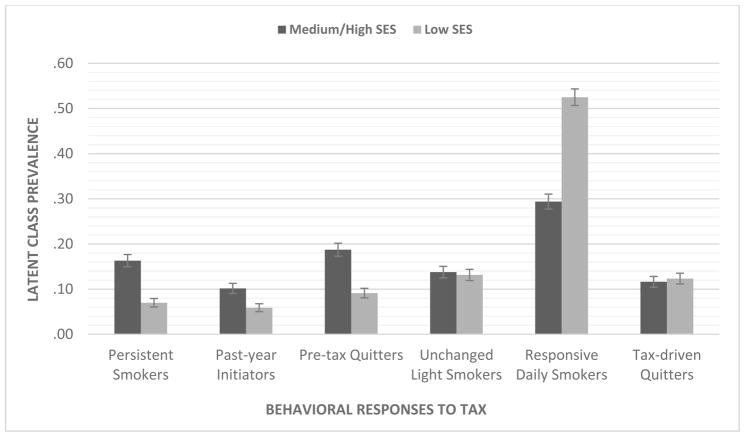
From the LCA, six classes were identified, and 42% of respondents were classified as reporting action-oriented behavioral change related to the tax-8% reported sustained smoking abstinence. We found differential behavior change across levels of SES. Low-SES and medium/high-SES individuals were equally likely to report complete tobacco cessation, but the prevalence of daily smokers who reported action-oriented behavior without sustained cessation was nearly double for low-SES individuals.
Smokers report a range of behavioral changes in response to cigarette taxes, with differences across SES. The majority of smokers, and particularly low-SES smokers, report behavioral steps toward quitting or achieving sustained tobacco cessation in response to cigarette taxes. Complementary population-based programs geared toward assisting individuals, especially low-SES individuals, to achieve continuous tobacco cessation could increase the reach and effectiveness of cigarette taxes.
烟草使用是发病和死亡的主要行为风险因素,烟草流行对社会经济地位低的人群影响尤为严重。征税对减少香烟使用有效,是一项基于人群的有效政策,可减少与社会经济地位相关的烟草差异。然而,美国各地在实施香烟消费税方面的进展停滞不前,而且对于税收导致的全方位行为转变,尤其是在社会经济地位低的人群中,研究匮乏。本项目记录了明尼苏达州2013年实施的1.75美元香烟税上调的影响。
数据来自2014年明尼苏达成人烟草调查。采用描述性分析和潜在类别分析(LCA)来提供税收影响的类型。
通过潜在类别分析,确定了六个类别,42%的受访者被归类为报告了与税收相关的以行动为导向的行为变化——8%报告持续戒烟。我们发现不同社会经济地位水平的行为变化存在差异。社会经济地位低的人和中等/高社会经济地位的人报告完全戒烟的可能性相同,但报告了以行动为导向的行为但未持续戒烟的每日吸烟者中,社会经济地位低的人的比例几乎是中等/高社会经济地位者的两倍。
吸烟者报告了一系列因香烟税而产生的行为变化,不同社会经济地位的情况存在差异。大多数吸烟者,尤其是社会经济地位低的吸烟者,报告了为应对香烟税而采取的朝着戒烟或实现持续戒烟的行为步骤。针对协助个人,特别是社会经济地位低的个人实现持续戒烟的基于人群的补充项目,可能会提高香烟税的覆盖范围和效果。