Barrois Rémi Pierre-Marie, Ricard Damien, Oudre Laurent, Tlili Leila, Provost Clément, Vienne Aliénor, Vidal Pierre-Paul, Buffat Stéphane, Yelnik Alain P
Cognition and Action Group, Cognac-G, CNRS UMR 8257, Université Paris Descartes, Service de Santé des Armées, Paris, France.
Service de Neurologie, Hôpital d'Instruction des Armées de Percy, Service de Santé des Armées, Clamart, France.
Front Neurol. 2017 May 15;8:194. doi: 10.3389/fneur.2017.00194. eCollection 2017.
We analyzed spontaneous 180° turning strategies in poststroke hemiparetic patients by using inertial measurement units (IMUs) and the association of turning strategies with risk of falls.
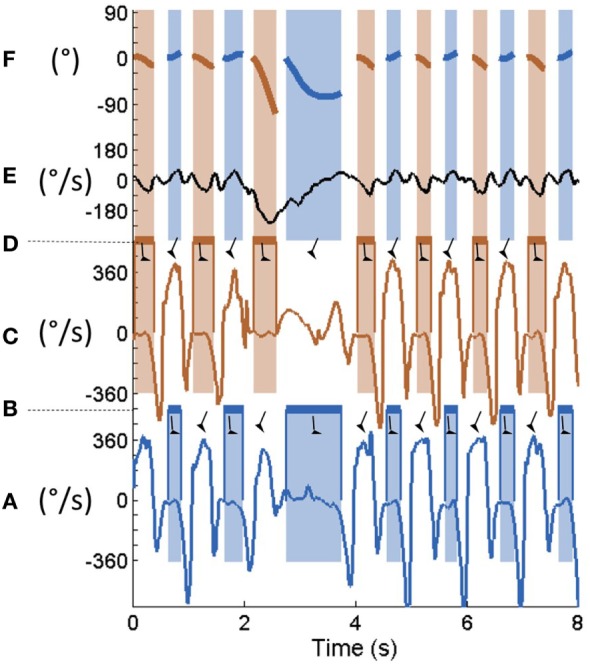
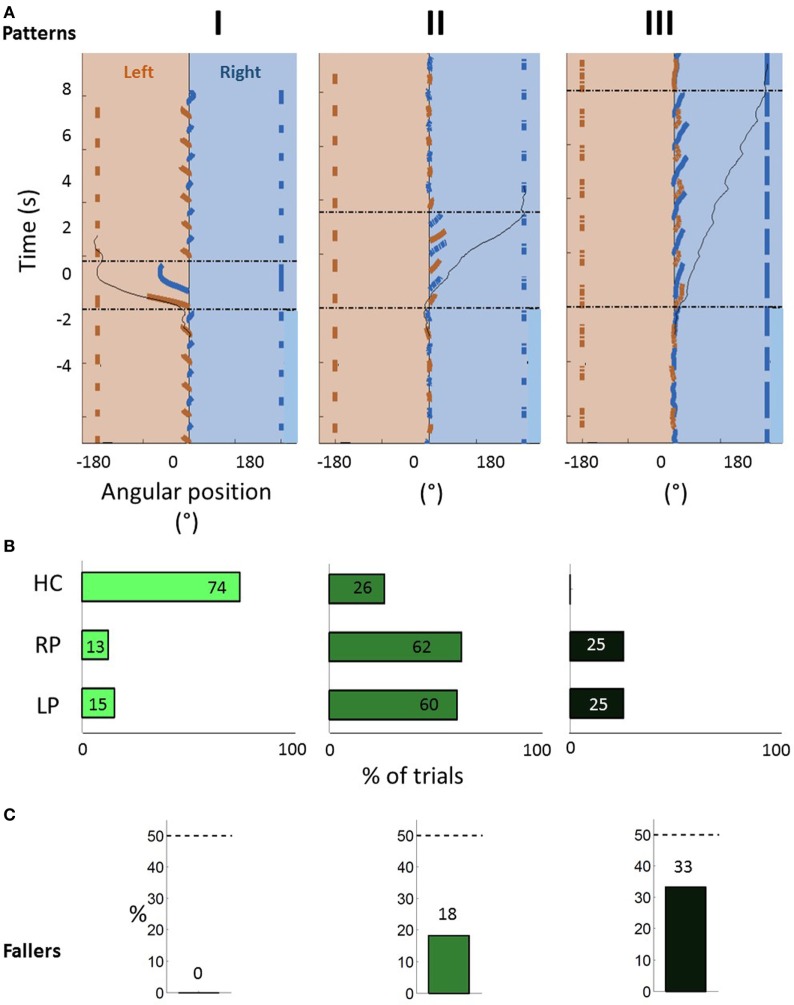
We included right paretic (RP) and left paretic (LP) post-stroke patients, and healthy controls (HCs) from a physical and rehabilitation department in France between July 2015 and October 2015. All subjects were right-handed and right-footed for mobilization tasks. Participants were instructed to turn 180° in a self-selected direction after a 10-m walk while wearing three IMUs on their trunk and both feet. We defined three turning patterns based on the number of external steps (pattern I = 1; II = 2-4 steps; and III ≥ 5) and four turning strategies based on the side chosen to turn (healthy or paretic) and the stance limb used during the first step of the turn (healthy or paretic). Falls in the 6 months after measurement were investigated.
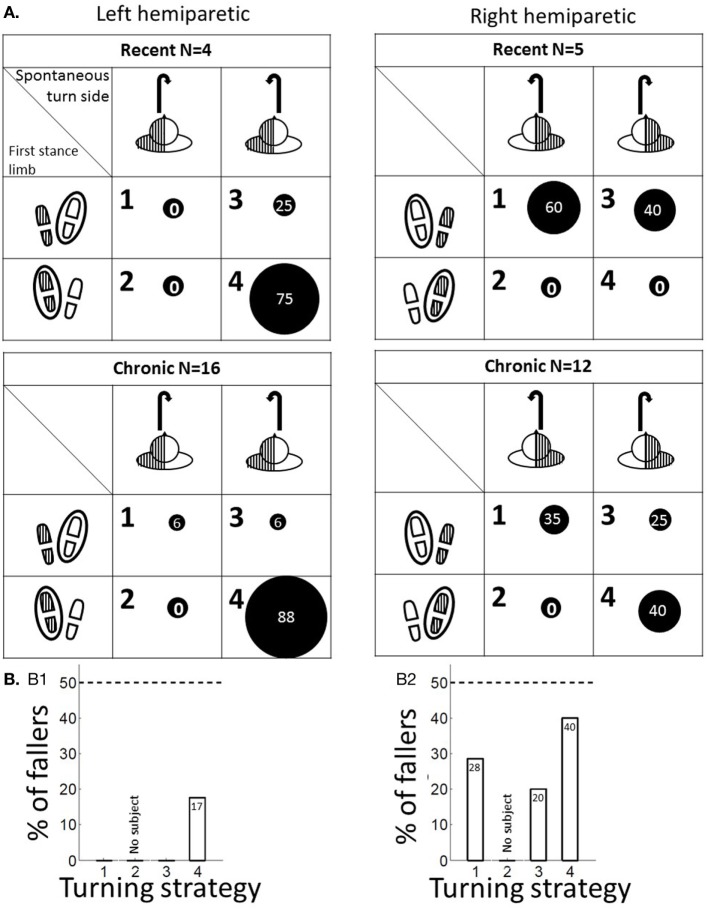
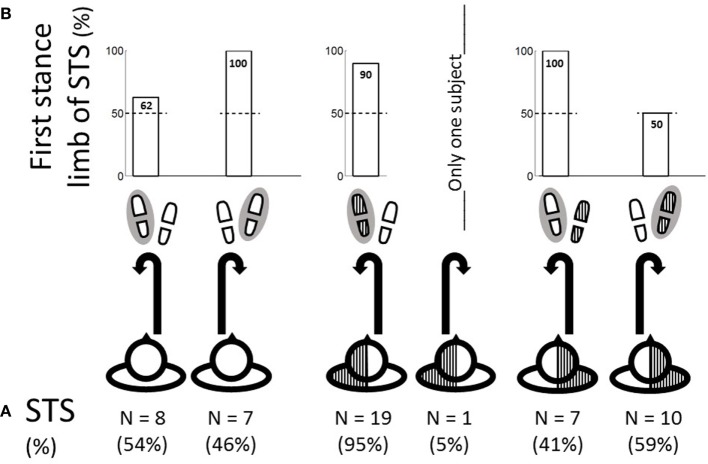
We included 17 RP [mean (SD) age 57.5 (9.5) years (range 43-73)], 20 LP patients [mean age 60.7 (8.8) years (range 43-63)], and 15 HCs [mean age 56.7 (16.1) years (range 36-83)]. The LP and RP groups behaved similarly in turning patterns, but 90% of LP patients turned spontaneously to the paretic side versus 59% of RP patients. This difference increased with turning strategies: 85% of LP versus 29% of RP patients used strategy 4 (paretic turn side with paretic limb). Patients using strategy 4 had the highest rate of falls.
We propose to consider spontaneous turning strategies as new indicators to evaluate the risk of fall after stroke. IMU could be routinely used to identify this risk and guide balance rehabilitation programs.
我们通过使用惯性测量单元(IMU)分析了中风后偏瘫患者的自发180°转身策略,以及转身策略与跌倒风险的关联。
我们纳入了2015年7月至2015年10月期间来自法国某物理与康复科的右侧偏瘫(RP)和左侧偏瘫(LP)中风患者以及健康对照(HC)。所有受试者在进行移动任务时均为右利手且右脚优先。参与者被要求在10米步行后,朝着自选方向转身180°,同时在其躯干和双脚上佩戴三个IMU。我们根据外部步数定义了三种转身模式(模式I = 1步;II = 2 - 4步;III≥5步),并根据转身所选择的一侧(健侧或患侧)以及转身第一步所使用的支撑腿(健侧或患侧)定义了四种转身策略。对测量后6个月内的跌倒情况进行了调查。
我们纳入了17名RP患者[平均(标准差)年龄57.5(9.5)岁(范围43 - 73岁)]、20名LP患者[平均年龄60.7(8.8)岁(范围43 - 63岁)]和15名HC[平均年龄56.7(16.1)岁(范围36 - 83岁)]。LP组和RP组在转身模式上表现相似,但90%的LP患者自发转向患侧,而RP患者为59%。这种差异随着转身策略的不同而增加:85%的LP患者与29%的RP患者使用策略4(患侧转身且第一步使用患侧肢体)。使用策略4的患者跌倒率最高。
我们建议将自发转身策略视为评估中风后跌倒风险的新指标。IMU可常规用于识别这种风险并指导平衡康复计划。