Oguttu David W, Matovu Joseph K B, Okumu David C, Ario Alex R, Okullo Allen E, Opigo Jimmy, Nankabirwa Victoria
Uganda Public Health Fellowship Programme-Field Epidemiology Track, P.O. Box 7072, Kampala, Uganda.
Tororo District Health Office, Tororo, Uganda.
Malar J. 2017 May 30;16(1):227. doi: 10.1186/s12936-017-1871-3.
In 2012, Tororo District had the highest malaria burden in Uganda with community Plasmodium prevalence of 48%. To control malaria in the district, the Ministry of Health introduced universal distribution of long lasting insecticide-treated nets (LLINs) in 2013 and added indoor residual spraying (IRS) in 2014. This study assessed malaria incidence, test positivity rates and outpatient (OPD) attendance due to malaria before and after vector control interventions.
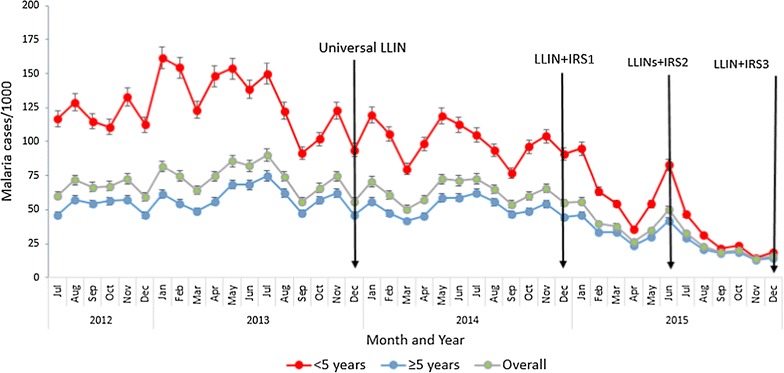
This study was based on analysis of Health Management Information System (HMIS) secondary malaria surveillance data of 2,727,850 patient records in OPD registers of 61 health facilities from 2012 to 2015. The analysis estimated monthly malaria incidence for the entire population and also separately for <5- and ≥5-year-olds before and after introduction of vector control interventions; determined laboratory test positivity rates and annual percentage of malaria cases in OPD. Chi square for trends was used to analyse annual change in malaria incidence and logistic regression for monthly reduction.
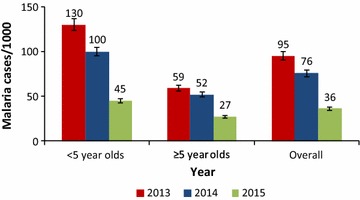
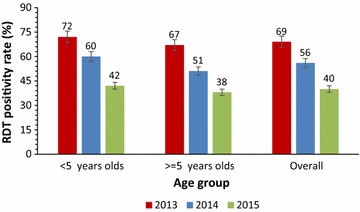
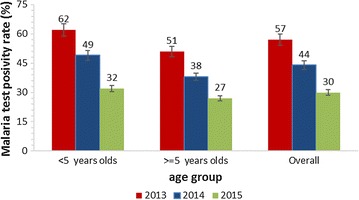
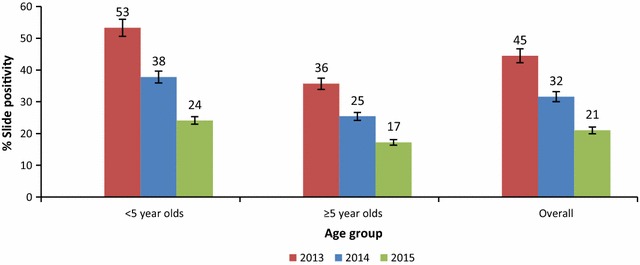
Following universal LLINs coverage, the annual mean monthly malaria incidence fell from 95 cases in 2013 to 76 cases per 1000 in 2014 with no significant monthly reduction (OR = 0.99, 95% CI 0.96-1.01, P = 0.37). Among children <5 years, the malaria incidence reduced from 130 to 100 cases per 1000 (OR = 0.98, 95% CI 0.97-1.00, P = 0.08) when LLINs were used alone in 2014, but declined to 45 per 1000 in 2015 when IRS was combined with LLINs (OR = 0.94, 95% CI 0.91-0.996, P < 0.0001). Among individuals aged ≥5 years, mean monthly malaria incidence reduced from 59 to 52 cases per 1000 (OR = 0.99, 95% CI 0.97-1.02, P = 0.8) when LLINs were used alone in 2014, but reduced significantly to 25 per 1000 in 2015 (OR = 0.91, 95% CI 0.88-0.94, P < 0.0001). Malaria test positivity rate reduced from 57% in 2013 to 30% (Chi = 15, P < 0.0001) in 2015. Slide positivity rate reduced from 45% in 2013 to 21% in 2015 (P = 0.004) while RDT positivity declined from 69 to 40%.
A rapid reduction in malaria incidence was observed in Tororo District following the introduction of IRS in addition to LLINs. There was no significant reduction in malaria incidence following universal distribution of LLINs to communities before introduction of IRS.
2012年,托罗罗区是乌干达疟疾负担最重的地区,社区疟原虫感染率达48%。为控制该地区的疟疾,卫生部于2013年开始普遍分发长效驱虫蚊帐(LLINs),并于2014年增加了室内滞留喷洒(IRS)。本研究评估了病媒控制干预措施前后的疟疾发病率、检测阳性率以及因疟疾前来门诊(OPD)就诊的情况。
本研究基于对2012年至2015年61家医疗机构门诊登记册中2,727,850份患者记录的卫生管理信息系统(HMIS)二次疟疾监测数据的分析。该分析估算了病媒控制干预措施实施前后整个人口以及年龄小于5岁和大于等于5岁人群的月度疟疾发病率;确定了实验室检测阳性率以及门诊中疟疾病例的年度百分比。采用趋势卡方检验分析疟疾发病率的年度变化,采用逻辑回归分析月度降幅。
在实现长效驱虫蚊帐全面覆盖后,年度平均月度疟疾发病率从2013年的95例降至2014年的每1000人76例,月度降幅不显著(比值比=0.99,95%置信区间0.96 - 1.01,P = 0.37)。在年龄小于5岁的儿童中,2014年单独使用长效驱虫蚊帐时,疟疾发病率从每1000人130例降至100例(比值比=0.98,95%置信区间0.97 - 1.00,P = 0.08),但在2015年长效驱虫蚊帐与室内滞留喷洒联合使用时,发病率降至每1000人45例(比值比=0.94,95%置信区间0.91 - 0.996,P < 0.0001)。在年龄大于等于5岁的人群中,2014年单独使用长效驱虫蚊帐时,平均月度疟疾发病率从每1000人59例降至52例(比值比=0.99,95%置信区间0.97 - 1.02,P = 0.8),但在2015年显著降至每1000人25例(比值比=0.91,95%置信区间0.88 - 0.94,P < 0.0001)。疟疾检测阳性率从2013年的57%降至2015年的30%(卡方值=15,P < 0.0001)。涂片阳性率从2013年的45%降至2015年的21%(P = 0.004),而快速诊断检测阳性率从69%降至40%。
在托罗罗区,除长效驱虫蚊帐外引入室内滞留喷洒后,疟疾发病率迅速下降。在引入室内滞留喷洒之前,向社区普遍分发长效驱虫蚊帐后,疟疾发病率没有显著下降。