Chien Li-Hsin, Tseng Tzu-Jui, Chen Chung-Hsing, Jiang Hsin-Fang, Tsai Fang-Yu, Liu Tsang-Wu, Hsiung Chao A, Chang I-Shou
Division of Biostatistics and Bioinformatics, Institute of Population Health Sciences, National Health Research Institutes, Taiwan.
Center of Biomedical Resources, National Health Research Institutes, Taiwan.
Cancer Med. 2017 Jul;6(7):1762-1775. doi: 10.1002/cam4.1102. Epub 2017 May 31.
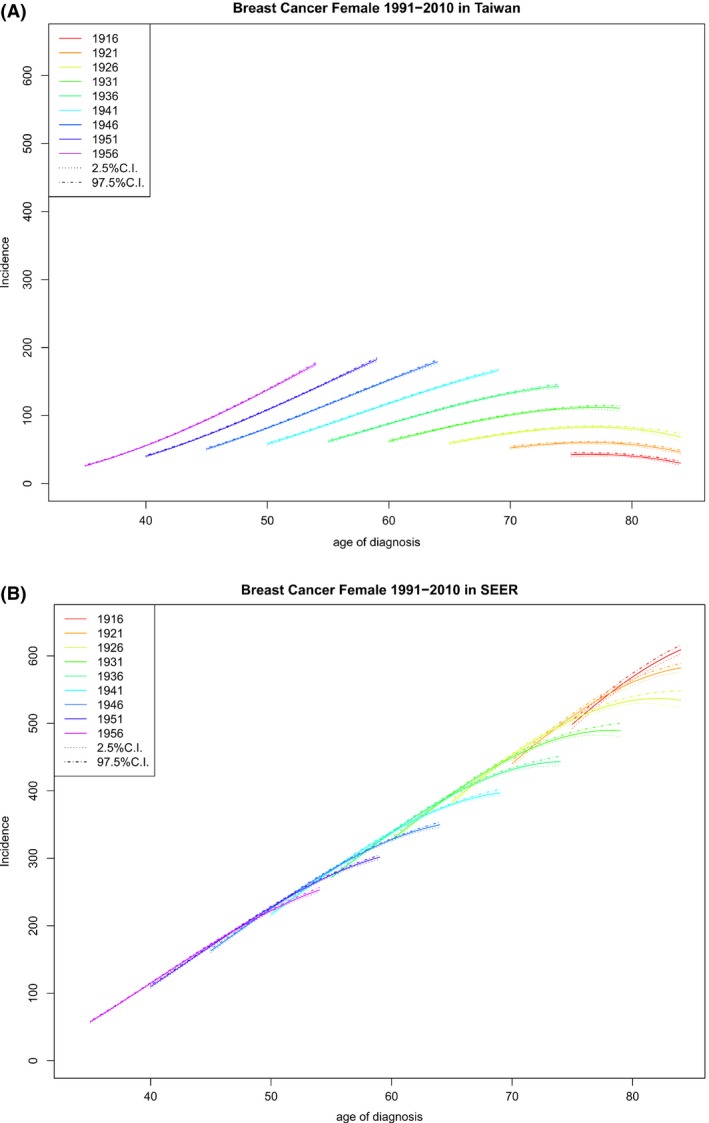
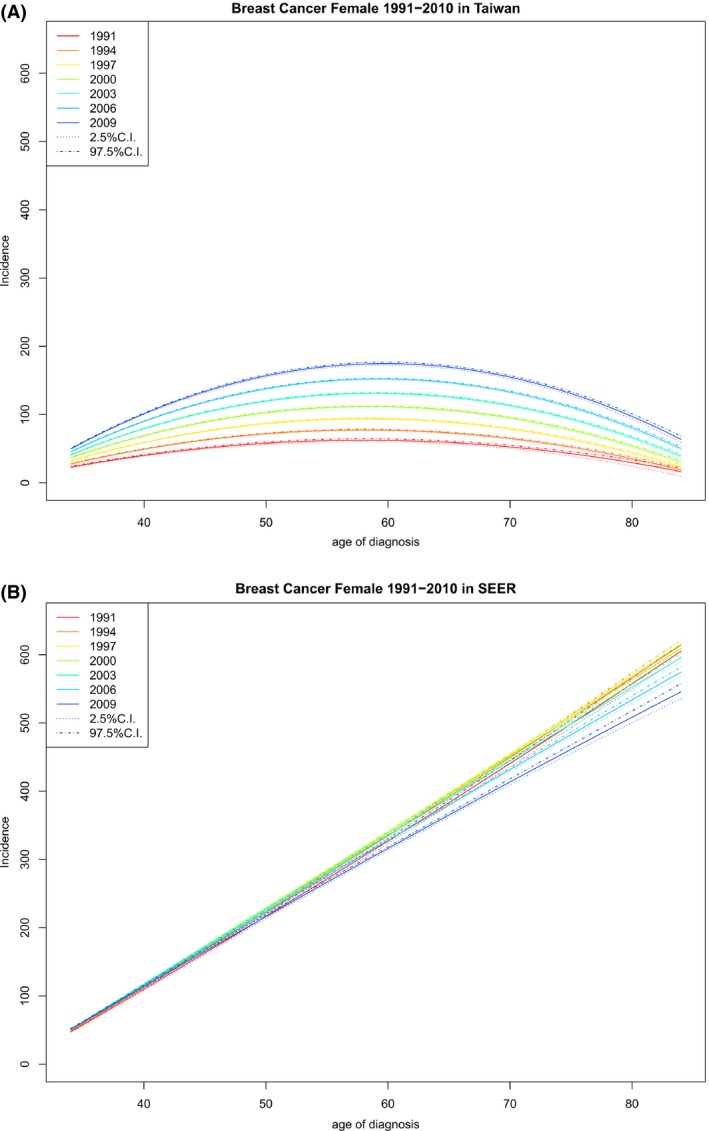
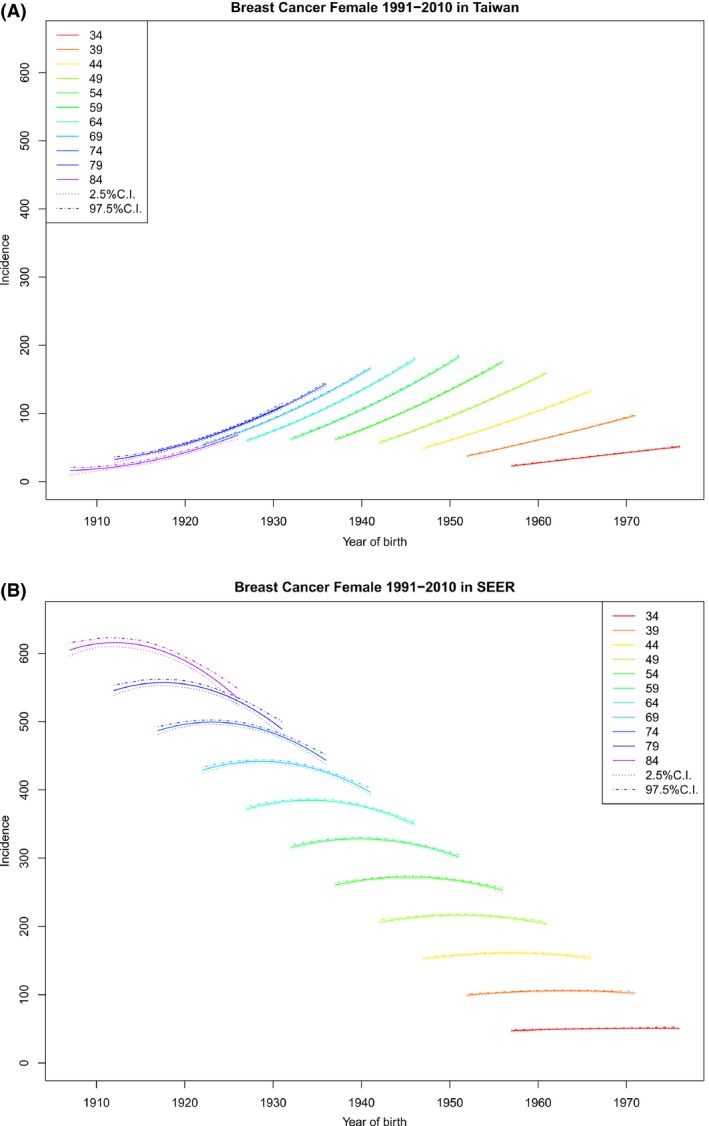
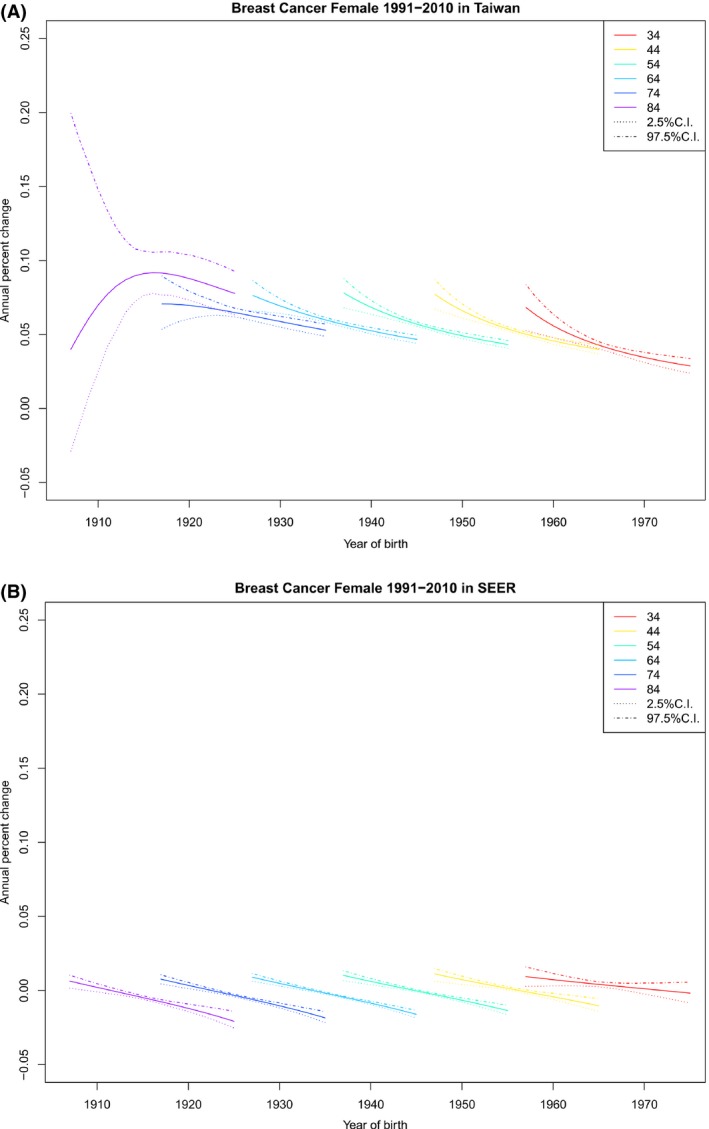
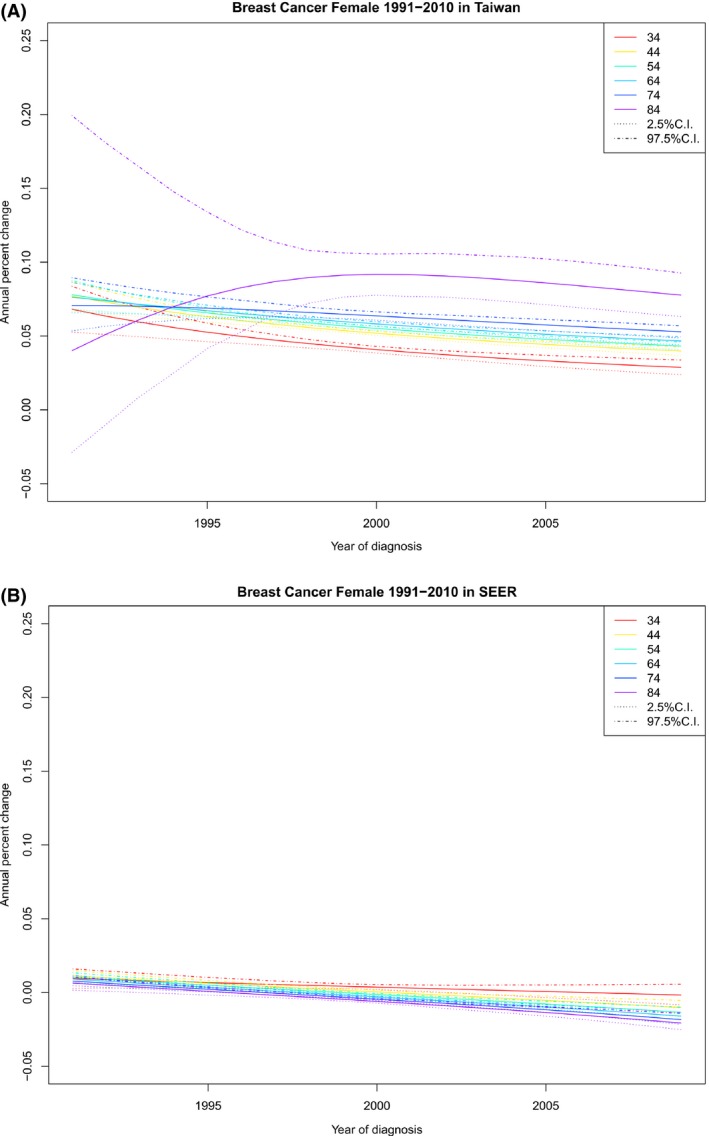
Recent studies compared the age effects and birth cohort effects on female invasive breast cancer (FIBC) incidence in Asian populations with those in the US white population. They were based on age-period-cohort model extrapolation and estimated annual percentage change (EAPC) in the age-standardized incidence rates (ASR). It is of interest to examine these results based on cohort-specific annual percentage change in rate (APCR) by age and without age-period-cohort model extrapolation. FIBC data (1991-2010) were obtained from the Taiwan Cancer Registry and the U.S. SEER 9 registries. APCR based on smoothed Lexis diagrams were constructed to study the age, period, and cohort effects on FIBC incidence. The patterns of age-specific rates by birth cohort are similar between Taiwan and the US. Given any age-at-diagnosis group, cohort-specific rates increased overtime in Taiwan but not in the US; cohort-specific APCR by age decreased with birth year in both Taiwan and the US but was always positive and large in Taiwan. Given a diagnosis year, APCR decreased as birth year increased in Taiwan but not in the US. In Taiwan, the proportion of APCR attributable to cohort effect was substantial and that due to case ascertainment was becoming smaller. Although our study shows that incidence rates of FIBC have increased rapidly in Taiwan, thereby confirming previous results, the rate of increase over time is slowing. Continued monitoring of APCR and further investigation of the cause of the APCR decrease in Taiwan are warranted.
近期研究比较了亚洲人群与美国白人女性浸润性乳腺癌(FIBC)发病率的年龄效应和出生队列效应。这些研究基于年龄-时期-队列模型外推法,并估计了年龄标准化发病率(ASR)的年度百分比变化(EAPC)。基于按年龄划分的队列特异性发病率年度百分比变化(APCR)且不采用年龄-时期-队列模型外推法来检验这些结果是很有意义的。FIBC数据(1991 - 2010年)来自台湾癌症登记处和美国监测、流行病学及最终结果(SEER)9登记处。构建基于平滑莱克西斯图的APCR,以研究年龄、时期和队列对FIBC发病率的影响。台湾和美国按出生队列划分的年龄别发病率模式相似。对于任何诊断年龄组,台湾队列特异性发病率随时间增加,而美国则不然;台湾和美国按年龄划分的队列特异性APCR均随出生年份下降,但在台湾始终为正且数值较大。对于给定的诊断年份,台湾的APCR随出生年份增加而下降,而美国则不然。在台湾,归因于队列效应的APCR比例很大,而归因于病例确诊的比例则越来越小。尽管我们的研究表明台湾的FIBC发病率迅速上升,从而证实了先前的结果,但随着时间推移,上升速度正在放缓。有必要持续监测APCR,并进一步调查台湾APCR下降的原因。