a Department of Bioengineering , University of Pittsburgh , Pittsburgh , PA , USA.
b Department of Mechanical Engineering and Materials Science , University of Pittsburgh , Pittsburgh , PA , USA.
J Biomater Sci Polym Ed. 2018 May-Jun;29(7-9):907-916. doi: 10.1080/09205063.2017.1335076. Epub 2017 Jun 16.
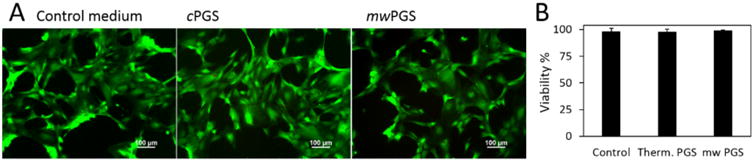
The biodegradable elastomeric polyester poly(glycerol sebacate) (PGS) was developed for soft-tissue engineering. It has been used in various research applications such as wound healing, cartilage tissue engineering, and vascular grafting due to its biocompatibility and elastomeric properties. However conventional PGS manufacture is generally limited by the laborious reaction conditions needed for curing which requires elevated reaction temperatures, high vacuum and multi-day reaction times. In this study, we developed a microwave irradiation methodology to fabricate PGS scaffolds under milder conditions with curing times that are 8 times faster than conventional methods. In particular, we determined microwave reaction temperatures and times for maximum crosslinking of PGS elastomers, demonstrating that PGS is fully crosslinked using gradual heating up to 160 °C for 3 h. Porosity and mechanical properties of these microwave-cured PGS elastomers were shown to be similar to PGS elastomers fabricated by the conventional polycondensation method (150 °C under 30 Torr for 24 h). To move one step closer to clinical application, we also examined the biocompatibility of microwave-cured PGS using in vitro cell viability assays with primary baboon arterial smooth muscle cells (SMCs). These combined results show microwave curing of PGS is a viable alternative to conventional curing.
可生物降解的弹性聚酯聚(癸二酸甘油酯)(PGS)是为软组织工程开发的。由于其生物相容性和弹性特性,它已在各种研究应用中得到了应用,如伤口愈合、软骨组织工程和血管移植。然而,传统的 PGS 制造通常受到固化所需的费力反应条件的限制,这需要升高的反应温度、高真空和多日反应时间。在这项研究中,我们开发了一种微波辐射方法,在更温和的条件下制造 PGS 支架,固化时间比传统方法快 8 倍。特别是,我们确定了微波反应温度和时间,以实现 PGS 弹性体的最大交联,证明 PGS 在逐步加热至 160°C 3 小时的情况下完全交联。这些微波固化的 PGS 弹性体的孔隙率和机械性能与通过传统缩聚方法(在 150°C 和 30 托下 24 小时)制造的 PGS 弹性体相似。为了更接近临床应用,我们还使用原代狒狒动脉平滑肌细胞(SMC)的体外细胞活力测定来检查微波固化的 PGS 的生物相容性。这些综合结果表明,微波固化 PGS 是传统固化的可行替代方法。