Vanderwall Cassandra, Randall Clark R, Eickhoff Jens, Carrel Aaron L
University of Wisconsin, Madison, WI, USA.
UW Health, University Hospital, 600 Highland Ave, Madison, WI, 53792, USA.
BMC Pediatr. 2017 Jun 2;17(1):135. doi: 10.1186/s12887-017-0891-z.
The body mass index (BMI) is a simple and widely utilized screening tool for obesity in children and adults. The purpose of this investigation was to evaluate if BMI could predict total fat mass (TFM) and percent body fat (%FAT) in a sample of overweight and obese children.
In this observational study, body composition was measured by dual energy x-ray absorptiometry (DXA) in 663 male and female overweight and obese children at baseline within a multidisciplinary, pediatric fitness clinic at an academic medical center. Univariate and multivariate regression analyses were conducted to evaluate whether BMI z-score (BMIz) predicts TFM or %FAT.
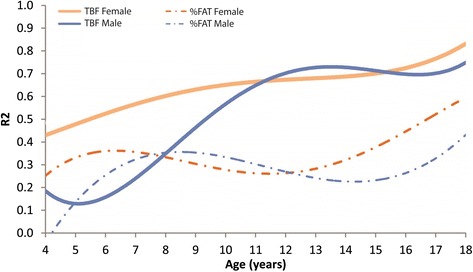
The BMIz, sex and age of subjects were identified as significant predictors for both TFM and %FAT. In subjects younger than 9 years, the BMIz was a weak to moderate predictor for both TFM (R = 0.03 for males and 0.26 for females) and %FAT (R = 0.22 for males and 0.38 for females). For subjects between 9 and 18 years, the BMIz was a strong predictor for TFM (R between 0.57 and 0.73) while BMIz remained only moderately predictive for %FAT (R between 0.22 and 0.42).
These findings advance the understanding of the utility and limitations of BMI in children and adolescents. In youth (9-18y), BMIz is a strong predictor for TFM, but a weaker predictor of relative body fat (%FAT). In children younger than 9y, BMIz is only a weak to moderate predictor for both TFM and %FAT. This study cautions the use of BMIz as a predictor of %FAT in children younger than 9 years.
体重指数(BMI)是一种简单且广泛应用于儿童和成人肥胖筛查的工具。本研究的目的是评估BMI能否预测超重和肥胖儿童样本中的总脂肪量(TFM)和体脂百分比(%FAT)。
在这项观察性研究中,在一所学术医疗中心的多学科儿科健身诊所,对663名超重和肥胖的男女儿童进行了基线双能X线吸收法(DXA)身体成分测量。进行单变量和多变量回归分析,以评估BMI z评分(BMIz)是否能预测TFM或%FAT。
受试者的BMIz、性别和年龄被确定为TFM和%FAT的显著预测因素。在9岁以下的受试者中,BMIz对TFM(男性R = 0.03,女性R = 0.26)和%FAT(男性R = 0.22,女性R = 0.38)都是弱至中度预测因素。对于9至18岁的受试者,BMIz对TFM是强预测因素(R在0.57至0.73之间),而BMIz对%FAT仍然只是中度预测因素(R在0.22至0.42之间)。
这些发现增进了对BMI在儿童和青少年中的效用及局限性的理解。在青少年(9 - 18岁)中,BMIz是TFM的强预测因素,但对相对体脂(%FAT)的预测较弱。在9岁以下的儿童中,BMIz对TFM和%FAT都只是弱至中度预测因素。本研究提醒在9岁以下儿童中使用BMIz作为%FAT的预测指标时需谨慎。