Nair Prajeeda M, Pandya Shaunak G, Dallo Shatha F, Reddoch Kristin M, Montgomery Robbie K, Pidcoke Heather F, Cap Andrew P, Ramasubramanian Anand K
Department of Biomedical Engineering, University of Texas at San Antonio, San Antonio, TX, USA.
Blood Research Program, U.S. Army Institute of Surgical Research, Fort Sam Houston, TX, USA.
Br J Haematol. 2017 Jul;178(1):119-129. doi: 10.1111/bjh.14751. Epub 2017 Jun 4.
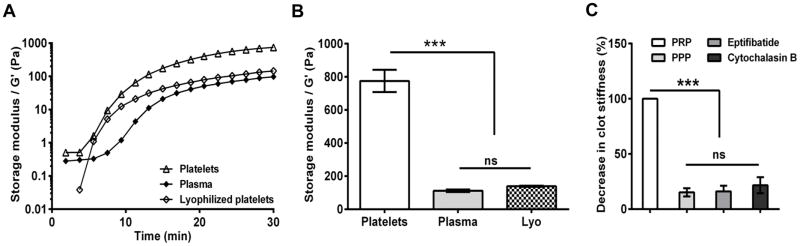
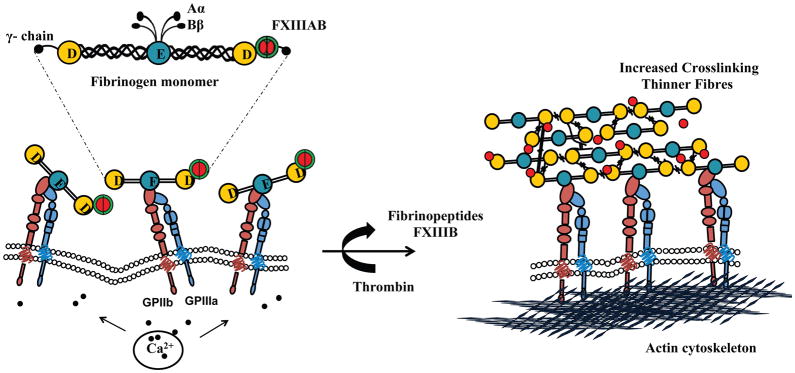
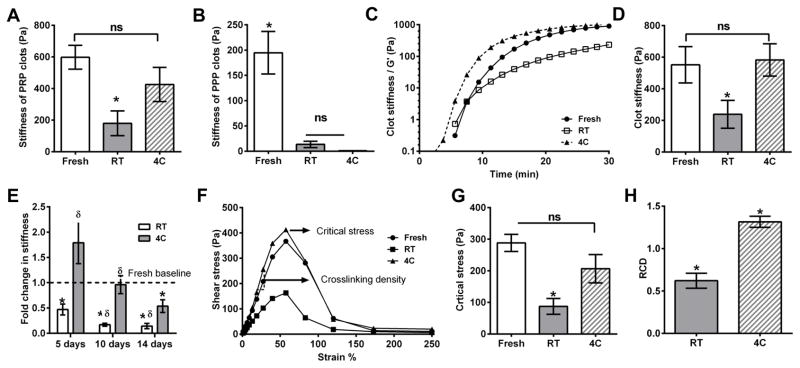
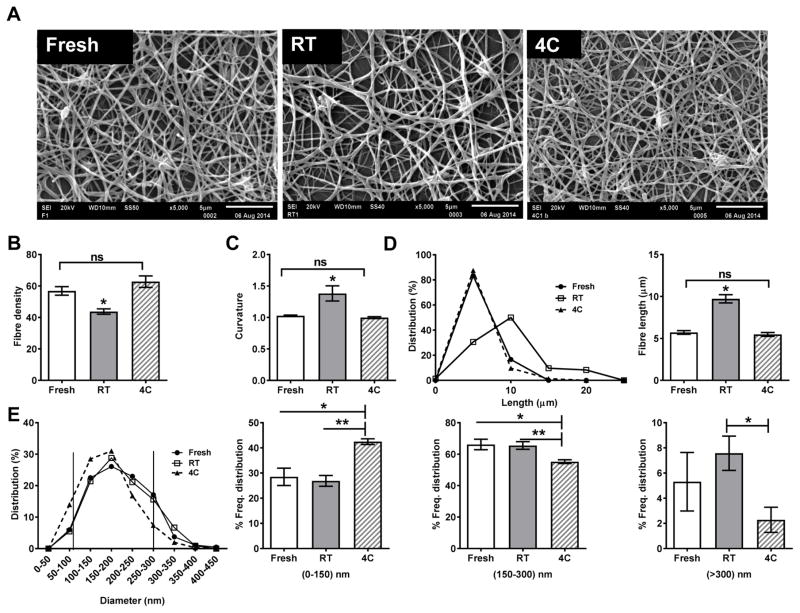
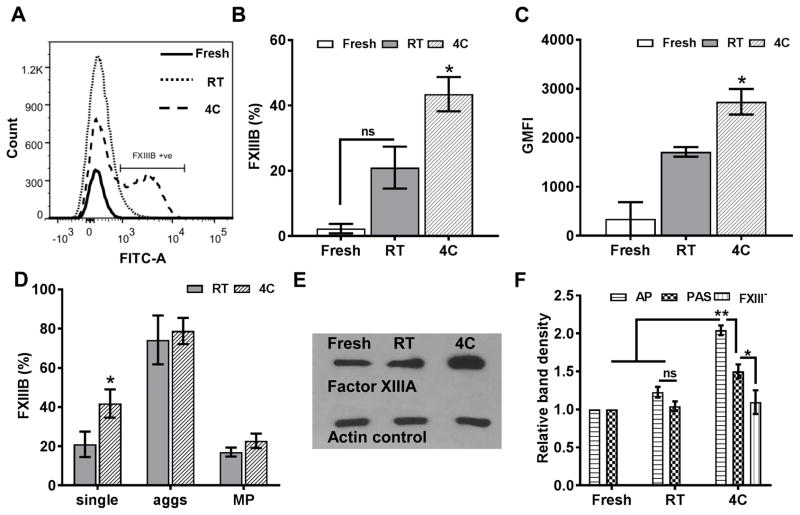
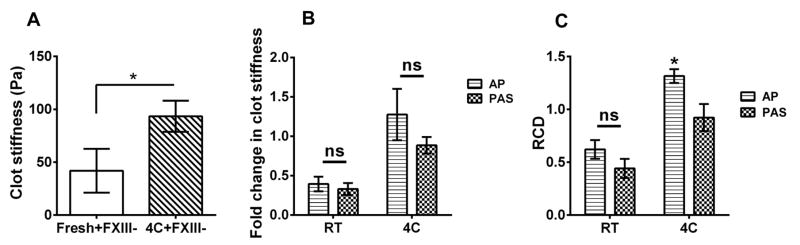
Currently, platelets for transfusion are stored at room temperature (RT) for 5-7 days with gentle agitation, but this is less than optimal because of loss of function and risk of bacterial contamination. We have previously demonstrated that cold (4°C) storage is an attractive alternative because it preserves platelet metabolic reserves, in vitro responses to agonists of activation, aggregation and physiological inhibitors, as well as adhesion to thrombogenic surfaces better than RT storage. Recently, the US Food and Drug Administration clarified that apheresis platelets stored at 4°C for up to 72 h may be used for treating active haemorrhage. In this work, we tested the hypothesis that cold-stored platelets contribute to generating clots with superior mechanical properties compared to RT-stored platelets. Rheological studies demonstrate that the clots formed from platelets stored at 4°C for 5 days are significantly stiffer (higher elastic modulus) and stronger (higher critical stress) than those formed from RT-stored platelets. Morphological analysis shows that clot fibres from cold-stored platelets were denser, thinner, straighter and with more branch points or crosslinks than those from RT-stored platelets. Our results also show that the enhanced clot strength and packed structure is due to cold-induced plasma factor XIII binding to platelet surfaces, and the consequent increase in crosslinking.
目前,用于输血的血小板在室温下轻柔搅拌储存5至7天,但由于功能丧失和细菌污染风险,这并非最佳储存方式。我们之前已经证明,冷藏(4°C)储存是一种有吸引力的替代方法,因为它能更好地保存血小板的代谢储备、体外对激活剂的反应、聚集能力、对生理抑制剂的反应,以及与血栓形成表面的黏附能力,优于室温储存。最近,美国食品药品监督管理局明确表示,在4°C下储存长达72小时的单采血小板可用于治疗活动性出血。在这项研究中,我们检验了以下假设:与室温储存的血小板相比,冷藏储存的血小板有助于形成机械性能更优的凝块。流变学研究表明,在4°C下储存5天的血小板形成的凝块比室温储存的血小板形成的凝块明显更硬(弹性模量更高)、更强(临界应力更高)。形态学分析显示,冷藏储存的血小板形成的凝块纤维比室温储存的血小板形成的凝块纤维更致密、更细、更直,且分支点或交联更多。我们的结果还表明,凝块强度和紧密结构的增强是由于低温诱导血浆因子XIII与血小板表面结合,以及随之而来的交联增加。