Dreyhaupt Jens, Mayer Benjamin, Keis Oliver, Öchsner Wolfgang, Muche Rainer
Ulm University, Institute of Epidemiology and Medical Biometry, Ulm, Germany.
Ulm University, Office of the Dean of Studies for Medicine, Ulm, Germany.
GMS J Med Educ. 2017 May 15;34(2):Doc26. doi: 10.3205/zma001103. eCollection 2017.
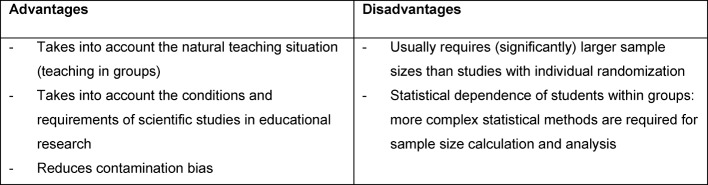
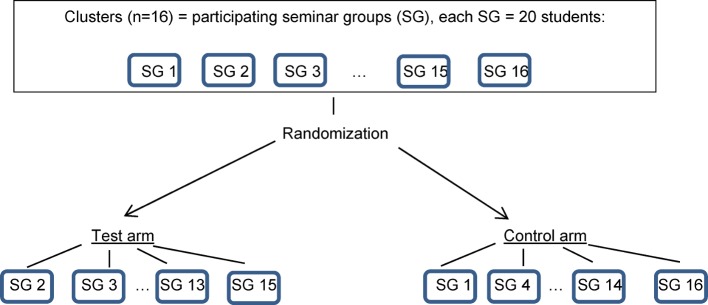
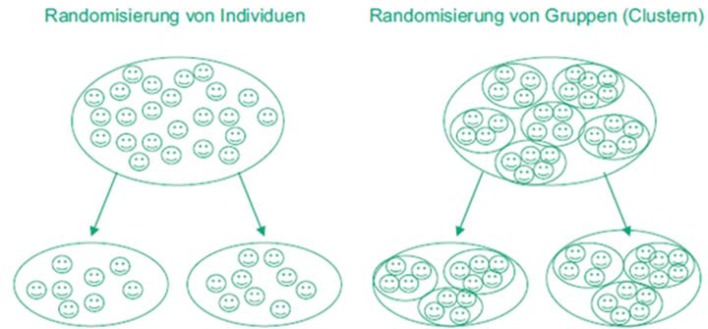
An increasing number of studies are being performed in educational research to evaluate new teaching methods and approaches. These studies could be performed more efficiently and deliver more convincing results if they more strictly applied and complied with recognized standards of scientific studies. Such an approach could substantially increase the quality in particular of prospective, two-arm (intervention) studies that aim to compare two different teaching methods. A key standard in such studies is randomization, which can minimize systematic bias in study findings; such bias may result if the two study arms are not structurally equivalent. If possible, educational research studies should also achieve this standard, although this is not yet generally the case. Some difficulties and concerns exist, particularly regarding organizational and methodological aspects. An important point to consider in educational research studies is that usually individuals cannot be randomized, because of the teaching situation, and instead whole groups have to be randomized (so-called "cluster randomization"). Compared with studies with individual randomization, studies with cluster randomization normally require (significantly) larger sample sizes and more complex methods for calculating sample size. Furthermore, cluster-randomized studies require more complex methods for statistical analysis. The consequence of the above is that a competent expert with respective special knowledge needs to be involved in all phases of cluster-randomized studies. Studies to evaluate new teaching methods need to make greater use of randomization in order to achieve scientifically convincing results. Therefore, in this article we describe the general principles of cluster randomization and how to implement these principles, and we also outline practical aspects of using cluster randomization in prospective, two-arm comparative educational research studies.
在教育研究中,越来越多的研究正在开展,以评估新的教学方法和途径。如果这些研究能更严格地应用并遵循公认的科学研究标准,那么它们就能更高效地进行,并产生更具说服力的结果。这样一种方法尤其能够大幅提高前瞻性双臂(干预)研究的质量,这类研究旨在比较两种不同的教学方法。此类研究中的一个关键标准是随机化,它可以最大限度地减少研究结果中的系统偏差;如果两个研究组在结构上不相等,就可能产生这种偏差。如果可能的话,教育研究也应达到这一标准,尽管目前普遍尚未做到。存在一些困难和问题,尤其是在组织和方法方面。在教育研究中需要考虑的一个重要问题是,由于教学情况,通常不能对个体进行随机化,而是必须对整个组进行随机化(所谓的“整群随机化”)。与个体随机化的研究相比,整群随机化的研究通常需要(显著)更大的样本量以及更复杂的样本量计算方法。此外,整群随机化研究需要更复杂的统计分析方法。上述情况的结果是,在整群随机化研究的所有阶段都需要有具备相应专业知识的胜任专家参与。为了获得具有科学说服力的结果,评估新教学方法的研究需要更多地运用随机化。因此,在本文中,我们描述了整群随机化的一般原则以及如何实施这些原则,并且我们还概述了在前瞻性双臂比较教育研究中使用整群随机化的实际情况。