Laboratory of Sport and Exercise Psychology, Santa Catarina State University, Florianópolis, Brazil.
Laboratory of Aquatic Biomechanics, Santa Catarina State University, Florianópolis, Brazil.
PLoS One. 2020 Jun 5;15(6):e0232392. doi: 10.1371/journal.pone.0232392. eCollection 2020.
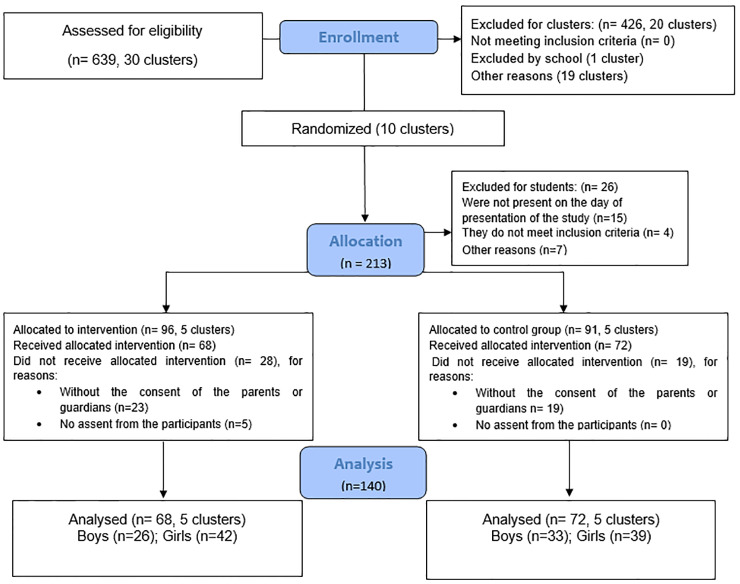
Reduced physical exercise can impact children's mental health. Use of active electronic games can help promote psychological health. Physical education (PE class) uses different resources, methods, and contents to promote student health. We investigated the effect of exergames on the mood and self-esteem of children and compare it that of with traditional PE classes. From a sample of 213 children (7-11 years old), 140 from 10 classes of the fourth and fifth grades of elementary school (59 boys, 81 girls; mean age 9.41±0.48 years), allocated to an experimental group (EG; n = 68; five clusters) and a PE group (PE; n = 72; five clusters), participated in this experimental controlled study. The EG practiced exergames during three 40-minute classes, and the PE group held three routine curricular PE classes. Brunel's Mood Scale and Rosenberg's Self-Esteem Scale were applied. Repeated measures ANOVA identified differences between sexes and groups. The main results of the EG demonstrated reduced tension in girls (p <0.05; ES: 0.62; 95% CI: 0.17-1.05). Regarding sex comparisons, anger was lower in girls (F: 4.57; p <0.05; ES: 0.61; 95% CI: 0.11-1.11) in the EG. Vigor was higher in girls in the EG than in those in the PE group (F: 5.46; p <0.05; ES: 0.56; 95% CI: 0.12-1.01). The main results of the PE group indicated increased self-esteem in boys (p <0.05; ES: 0.58; 95% CI: 0.08-1.07) and reduction of girls' mental confusion (p <0.05; ES 0.58; 95% CI 0.15-1.06). Thus, exergames impact boys' and girls' self-esteem and mood, as well as traditional physical education classes. Further study on exergames in schools is essential, with long-term effects on physical and mental health. Exergames bring interesting, varied content, technology, and innovation that can increase the attractiveness of physical education.
减少体育锻炼会影响儿童的心理健康。使用积极的电子游戏可以帮助促进心理健康。体育课(体育课)使用不同的资源、方法和内容来促进学生的健康。我们调查了运动游戏对儿童情绪和自尊的影响,并将其与传统的体育课进行了比较。从 213 名儿童(7-11 岁)中,从 10 个四年级和五年级的班级中抽取了 140 名学生(59 名男生,81 名女生;平均年龄 9.41±0.48 岁),分为实验组(EG;n=68;五个集群)和体育组(PE;n=72;五个集群),参加了这项实验对照研究。实验组在三节 40 分钟的课程中练习运动游戏,而体育组则进行三节常规体育课。采用 Brunel 情绪量表和 Rosenberg 自尊量表。重复测量方差分析确定了性别和组间的差异。实验组的主要结果表明,女生的紧张情绪降低(p<0.05;ES:0.62;95%CI:0.17-1.05)。关于性别比较,实验组中的愤怒情绪在女生中较低(F:4.57;p<0.05;ES:0.61;95%CI:0.11-1.11)。实验组中女生的活力高于体育组(F:5.46;p<0.05;ES:0.56;95%CI:0.12-1.01)。体育组的主要结果表明,男生的自尊提高(p<0.05;ES:0.58;95%CI:0.08-1.07),女生的精神混乱减少(p<0.05;ES 0.58;95%CI 0.15-1.06)。因此,运动游戏对男孩和女孩的自尊和情绪都有影响,就像传统的体育课一样。进一步研究学校的运动游戏非常必要,可以对身心健康产生长期影响。运动游戏带来了有趣、多样的内容、技术和创新,可以提高体育课的吸引力。