Löffler Patrick, Schmitz Samuel, Hupfeld Enrico, Sterner Reinhard, Merkl Rainer
Institute of Biophysics and Physical Biochemistry, University of Regensburg, Regensburg, Germany.
PLoS Comput Biol. 2017 Jun 12;13(6):e1005600. doi: 10.1371/journal.pcbi.1005600. eCollection 2017 Jun.
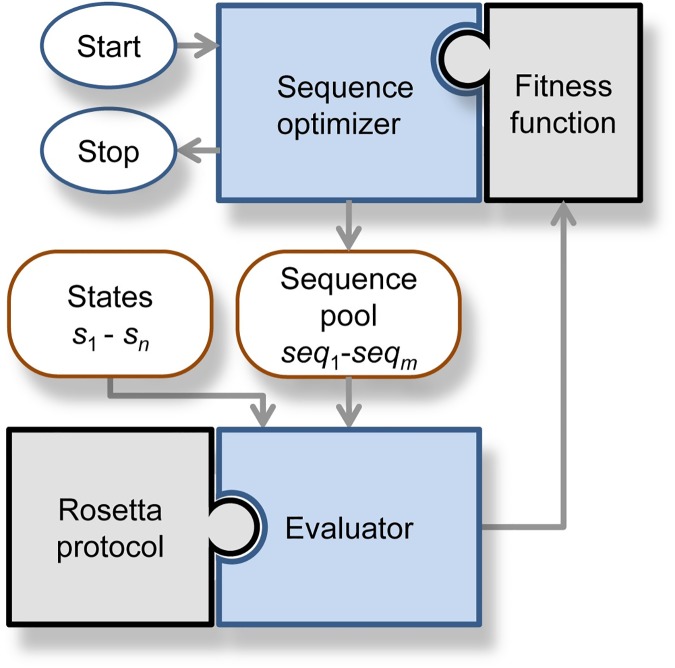
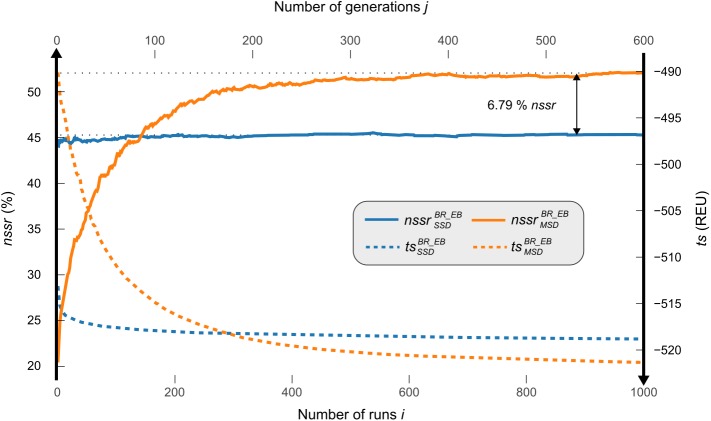
Computational protein design (CPD) is a powerful technique to engineer existing proteins or to design novel ones that display desired properties. Rosetta is a software suite including algorithms for computational modeling and analysis of protein structures and offers many elaborate protocols created to solve highly specific tasks of protein engineering. Most of Rosetta's protocols optimize sequences based on a single conformation (i. e. design state). However, challenging CPD objectives like multi-specificity design or the concurrent consideration of positive and negative design goals demand the simultaneous assessment of multiple states. This is why we have developed the multi-state framework MSF that facilitates the implementation of Rosetta's single-state protocols in a multi-state environment and made available two frequently used protocols. Utilizing MSF, we demonstrated for one of these protocols that multi-state design yields a 15% higher performance than single-state design on a ligand-binding benchmark consisting of structural conformations. With this protocol, we designed de novo nine retro-aldolases on a conformational ensemble deduced from a (βα)8-barrel protein. All variants displayed measurable catalytic activity, testifying to a high success rate for this concept of multi-state enzyme design.
计算蛋白质设计(CPD)是一种强大的技术,可用于改造现有蛋白质或设计具有所需特性的新型蛋白质。Rosetta是一个软件套件,包含用于蛋白质结构计算建模和分析的算法,并提供了许多精心设计的协议,用于解决蛋白质工程中的高度特定任务。Rosetta的大多数协议都是基于单一构象(即设计状态)来优化序列的。然而,诸如多特异性设计或同时考虑正向和负向设计目标等具有挑战性的CPD目标需要同时评估多个状态。这就是为什么我们开发了多状态框架MSF,它便于在多状态环境中实施Rosetta的单状态协议,并提供了两个常用协议。利用MSF,我们针对其中一个协议证明,在由结构构象组成的配体结合基准测试中,多状态设计比单状态设计的性能高出15%。通过这个协议,我们在从(βα)8桶状蛋白推导的构象集合上从头设计了九种逆醛缩酶。所有变体都表现出可测量的催化活性,证明了这种多状态酶设计概念具有很高的成功率。