Rodrigues Angela M, Sniehotta Falko F, Birch-Machin Mark A, Olivier Patrick, Araújo-Soares Vera
Institute of Health and Society, Newcastle University, Newcastle, United Kingdom.
Institute of Cellular Medicine, Newcastle University, Newcastle Upon Tyne, United Kingdom.
JMIR Res Protoc. 2017 Jun 12;6(6):e112. doi: 10.2196/resprot.7172.
Sunburn and intermittent exposure to ultraviolet rays are risk factors for melanoma. Sunburn is a common experience during holidays, making tourism settings of particular interest for skin cancer prevention. Holidaymakers are a volatile populations found at different locations, which may make them difficult to reach. Given the widespread use of smartphones, evidence suggests that this might be a novel, convenient, scalable, and feasible way of reaching the target population.
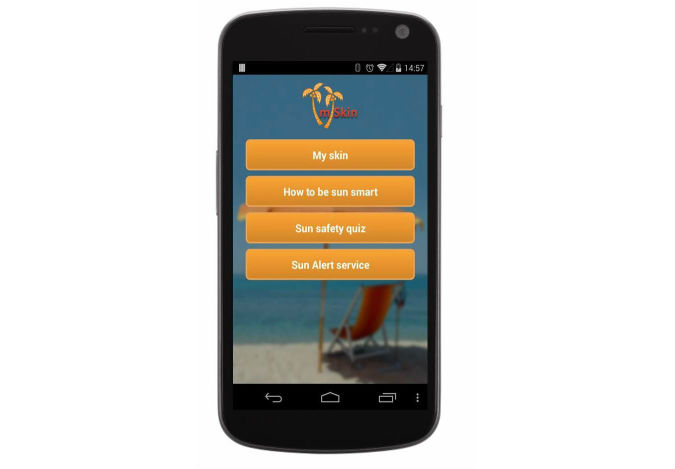
The main objective of this study was to describe and appraise the process of systematically developing a smartphone intervention (mISkin app) to promote sun-protection during holidays.
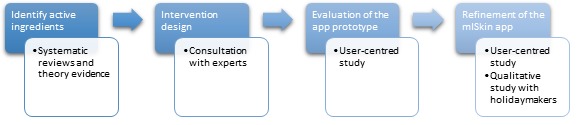
The iterative development process of the mISkin app was conducted over four sequential stages: (1) identify evidence on the most effective behavior change techniques (BCTs) used (active ingredients) as well as theoretical predictors and theories, (2) evidence-based intervention design, (3) co-design with users of the mISkin app prototype, and (4) refinement of the app. Each stage provided key findings that were subsequently used to inform the design of the mISkin app.
The sequential approach to development integrates different strands of evidence to inform the design of an evidence-based intervention. A systematic review on previously tested interventions to promote sun-protection provided cues and constraints for the design of this intervention. The development and design of the mISkin app also incorporated other sources of information, such as other literature reviews and experts' consultations. The developed prototype of the mISkin app was evaluated by engaging potential holidaymakers in the refinement and further development of the mISkin app through usability (ease-of-use) and acceptability testing of the intervention prototype. All 17 participants were satisfied with the mISkin prototype and expressed willingness to use it. Feedback on the app was integrated in the optimization process of the mISkin app.
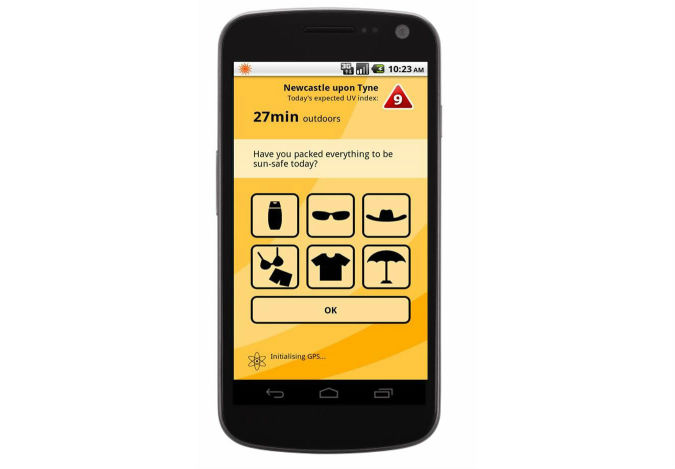
The mISkin app was designed to promote sun-protection among holidaymakers and was based on current evidence, experts' knowledge and experience, and user involvement. Based on user feedback, the app has been refined and a fully functional version is ready for formal testing in a feasibility pilot study.
晒伤和间歇性紫外线照射是黑色素瘤的危险因素。晒伤在假期很常见,这使得旅游环境在皮肤癌预防方面特别受关注。度假者是分布在不同地点的流动人群,这可能使他们难以接触到。鉴于智能手机的广泛使用,有证据表明这可能是一种新颖、便捷、可扩展且可行的接触目标人群的方式。
本研究的主要目的是描述和评估系统开发一款智能手机干预应用(mISkin应用程序)以促进假期防晒的过程。
mISkin应用程序的迭代开发过程分四个连续阶段进行:(1)确定关于所使用的最有效行为改变技术(BCTs)(有效成分)以及理论预测因素和理论的证据,(2)基于证据的干预设计,(3)与mISkin应用程序原型的用户共同设计,以及(4)应用程序的完善。每个阶段都提供了关键发现,随后用于为mISkin应用程序的设计提供信息。
这种循序渐进的开发方法整合了不同方面的证据,以为基于证据的干预设计提供信息。对先前测试过的促进防晒干预措施的系统评价为该干预措施的设计提供了线索和限制。mISkin应用程序的开发和设计还纳入了其他信息来源,如其他文献综述和专家咨询。通过对干预原型进行可用性(易用性)和可接受性测试,让潜在度假者参与mISkin应用程序的完善和进一步开发,从而对开发的mISkin应用程序原型进行了评估。所有17名参与者对mISkin原型都很满意,并表示愿意使用它。对该应用程序的反馈被纳入mISkin应用程序的优化过程。
mISkin应用程序旨在促进度假者的防晒,并且基于当前证据、专家知识和经验以及用户参与。根据用户反馈,该应用程序已得到完善,一个功能齐全的版本已准备好在可行性试点研究中进行正式测试。