Department of Population and Family Health, Columbia University, New York, NY, USA.
New York University College of Nursing, New York, New York, USA.
J Glob Health. 2017 Jun;7(1):010416. doi: 10.7189/jogh.07.010416.
Over half of displaced civilians in humanitarian emergencies are children, and these settings pose unique threats to children's safety with long-lasting consequences. Our study broadens the limited evidence on violence against adolescent girls in emergencies by estimating prevalence and predictors of violence among adolescent girls aged 13-14 in South Kivu, Democratic Republic of the Congo (DRC), and aged 13-19 in refugee camps in the Benishangul-Gumuz region of Ethiopia.
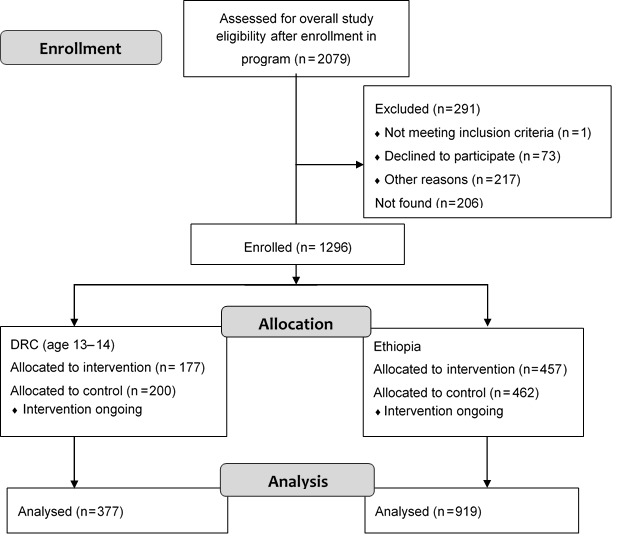
Survey data were collected from a sample of 1296 adolescent girls using Computer-Assisted Personal Interview and Audio Computer-Assisted Self-Interview programming. Predictors of violence were modeled using multivariable logistic regression.
The majority of adolescent girls (51.62%) reported experiencing at least one form of violence victimization in the previous 12 months: 31.78% reported being hit or beaten, 36.79% reported being screamed at loudly or aggressively, and 26.67% experienced unwanted sexual touching, forced sex, and/or sexual coercion. Across both countries, ever having a boyfriend and living with an intimate partner were strong predictors of violence. Fewer years of education completed in DRC, and young age in Ethiopia, were also associated with reported victimization.
Prevalence of violence against adolescent girls is high in these two conflict-affected contexts. Findings indicate a need for programs targeting younger populations, broader efforts to address different forms of victimization, and increased recognition of intimate partners and caregivers as perpetrators of violence in conflict-affected settings.
在人道主义紧急情况下,超过一半的流离失所平民是儿童,这些环境对儿童的安全构成了独特的威胁,并产生持久的后果。我们的研究通过估计刚果民主共和国南基伍地区 13-14 岁的少女和埃塞俄比亚本尚古勒-古马兹地区难民营中 13-19 岁少女在紧急情况下遭受暴力的流行率和预测因素,拓宽了关于少女在紧急情况下遭受暴力的有限证据。
使用计算机辅助个人访谈和音频计算机辅助自我访谈编程,从 1296 名少女中收集了调查数据。使用多变量逻辑回归模型来预测暴力行为的发生。
大多数少女(51.62%)报告在过去 12 个月中至少经历过一次暴力受害:31.78%报告被打或挨打,36.79%报告被大声或咄咄逼人地尖叫,26.67%经历过不受欢迎的性接触、强迫性性行为和/或性胁迫。在这两个国家,曾经有过男朋友和与亲密伴侣住在一起都是暴力的强烈预测因素。在刚果民主共和国,完成的教育年限较少,而在埃塞俄比亚,年龄较小,也与报告的受害有关。
在这两个受冲突影响的背景下,少女遭受暴力的发生率很高。调查结果表明,需要针对年轻人群体开展方案,更广泛地努力解决不同形式的受害问题,并在受冲突影响的环境中更加强调将亲密伴侣和照顾者视为暴力的实施者。