Mozaffari Hamid Reza, Ramezani Mazaher, Janbakhsh Alireza, Sadeghi Masoud
Department of Oral and Maxillofacial Medicine, School of Dentistry, Kermanshah University of Medical Sciences, Kermanshah, Iran.
Medical Biology Research Center, Kermanshah University of Medical Sciences, Kermanshah, Iran. Email:
Asian Pac J Cancer Prev. 2017 May 1;18(5):1201-1206. doi: 10.22034/APJCP.2017.18.5.1201.
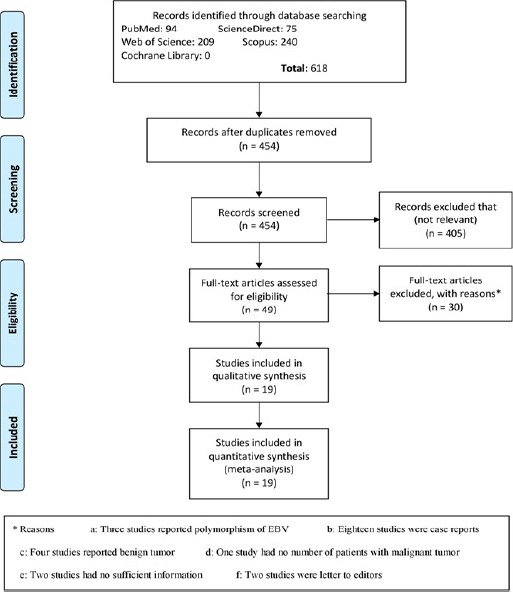
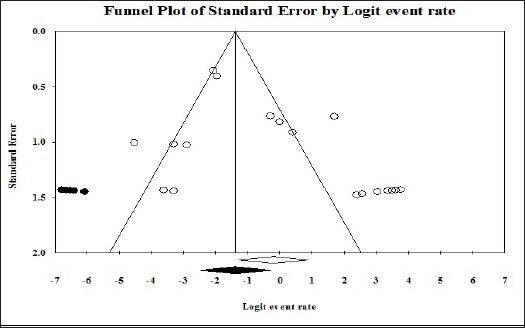
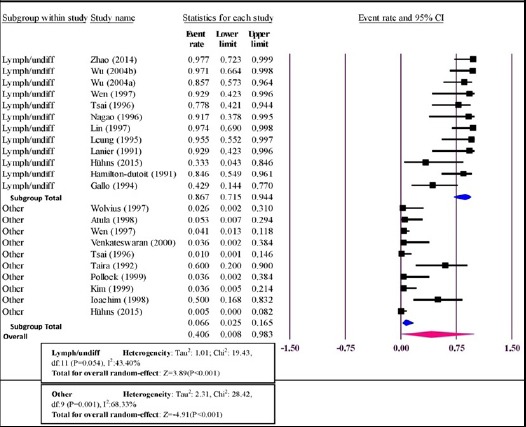
Background: Salivary gland tumors are rare head and neck tumors with lymphoepithelial carcinoma (LEC) as a particularly infrequent variant. This study was an evaluation of the incidence of EBV infection in malignant salivary gland tumors with the emphasis on tumor type and geographical area. Methods: Five databases (PubMed, ScienceDirect, Scopus, Web of Science and Cochrane library) were searched for data on the prevalence of EBV in malignant salivary gland tumors. A random-effects meta-analysis was conducted with Comprehensive Meta-Analysis software version 2.0 (CMA 2.0) using the event rate (ER) for estimation of the incidence of EBV in the salivary gland tumor patients. Publication bias was lacking as assessed through funnel plot analysis with the Begg’s and Egger’s tests (P>0.05). Results: Out of 618 studies searched in databases, 19 reported the prevalence of EBV in malignant salivary gland tumors and were included in the present meta-analysis. The pooled ER of all studies was 44% [95%CI=21.5-69.2%] with extreme heterogeneity that for the studies in America was 44.2% [95%CI=4.1-93.6%], in Asia (249 patients) was 70% [95%CI= 33.4-91.6%] and in Europe was 11.8% [95%CI=7.4-85.5%] with extreme heterogeneity for three subgroups. The pooled ER for patients with undifferentiated carcinoma was 86.7% [95%CI=71.5-94.4%] compared with 6.6% [95%CI=2.5-16.5%] for other carcinomas. Conclusions: The incidence of EBV infection in malignant salivary gland tumors in Asia was greater than in Europe and America and the higher presence of EBV infection in LEC cases implies that EBV may be a major factor in its etiology or pathogenesis. Genetic, environmental and other geographic factors may also be involved.
涎腺肿瘤是罕见的头颈部肿瘤,其中淋巴上皮癌(LEC)是一种特别罕见的亚型。本研究旨在评估恶性涎腺肿瘤中EB病毒感染的发生率,重点关注肿瘤类型和地理区域。方法:检索五个数据库(PubMed、ScienceDirect、Scopus、Web of Science和Cochrane图书馆),以获取有关恶性涎腺肿瘤中EB病毒流行率的数据。使用综合Meta分析软件2.0(CMA 2.0)进行随机效应Meta分析,采用事件发生率(ER)估计涎腺肿瘤患者中EB病毒的感染率。通过Begg检验和Egger检验的漏斗图分析评估,不存在发表偏倚(P>0.05)。结果:在数据库中检索的618项研究中,19项报告了恶性涎腺肿瘤中EB病毒的流行率,并纳入了本Meta分析。所有研究的合并ER为44%[95%CI=21.5-69.2%],异质性极高,其中美国的研究为44.2%[95%CI=4.1-93.6%],亚洲(249例患者)为70%[95%CI=33.4-91.6%],欧洲为11.8%[95%CI=7.4-85.5%],三个亚组的异质性均极高。未分化癌患者的合并ER为86.7%[95%CI=71.5-94.4%],而其他癌为6.6%[95%CI=2.5-16.5%]。结论:亚洲恶性涎腺肿瘤中EB病毒感染的发生率高于欧洲和美国,LEC病例中EB病毒感染率较高表明EB病毒可能是其病因或发病机制中的主要因素。遗传、环境和其他地理因素也可能参与其中。