Sell Tara Kirk, Hosangadi Divya, Trotochaud Marc
Johns Hopkins Center for Health Security, Baltimore, USA.
Department of Environmental Health and Engineering Johns Hopkins Bloomberg School of Public Health, Baltimore, USA.
BMC Public Health. 2020 May 7;20(1):550. doi: 10.1186/s12889-020-08697-3.
The Ebola communication crisis of 2014 generated widespread fear and attention among Western news media, social media users, and members of the United States (US) public. Health communicators need more information on misinformation and the social media environment during a fear-inducing disease outbreak to improve communication practices. The purpose of this study was to describe the content of Ebola-related tweets with a specific focus on misinformation, political content, health related content, risk framing, and rumors.
We examined tweets from a random 1% sample of all tweets published September 30th - October 30th, 2014, filtered for English-language tweets mentioning "Ebola" in the content or hashtag, that had at least 1 retweet (N = 72,775 tweets). A randomly selected subset of 3639 (5%) tweets were evaluated for inclusion. We analyzed the 3113 tweets that meet inclusion criteria using public health trained human coders to assess tweet characteristics (joke, opinion, discord), veracity (true, false, partially false), political context, risk frame, health context, Ebola specific messages, and rumors. We assessed the proportion of tweets with specific content using descriptive statistics and chi-squared tests.
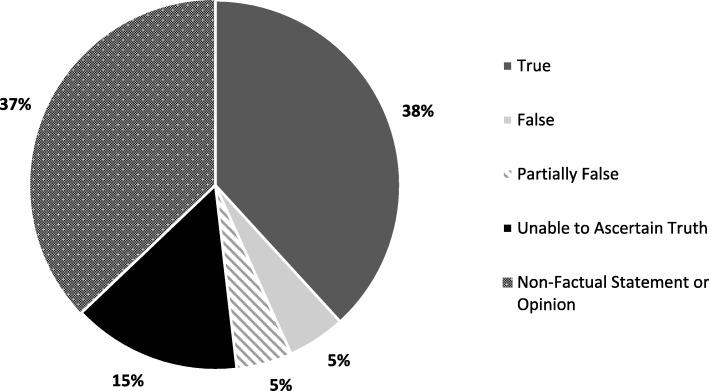
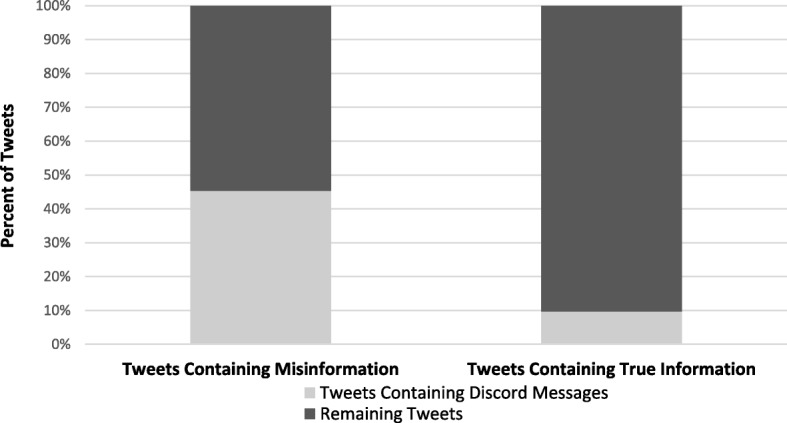
Of non-joke tweets, 10% of Ebola-related tweets contained false or partially false information. Twenty-five percent were related to politics, 28% contained content that provoked reader response or promoted discord, 42% contained risk elevating messages and 72% were related to health. The most frequent rumor mentioned focused on government conspiracy. When comparing tweets with true information to tweets with misinformation, a greater percentage of tweets with misinformation were political in nature (36% vs 15%) and contained discord-inducing statements (45% vs 10%). Discord-inducing statements and political messages were both significantly more common in tweets containing misinformation compared with those without(p < 0.001).
Results highlight the importance of anticipating politicization of disease outbreaks, and the need for policy makers and social media companies to build partnerships and develop response frameworks in advance of an event. While each public health event is different, our findings provide insight into the possible social media environment during a future epidemic and could help optimize potential public health communication strategies.
2014年埃博拉疫情引发的传播危机在西方新闻媒体、社交媒体用户以及美国公众中引起了广泛的恐惧和关注。在引发恐惧的疾病爆发期间,健康传播者需要更多关于错误信息和社交媒体环境的信息,以改进传播实践。本研究的目的是描述与埃博拉相关的推文内容,特别关注错误信息、政治内容、健康相关内容、风险框架和谣言。
我们检查了2014年9月30日至10月30日发布的所有推文中随机抽取的1%样本,筛选出内容或主题标签中提及“埃博拉”的英文推文,这些推文至少有1次转发(N = 72775条推文)。随机抽取3639条(5%)推文作为评估纳入对象。我们使用经过公共卫生培训的人工编码员对符合纳入标准的3113条推文进行分析,以评估推文特征(笑话、观点、分歧)、真实性(真、假、部分虚假)、政治背景、风险框架、健康背景、埃博拉特定信息和谣言。我们使用描述性统计和卡方检验评估具有特定内容的推文比例。
在非笑话推文中,10%的与埃博拉相关的推文包含虚假或部分虚假信息。25%与政治相关,28%包含引发读者反应或促进分歧的内容,42%包含风险提升信息,72%与健康相关。提及最多的谣言集中在政府阴谋。将包含真实信息的推文与包含错误信息的推文进行比较时,包含错误信息的推文中,具有政治性质的比例更高(36%对15%),且包含引发分歧的陈述(45%对10%)。与不包含错误信息的推文相比,包含错误信息的推文中引发分歧的陈述和政治信息都明显更常见(p < 0.001)。
结果凸显了预见到疾病爆发政治化的重要性,以及政策制定者和社交媒体公司在事件发生前建立伙伴关系并制定应对框架的必要性。虽然每次公共卫生事件都不同,但我们的研究结果为未来疫情期间可能的社交媒体环境提供了见解,并有助于优化潜在的公共卫生传播策略。