Beauchamp Michael J, Nordin Gregory P, Woolley Adam T
Department of Chemistry and Biochemistry, Brigham Young University, C100 BNSN, Provo, UT, 84602, USA.
Department of Electrical and Computer Engineering, Brigham Young University, Provo, UT, 84602, USA.
Anal Bioanal Chem. 2017 Jul;409(18):4311-4319. doi: 10.1007/s00216-017-0398-3. Epub 2017 Jun 13.
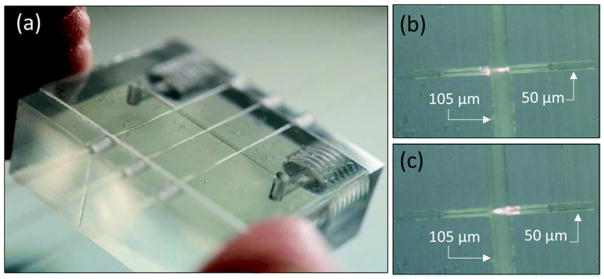
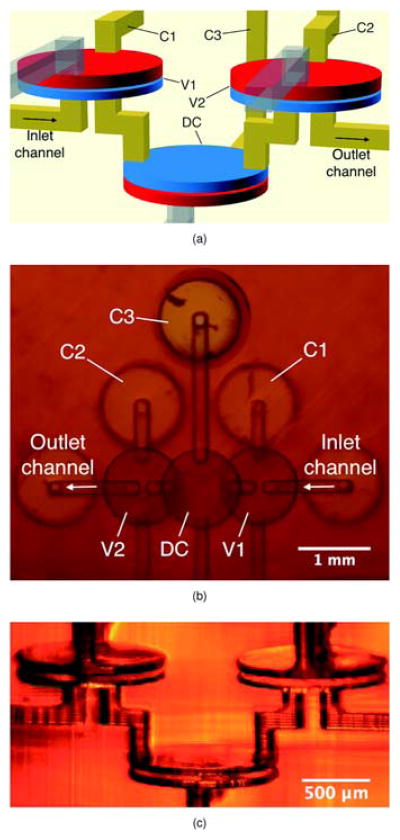
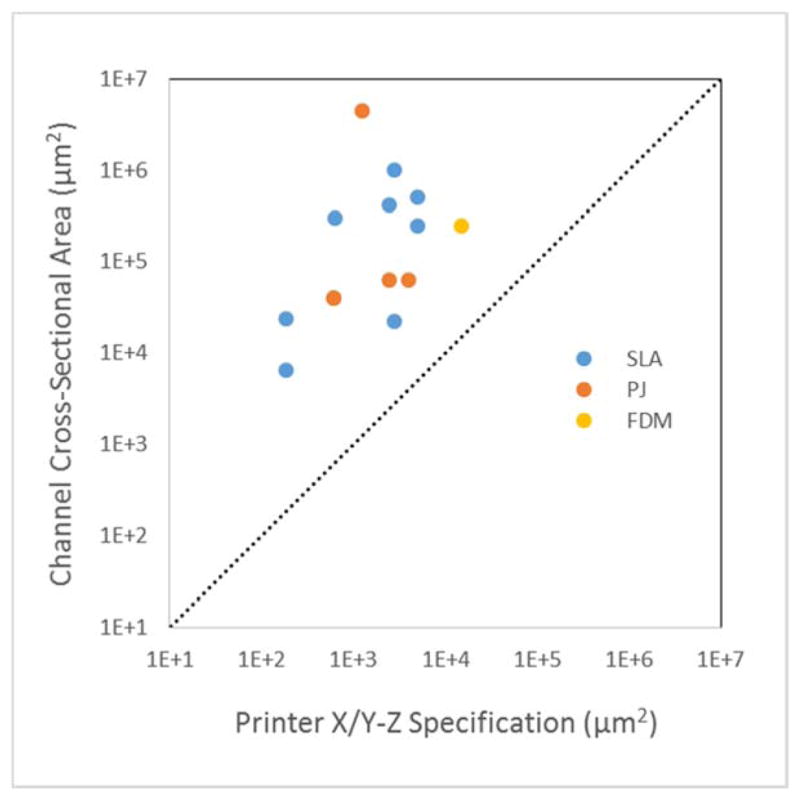
Three-dimensional (3D) printing has generated considerable excitement in recent years regarding the extensive possibilities of this enabling technology. One area in which 3D printing has potential, not only for positive impact but also for substantial improvement, is microfluidics. To date many researchers have used 3D printers to make fluidic channels directed at point-of-care or lab-on-a-chip applications. Here, we look critically at the cross-sectional sizes of these 3D printed fluidic structures, classifying them as millifluidic (larger than 1 mm), sub-millifluidic (0.5-1.0 mm), large microfluidic (100-500 μm), or truly microfluidic (smaller than 100 μm). Additionally, we provide our prognosis for making 10-100-μm cross-section microfluidic features with custom-formulated resins and stereolithographic printers. Such 3D printed microfluidic devices for bioanalysis will accelerate research through designs that can be easily created and modified, allowing improved assays to be developed.
近年来,三维(3D)打印技术因其广泛的应用可能性而备受关注。3D打印技术在微流控领域具有巨大潜力,不仅能带来积极影响,还能实现显著改进。迄今为止,许多研究人员已使用3D打印机制造用于即时护理或芯片实验室应用的流体通道。在此,我们对这些3D打印流体结构的横截面尺寸进行了严格审视,将其分为毫流控(大于1毫米)、亚毫流控(0.5 - 1.0毫米)、大型微流控(100 - 500微米)或真正的微流控(小于100微米)。此外,我们还预测了使用定制配方树脂和立体光刻打印机制造横截面为10 - 100微米的微流控特征的可能性。这种用于生物分析的3D打印微流控设备将通过易于创建和修改的设计加速研究,从而开发出更完善的检测方法。