Gasparrini Massimiliano, Forbes-Hernandez Tamara Y, Afrin Sadia, Reboredo-Rodriguez Patricia, Cianciosi Danila, Mezzetti Bruno, Quiles Josè L, Bompadre Stefano, Battino Maurizio, Giampieri Francesca
Dipartimento di Scienze Cliniche Specialistiche ed Odontostomatologiche (DISCO)-Sez. Biochimica, Facoltà di Medicina, Università Politecnica delle Marche, 60131 Ancona, Italy.
Area de Nutrición y Salud, Universidad Internacional Iberoamericana (UNINI), 24040 Campeche, Mexico.
Nutrients. 2017 Jun 14;9(6):605. doi: 10.3390/nu9060605.
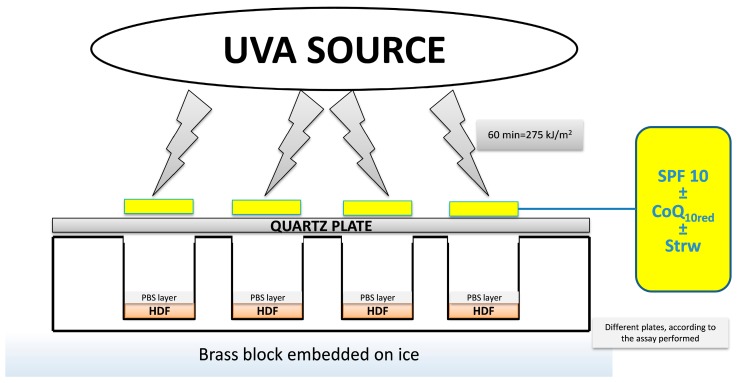
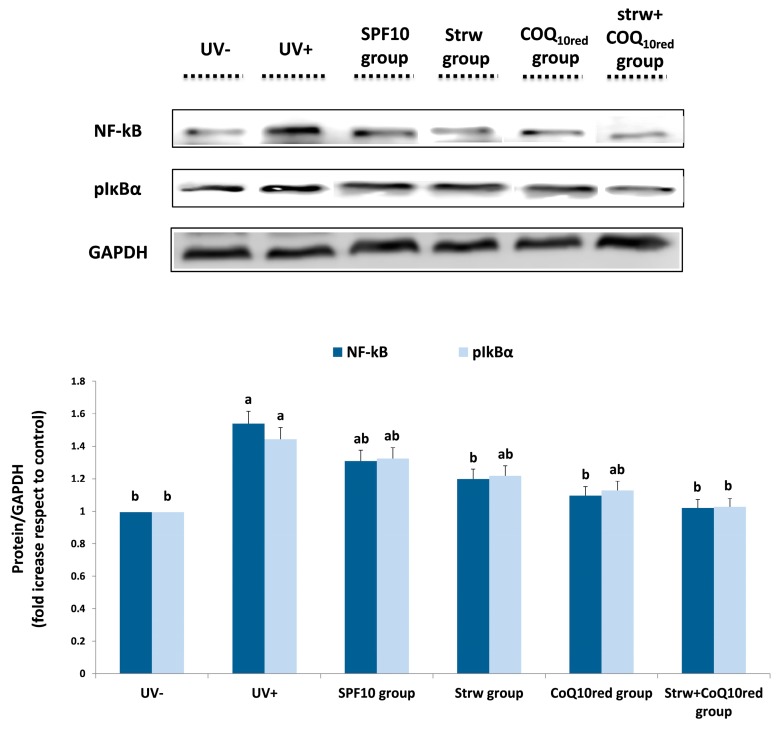
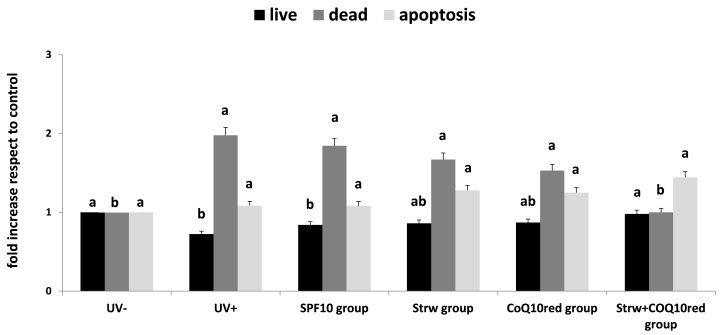
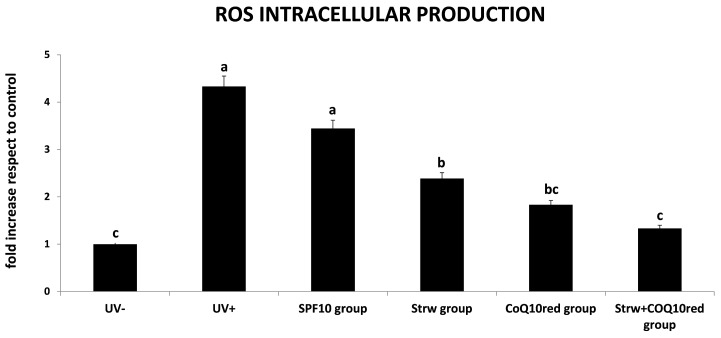
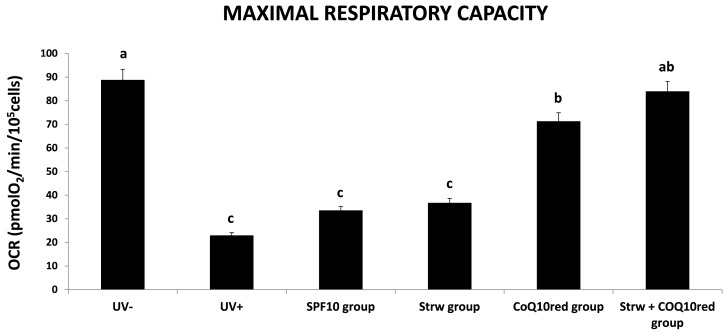
Extreme exposure of skin to Ultraviolet A (UVA)-radiation may induce a dysregulated production of reactive oxygen species (ROS) which can interact with cellular biomolecules leading to oxidative stress, inflammation, DNA damage, and alteration of cellular molecular pathways, responsible for skin photoaging, hyperplasia, erythema, and cancer. For these reasons, the use of dietary natural bioactive compounds with remarkable antioxidant activity could be a strategic tool to counteract these UVA-radiation-caused deleterious effects. Thus, the purpose of the present work was to test the efficacy of strawberry (50 μg/mL)-based formulations supplemented with Coenzyme Q (100 μg/mL) and sun protection factor 10 in human dermal fibroblasts irradiated with UVA-radiation. The apoptosis rate, the amount of intracellular reactive oxygen species (ROS) production, the expression of proteins involved in antioxidant and inflammatory response, and mitochondrial functionality were evaluated. The results showed that the synergic topical use of strawberry and Coenzyme Q provided a significant ( < 0.05) photoprotective effect, reducing cell death and ROS, increasing antioxidant defense, lowering inflammatory markers, and improving mitochondrial functionality. The obtained results suggest the use of strawberry-based formulations as an innovative, natural, and useful tool for the prevention of UVA exposure-induced skin diseases in order to decrease or substitute the amount of synthetic sunscreen agents.
皮肤过度暴露于紫外线A(UVA)辐射可能会导致活性氧(ROS)生成失调,ROS可与细胞生物分子相互作用,导致氧化应激、炎症、DNA损伤以及细胞分子途径改变,进而引发皮肤光老化、增生、红斑和癌症。基于这些原因,使用具有显著抗氧化活性的膳食天然生物活性化合物可能是对抗这些UVA辐射所致有害影响的一种策略性工具。因此,本研究的目的是测试添加辅酶Q(100μg/mL)和防晒系数为10的草莓(50μg/mL)基配方对接受UVA辐射的人皮肤成纤维细胞的功效。评估了细胞凋亡率、细胞内活性氧(ROS)生成量、参与抗氧化和炎症反应的蛋白质表达以及线粒体功能。结果表明,草莓和辅酶Q的协同局部使用具有显著(<0.05)的光保护作用,可减少细胞死亡和ROS,增强抗氧化防御,降低炎症标志物水平,并改善线粒体功能。所得结果表明,基于草莓的配方可作为一种创新、天然且有用的工具,用于预防UVA暴露引起的皮肤疾病,以减少或替代合成防晒剂的用量。