Wirth James P, Woodruff Bradley A, Engle-Stone Reina, Namaste Sorrel Ml, Temple Victor J, Petry Nicolai, Macdonald Barbara, Suchdev Parminder S, Rohner Fabian, Aaron Grant J
GroundWork, Fläsch, Switzerland;
GroundWork, Fläsch, Switzerland.
Am J Clin Nutr. 2017 Jul;106(Suppl 1):416S-427S. doi: 10.3945/ajcn.116.143073. Epub 2017 Jun 14.
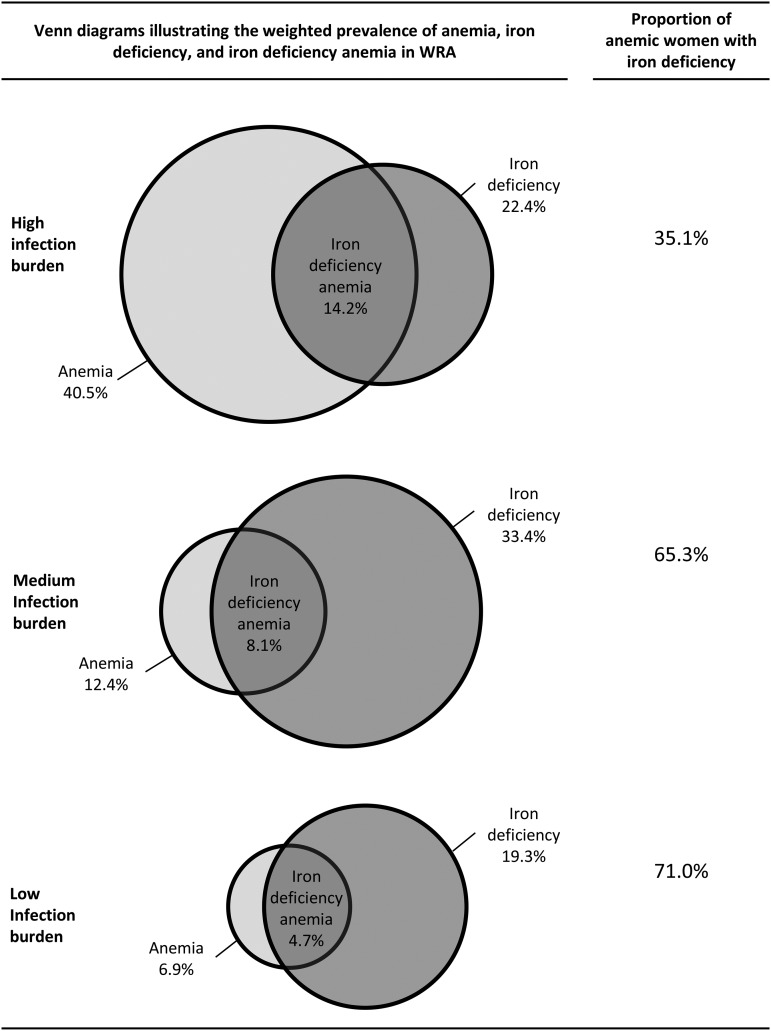
Anemia in women of reproductive age (WRA) (age range: 15-49 y) remains a public health problem globally, and reducing anemia in women by 50% by 2025 is a goal of the World Health Assembly. We assessed the associations between anemia and multiple proximal risk factors (e.g., iron and vitamin A deficiencies, inflammation, malaria, and body mass index) and distal risk factors (e.g., education status, household sanitation and hygiene, and urban or rural residence) in nonpregnant WRA. Cross-sectional, nationally representative data from 10 surveys ( = 27,018) from the Biomarkers Reflecting Inflammation and Nutritional Determinants of Anemia (BRINDA) project were analyzed individually and pooled by the infection burden and risk in the country. We examined the severity of anemia and measured the bivariate associations between anemia and factors at the country level and by infection burden, which we classified with the use of the national prevalences of malaria, HIV, schistosomiasis, sanitation, and water-quality indicators. Pooled multivariate logistic regression models were constructed for each infection-burden category to identify independent determinants of anemia (hemoglobin concertation <120 g/L). Anemia prevalence was ∼40% in countries with a high infection burden and 12% and 7% in countries with moderate and low infection burdens, respectively. Iron deficiency was consistently associated with anemia in multivariate models, but the proportion of anemic women who were iron deficient was considerably lower in the high-infection group (35%) than in the moderate- and low-infection groups (65% and 71%, respectively). In the multivariate analysis, inflammation, vitamin A insufficiency, socioeconomic status, and age were also significantly associated with anemia, but malaria and vitamin B-12 and folate deficiencies were not. The contribution of iron deficiency to anemia varies according to a country's infection burden. Anemia-reduction programs for WRA can be improved by considering the underlying infection burden of the population and by assessing the overlap of micronutrient deficiencies and anemia.
育龄妇女(年龄范围:15 - 49岁)贫血仍是全球的一个公共卫生问题,到2025年将妇女贫血率降低50%是世界卫生大会的一个目标。我们评估了非妊娠育龄妇女贫血与多种近端风险因素(如铁和维生素A缺乏、炎症、疟疾及体重指数)以及远端风险因素(如教育状况、家庭环境卫生和居住在城市或农村)之间的关联。对来自反映贫血炎症和营养决定因素(BRINDA)项目的10次调查(n = 27,018)的横断面、具有全国代表性的数据进行了单独分析,并按国家的感染负担和风险进行汇总。我们检查了贫血的严重程度,并测量了国家层面以及按感染负担划分的贫血与各因素之间的双变量关联,我们使用疟疾、艾滋病毒、血吸虫病、卫生设施及水质指标的国家患病率进行分类。针对每个感染负担类别构建了汇总多变量逻辑回归模型,以确定贫血(血红蛋白浓度<120 g/L)的独立决定因素。在感染负担高的国家,贫血患病率约为40%,在感染负担中等和低的国家分别为12%和7%。在多变量模型中,缺铁始终与贫血相关,但贫血妇女中铁缺乏的比例在高感染组(35%)中比在中等和低感染组(分别为65%和71%)中要低得多。在多变量分析中,炎症、维生素A不足、社会经济地位和年龄也与贫血显著相关,但疟疾以及维生素B - 12和叶酸缺乏与贫血无关。缺铁对贫血的影响因国家的感染负担而异。通过考虑人群潜在的感染负担并评估微量营养素缺乏与贫血的重叠情况,可改进育龄妇女贫血减少项目。