Institute of Integrative Biology, University of Liverpool, Liverpool L69 7ZB, UK.
Nanoscale. 2017 Aug 3;9(30):10662-10673. doi: 10.1039/c7nr02524f.
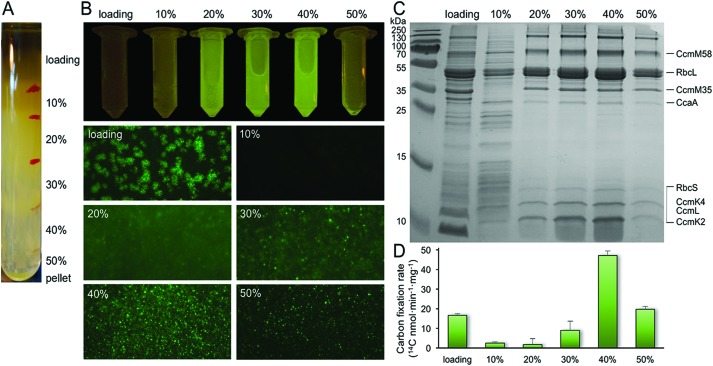
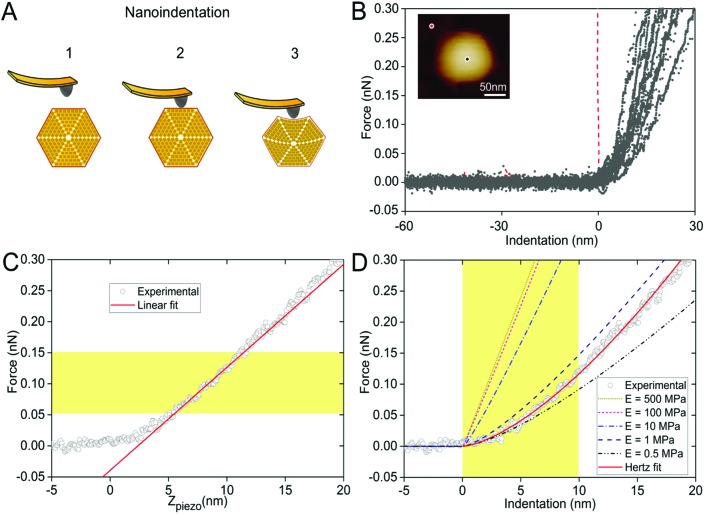
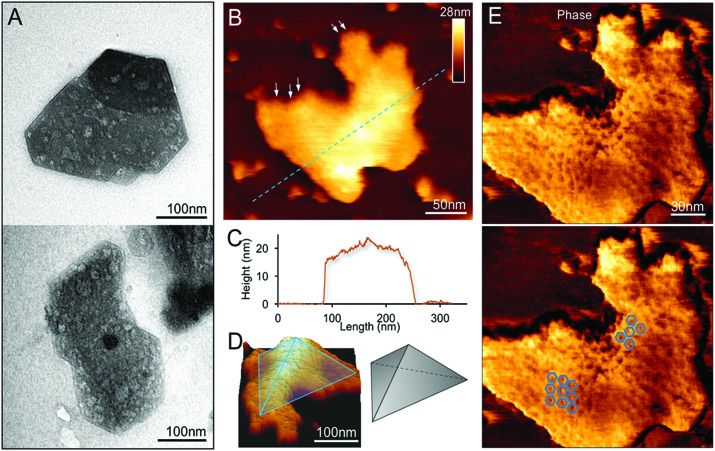
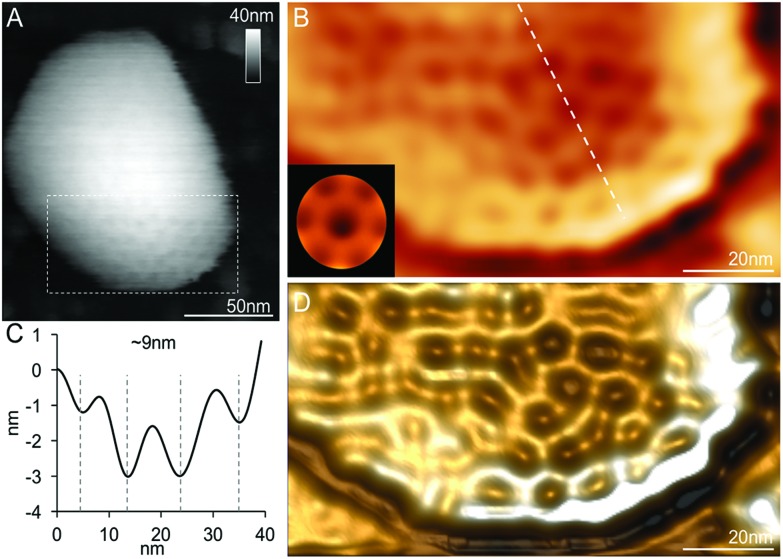
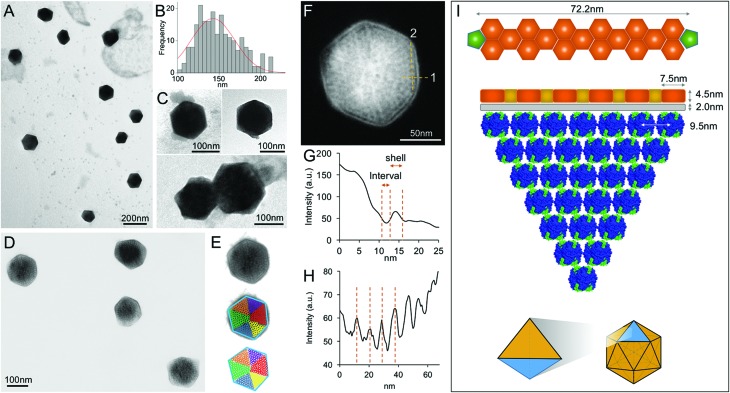
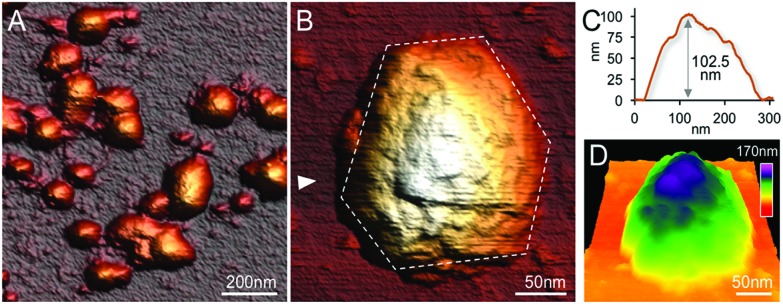
Carboxysomes are proteinaceous organelles that play essential roles in enhancing carbon fixation in cyanobacteria and some proteobacteria. These self-assembling organelles encapsulate Ribulose 1,5-bisphosphate carboxylase/oxygenase (Rubisco) and carbonic anhydrase using a protein shell structurally resembling an icosahedral viral capsid. The protein shell serves as a physical barrier to protect enzymes from the cytosol and a selectively permeable membrane to mediate transport of enzyme substrates and products. The structural and mechanical nature of native carboxysomes remain unclear. Here, we isolate functional β-carboxysomes from the cyanobacterium Synechococcus elongatus PCC7942 and perform the first characterization of the macromolecular architecture and inherent physical mechanics of single β-carboxysomes using electron microscopy, atomic force microscopy (AFM) and proteomics. Our results illustrate that the intact β-carboxysome comprises three structural domains, a single-layered icosahedral shell, an inner layer and paracrystalline arrays of interior Rubisco. We also observe the protein organization of the shell and partial β-carboxysomes that likely serve as the β-carboxysome assembly intermediates. Furthermore, the topography and intrinsic mechanics of functional β-carboxysomes are determined in native conditions using AFM and AFM-based nanoindentation, revealing the flexible organization and soft mechanical properties of β-carboxysomes compared to rigid viruses. Our study provides new insights into the natural characteristics of β-carboxysome organization and nanomechanics, which can be extended to diverse bacterial microcompartments and are important considerations for the design and engineering of functional carboxysomes in other organisms to supercharge photosynthesis. It offers an approach for inspecting the structural and mechanical features of synthetic metabolic organelles and protein scaffolds in bioengineering.
羧基体是一种蛋白质细胞器,在增强蓝藻和一些变形菌的碳固定中发挥着重要作用。这些自组装的细胞器使用类似于二十面体病毒衣壳的蛋白质壳来封装核酮糖 1,5-二磷酸羧化酶/加氧酶 (Rubisco) 和碳酸酐酶。蛋白质壳作为物理屏障,保护酶免受细胞质的影响,并作为选择性渗透膜,介导酶底物和产物的运输。天然羧基体的结构和力学性质仍不清楚。在这里,我们从蓝藻 Synechococcus elongatus PCC7942 中分离出功能性β-羧基体,并使用电子显微镜、原子力显微镜 (AFM) 和蛋白质组学首次对单个β-羧基体的大分子结构和固有物理力学特性进行了表征。我们的结果表明,完整的β-羧基体由三个结构域组成,一个单层二十面体壳、一个内层和内部 Rubisco 的准晶阵列。我们还观察到壳和部分β-羧基体的蛋白质组织,它们可能作为β-羧基体组装的中间产物。此外,我们还在原生条件下使用 AFM 和基于 AFM 的纳米压痕法确定了功能性β-羧基体的形貌和固有力学特性,与刚性病毒相比,揭示了β-羧基体的灵活组织和柔软机械特性。我们的研究为β-羧基体组织和纳米力学的自然特性提供了新的见解,可以扩展到不同的细菌微区室,并且对于在其他生物体中设计和工程功能性羧基体以增强光合作用非常重要。它为检查生物工程中合成代谢细胞器和蛋白质支架的结构和机械特性提供了一种方法。