Sun Yeran, Du Yunyan, Wang Yu, Zhuang Liyuan
Urban Big Data Centre, School of Social and Political Sciences, University of Glasgow, Glasgow G12 8RZ, UK.
State Key Laboratory of Resources and Environmental Information System, Institute of Geographic Sciences & Natural Resources Research, Chinese Academy of Sciences, Beijing 100101, China.
Int J Environ Res Public Health. 2017 Jun 15;14(6):644. doi: 10.3390/ijerph14060644.
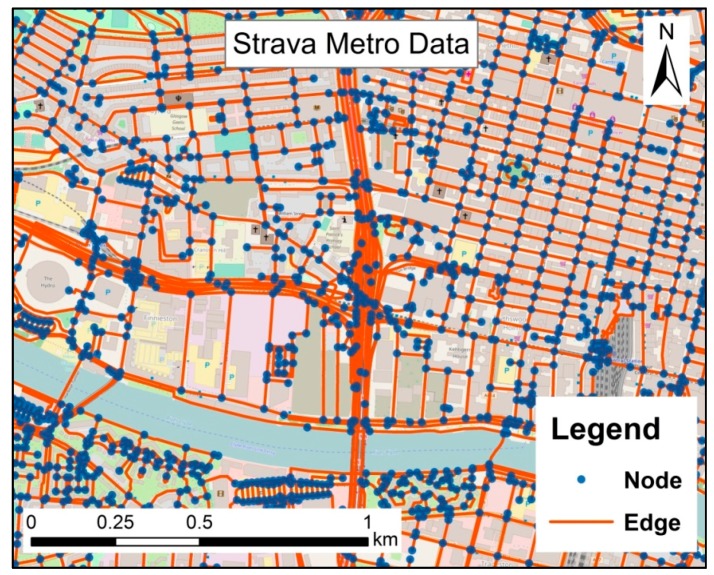
Policymakers pay much attention to effectively increasing frequency of people's cycling in the context of developing sustainable and green cities. Investigating associations of environmental characteristics and cycling behaviour could offer implications for changing urban infrastructure aiming at encouraging active travel. However, earlier examinations of associations between environmental characteristics and active travel behaviour are limited by low spatial granularity and coverage of traditional data. Crowdsourced geographic information offers an opportunity to determine the fine-grained travel patterns of people. Particularly, Strava Metro data offer a good opportunity for studies of recreational cycling behaviour as they can offer hourly, daily or annual cycling volumes with different purposes (commuting or recreational) in each street across a city. Therefore, in this study, we utilised Strava Metro data for investigating associations between environmental characteristics and recreational cycling behaviour at a large spatial scale (street level). In this study, we took account of population density, employment density, road length, road connectivity, proximity to public transit services, land use mix, proximity to green space, volume of motor vehicles and traffic accidents in an empirical investigation over Glasgow. Empirical results reveal that Strava cyclists are more likely to cycle for recreation on streets with short length, large connectivity or low volume of motor vehicles or on streets surrounded by residential land.
在发展可持续绿色城市的背景下,政策制定者十分关注如何有效提高人们骑自行车的频率。研究环境特征与骑行行为之间的关联,可为旨在鼓励积极出行的城市基础设施变革提供启示。然而,早期对环境特征与积极出行行为之间关联的研究,受到传统数据空间粒度低和覆盖范围有限的限制。众包地理信息为确定人们的细粒度出行模式提供了契机。特别是,Strava Metro数据为研究休闲骑行行为提供了良好机会,因为它们可以提供一个城市每条街道按不同目的(通勤或休闲)划分的每小时、每日或年度骑行量。因此,在本研究中,我们利用Strava Metro数据在大空间尺度(街道层面)上研究环境特征与休闲骑行行为之间的关联。在本研究中,我们在对格拉斯哥的实证调查中考虑了人口密度、就业密度、道路长度、道路连通性、与公共交通服务的距离、土地利用混合度、与绿地的距离、机动车流量和交通事故情况。实证结果表明,使用Strava软件的骑行者更有可能在长度较短、连通性高、机动车流量低的街道上,或在被住宅用地环绕的街道上进行休闲骑行。