Leeds Institute for Data Analytics, University of Leeds, Clarendon Way, Leeds, LS2 9JT, UK.
School of Geography, University of Leeds, Leeds, LS2 9JT, UK.
Int J Behav Nutr Phys Act. 2022 Sep 14;19(1):119. doi: 10.1186/s12966-022-01352-7.
Objective measures of built environment and physical activity provide the opportunity to directly compare their relationship across different populations and spatial contexts. This systematic review synthesises the current body of knowledge and knowledge gaps around the impact of objectively measured built environment metrics on physical activity levels in adults (≥ 18 years). Additionally, this review aims to address the need for improved quality of methodological reporting to evaluate studies and improve inter-study comparability though the creation of a reporting framework.
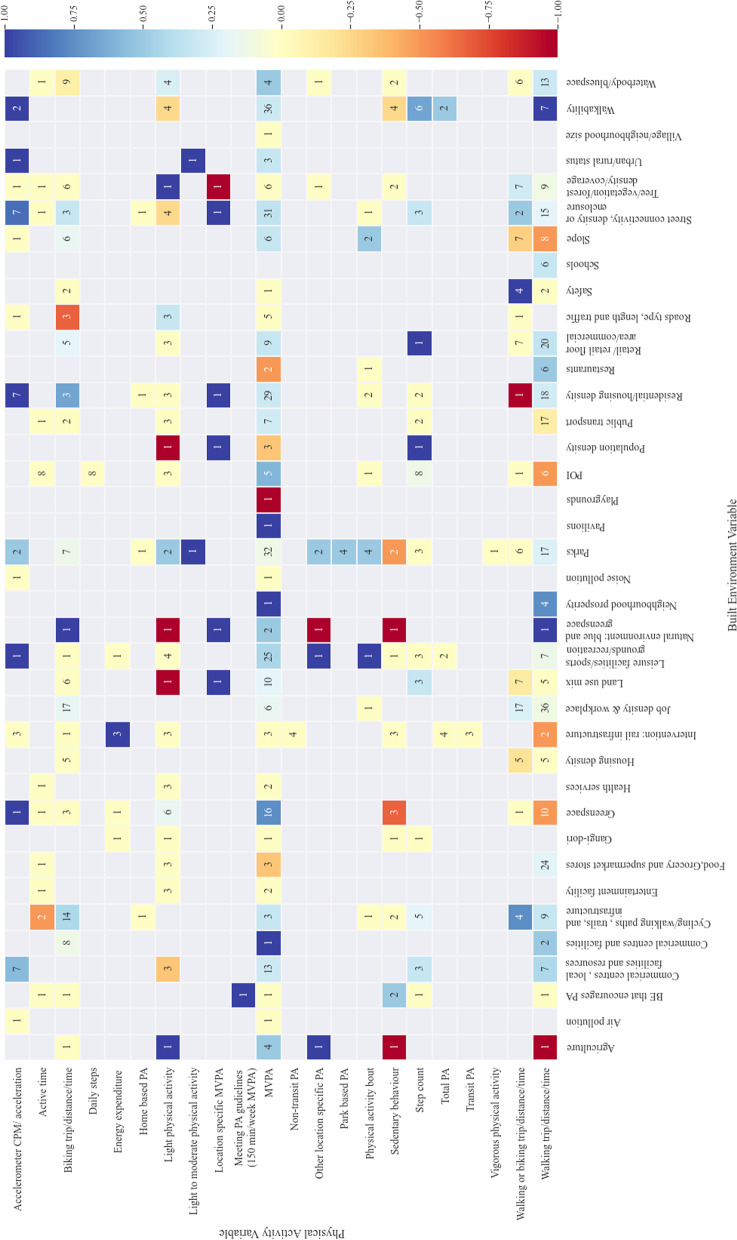
A systematic search of the literature was conducted following the PRISMA guidelines. After abstract and full-text screening, 94 studies were included in the final review. Results were synthesised using an association matrix to show overall association between built environment and physical activity variables. Finally, the new PERFORM ('Physical and Environmental Reporting Framework for Objectively Recorded Measures') checklist was created and applied to the included studies rating them on their reporting quality across four key areas: study design and characteristics, built environment exposures, physical activity metrics, and the association between built environment and physical activity.
Studies came from 21 countries and ranged from two days to six years in duration. Accelerometers and using geographic information system (GIS) to define the spatial extent of exposure around a pre-defined geocoded location were the most popular tools to capture physical activity and built environment respectively. Ethnicity and socio-economic status of participants were generally poorly reported. Moderate-to-vigorous physical activity (MVPA) was the most common metric of physical activity used followed by walking. Commonly investigated elements of the built environment included walkability, access to parks and green space. Areas where there was a strong body of evidence for a positive or negative association between the built environment and physical activity were identified. The new PERFORM checklist was devised and poorly reported areas identified, included poor reporting of built environment data sources and poor justification of method choice.
This systematic review highlights key gaps in studies objectively measuring the built environment and physical activity both in terms of the breadth and quality of reporting. Broadening the variety measures of the built environment and physical activity across different demographic groups and spatial areas will grow the body and quality of evidence around built environment effect on activity behaviour. Whilst following the PERFORM reporting guidance will ensure the high quality, reproducibility, and comparability of future research.

客观的环境和身体活动指标为比较不同人群和空间背景下它们之间的关系提供了机会。本系统综述综合了当前关于客观测量的建成环境指标对成年人(≥18 岁)身体活动水平影响的知识体系和知识空白。此外,本综述旨在通过创建一个报告框架来解决提高评估研究的方法报告质量和提高研究间可比性的需求。
按照 PRISMA 指南进行系统文献检索。经过摘要和全文筛选,94 项研究被纳入最终综述。使用关联矩阵综合结果,以显示建成环境和身体活动变量之间的总体关联。最后,创建了新的 PERFORM(客观记录测量的物理和环境报告框架)清单,并将其应用于纳入的研究,根据四个关键领域对其报告质量进行评分:研究设计和特征、建成环境暴露、身体活动指标以及建成环境与身体活动之间的关联。
研究来自 21 个国家,研究持续时间从两天到六年不等。加速度计和使用地理信息系统(GIS)来定义围绕预定义地理编码位置的空间暴露范围是捕捉身体活动和建成环境的最流行工具。参与者的种族和社会经济地位通常报告得很差。中度至剧烈体力活动(MVPA)是最常用的身体活动指标,其次是步行。研究中常见的建成环境要素包括步行性、公园和绿地可达性。确定了有大量证据表明建成环境与身体活动之间存在正或负关联的领域。新的 PERFORM 清单被设计出来,并确定了报告较差的领域,包括建成环境数据来源报告较差和方法选择的理由不足。
本系统综述强调了客观测量建成环境和身体活动的研究在报告的广度和质量方面存在的主要差距。拓宽不同人口群体和空间区域的建成环境和身体活动的各种测量方法将增加关于建成环境对活动行为影响的证据数量和质量。遵循 PERFORM 报告指南将确保未来研究的高质量、可重复性和可比性。