Davies Eleanor M M, Van der Heijden Beatrice I J M, Flynn Matt
Huddersfield Business School, University of HuddersfieldHuddersfield, United Kingdom.
Institute for Management Research, Radboud University NijmegenNijmegen, Netherlands.
Front Psychol. 2017 May 31;8:891. doi: 10.3389/fpsyg.2017.00891. eCollection 2017.
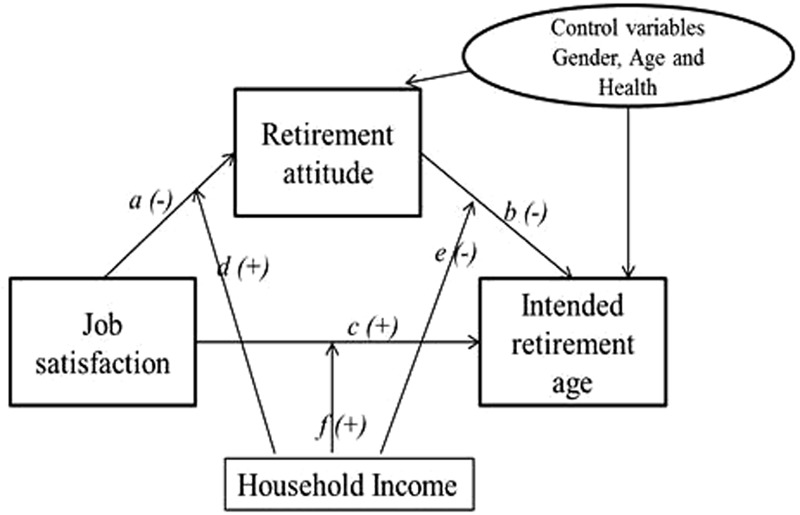
In the contemporary workplace, insight into retirement behaviors is of crucial importance. Previous empirical evidence has found mixed results regarding the relationship between work attitudes, such as job satisfaction, and retirement behaviors, suggesting that further scholarly examination incorporating moderating and mediating variables into retirement models is needed. Drawing on comparative models of attitude to retirement, we hypothesized a direct relationship between job satisfaction and intended retirement age for workers with a high household income and an indirect relationship between job satisfaction and intended retirement age, via retirement attitude, for workers with a low or mean household income. We collected data from a sample of 590 United Kingdom workers aged 50+. Using conditional process analysis, we found that the underlying mechanisms in our research model differ according to socio-economic status. We found no direct effect between job satisfaction and intended retirement age. However, an indirect effect was observed between job satisfaction and intended retirement age, via retirement attitude, for both low- and mean-household income individuals. Specifically, the relationship between job satisfaction and retirement attitude differed according to socio-economic group: for high-household income older workers, there was no relationship between job satisfaction and retirement attitude. However, for low- and mean-household income older workers, we observed a negative relationship between job satisfaction and retirement attitude. Otherwise stated, increases in job satisfaction for mean and low household income workers are likely to make the prospect of retirement less attractive. Therefore, we argue that utmost care must be taken around the conditions under which lower income employees will continue their work when getting older in order to protect their sustainable employability.
在当代职场中,洞察退休行为至关重要。先前的实证证据显示,工作态度(如工作满意度)与退休行为之间的关系结果不一,这表明需要进一步开展学术研究,将调节变量和中介变量纳入退休模型。借鉴退休态度的比较模型,我们假设高家庭收入的员工工作满意度与预期退休年龄之间存在直接关系,而低家庭收入或中等家庭收入的员工工作满意度与预期退休年龄之间通过退休态度存在间接关系。我们从590名年龄在50岁以上的英国员工样本中收集了数据。通过条件过程分析,我们发现研究模型中的潜在机制因社会经济地位而异。我们发现工作满意度与预期退休年龄之间没有直接影响。然而,对于低家庭收入和中等家庭收入的个体,通过退休态度观察到工作满意度与预期退休年龄之间存在间接影响。具体而言,工作满意度与退休态度之间的关系因社会经济群体而异:对于高家庭收入的老年员工,工作满意度与退休态度之间没有关系。然而,对于低家庭收入和中等家庭收入的老年员工,我们观察到工作满意度与退休态度之间存在负相关关系。换句话说,中等和低家庭收入员工工作满意度的提高可能会使退休前景不那么有吸引力。因此,我们认为,在低收入员工年老时继续工作的条件方面必须格外谨慎,以保护他们的可持续就业能力。