Peruyero Fernando, Zapata Julio, Pastor Diego, Cervelló Eduardo
Sport Research Center, Miguel Hernandez University of ElcheElche, Spain.
Front Psychol. 2017 May 31;8:921. doi: 10.3389/fpsyg.2017.00921. eCollection 2017.
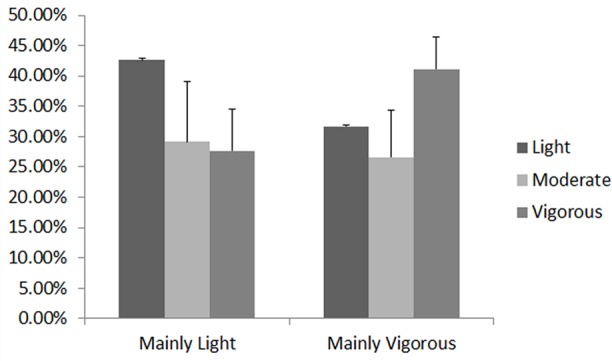
Adolescence is an important stage for brain maturation. There are many studies of exercise-cognition relations, but there is still a lack of knowledge about the impact of combining different intensities of exercise on adolescents' cognitive responses. The main objective of this study was to analyze the effect of three physical education sessions (based on Zumba dance) of different intensities (no exercise, predominantly light intensity, and predominantly vigorous intensity) on the inhibition response (measured with the Stroop test) in adolescents. Forty-four adolescent students (age 16.39 ± 0.68) completed a Stroop test before and after the three different physical education sessions. The results show than the predominantly vigorous session represented the strongest stimulus to increase cognitive inhibitory control. This means that the cognitive effect of exercise can be conditioned by exercise intensity and implies the need to control exercise intensity in physical educational programs for adolescents.
青春期是大脑成熟的重要阶段。关于运动与认知关系已有许多研究,但对于不同强度运动相结合对青少年认知反应的影响仍缺乏了解。本研究的主要目的是分析三种不同强度(无运动、主要为轻度强度、主要为剧烈强度)的体育课(基于尊巴舞)对青少年抑制反应(通过斯特鲁普测试测量)的影响。44名青少年学生(年龄16.39±0.68)在三种不同体育课前后完成了斯特鲁普测试。结果表明,主要为剧烈强度的课程对增强认知抑制控制的刺激最强。这意味着运动的认知效果可能受运动强度的制约,并暗示在青少年体育课程中需要控制运动强度。