Zhao Zhengqing, Zhao Xiangxiang, Veasey Sigrid C
Department of Neurology, Changzheng Hospital, Second Military Medical University, Shanghai, China.
Center for Sleep and Circadian Neurobiology, Department of Medicine, Perelman School of Medicine, University of Pennsylvania, Philadelphia, PA, United States.
Front Neurol. 2017 May 31;8:235. doi: 10.3389/fneur.2017.00235. eCollection 2017.
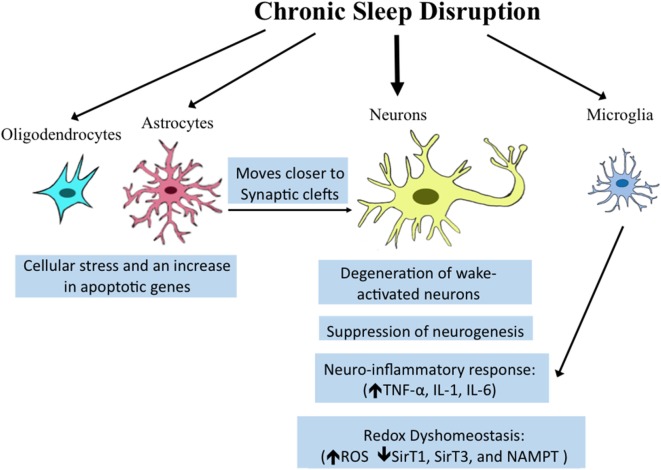
Approximately one-third of adolescents and adults in developed countries regularly experience insufficient sleep across the school and/or work week interspersed with weekend catch up sleep. This common practice of weekend recovery sleep reduces subjective sleepiness, yet recent studies demonstrate that one weekend of recovery sleep may not be sufficient in all persons to fully reverse all neurobehavioral impairments observed with chronic sleep loss, particularly vigilance. Moreover, recent studies in animal models demonstrate persistent injury to and loss of specific neuron types in response to chronic short sleep (CSS) with lasting effects on sleep/wake patterns. Here, we provide a comprehensive review of the effects of chronic sleep disruption on neurobehavioral performance and injury to neurons, astrocytes, microglia, and oligodendrocytes and discuss what is known and what is not yet established for reversibility of neural injury. Recent neurobehavioral findings in humans are integrated with animal model research examining long-term consequences of sleep loss on neurobehavioral performance, brain development, neurogenesis, neurodegeneration, and connectivity. While it is now clear that recovery of vigilance following short sleep requires longer than one weekend, less is known of the impact of CSS on cognitive function, mood, and brain health long term. From work performed in animal models, CSS in the young adult and short-term sleep loss in critical developmental windows can have lasting detrimental effects on neurobehavioral performance.
在发达国家,约三分之一的青少年和成年人在整个上学日和/或工作日经常睡眠不足,周末则进行补觉。这种常见的周末恢复性睡眠做法可减轻主观困倦感,但最近的研究表明,对所有人而言,一个周末的恢复性睡眠可能不足以完全扭转长期睡眠不足所导致的所有神经行为损伤,尤其是警觉性方面的损伤。此外,最近在动物模型上的研究表明,慢性短睡眠(CSS)会导致特定神经元类型持续受损并丧失,对睡眠/觉醒模式产生持久影响。在此,我们全面综述了慢性睡眠中断对神经行为表现以及对神经元、星形胶质细胞、小胶质细胞和少突胶质细胞损伤的影响,并讨论了神经损伤可逆性方面已知和未知的情况。人类最近的神经行为研究结果与动物模型研究相结合,后者探讨了睡眠不足对神经行为表现、大脑发育、神经发生、神经退行性变和连通性的长期影响。虽然现在很清楚,短睡眠后警觉性的恢复需要不止一个周末的时间,但关于慢性短睡眠对认知功能、情绪和长期大脑健康的影响,我们所知甚少。从动物模型的研究来看,年轻成年人的慢性短睡眠以及关键发育窗口期的短期睡眠不足会对神经行为表现产生持久的有害影响。