Bernhardt Nadine, Brassac Jonathan, Kilian Benjamin, Blattner Frank R
Leibniz Institute of Plant Genetics and Crop Plant Research (IPK), Gatersleben, Germany.
Present address: Crop Trust, Bonn, Germany.
BMC Evol Biol. 2017 Jun 16;17(1):141. doi: 10.1186/s12862-017-0989-9.
Triticeae, the tribe of wheat grasses, harbours the cereals barley, rye and wheat and their wild relatives. Although economically important, relationships within the tribe are still not understood. We analysed the phylogeny of chloroplast lineages among nearly all monogenomic Triticeae taxa and polyploid wheat species aiming at a deeper understanding of the tribe's evolution. We used on- and off-target reads of a target-enrichment experiment followed by Illumina sequencing.
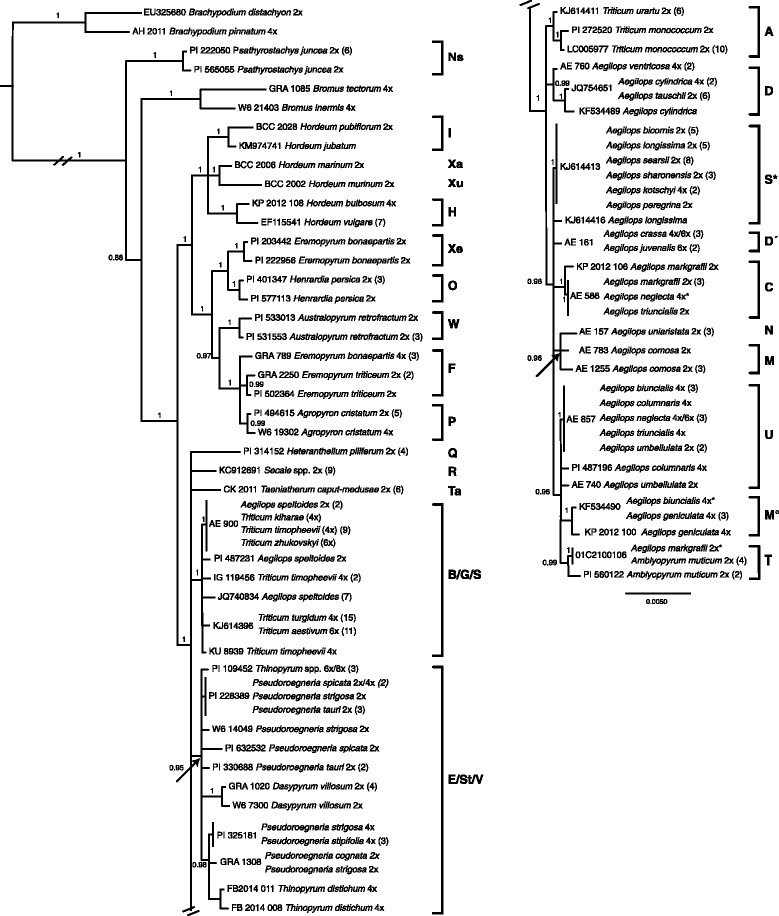
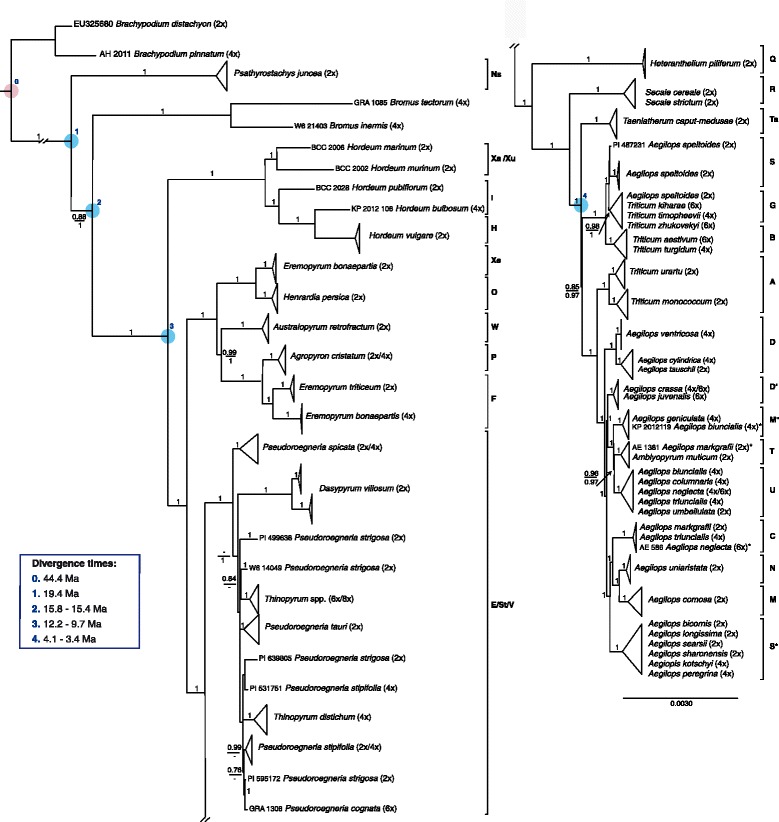
The read data was used to assemble the plastid locus ndhF for 194 individuals and the whole chloroplast genome for 183 individuals, representing 53 Triticeae species and 15 genera. We conducted Bayesian and multispecies coalescent analyses to infer relationships and estimate divergence times of the taxa. We present the most comprehensive dated Triticeae chloroplast phylogeny and review previous hypotheses in the framework of our results. Monophyly of Triticeae chloroplasts could not be confirmed, as either Bromus or Psathyrostachys captured a chloroplast from a lineage closely related to a Bromus-Triticeae ancestor. The most recent common ancestor of Triticeae occurred approximately between ten and 19 million years ago.
The comparison of the chloroplast phylogeny with available nuclear data in several cases revealed incongruences indicating past hybridizations. Recent events of chloroplast capture were detected as individuals grouped apart from con-specific accessions in otherwise monopyhletic groups.
小麦族包含大麦、黑麦、小麦等谷物及其野生近缘种。尽管该族具有重要的经济意义,但其内部关系仍不清楚。我们分析了几乎所有单基因组小麦族分类群和多倍体小麦物种的叶绿体谱系系统发育,旨在更深入地了解该族的进化。我们使用了目标富集实验的靶向和脱靶读数,随后进行了Illumina测序。
读取的数据用于组装194个个体的质体基因座ndhF和183个个体的完整叶绿体基因组,代表53个小麦族物种和15个属。我们进行了贝叶斯分析和多物种溯祖分析,以推断分类群之间的关系并估计分歧时间。我们展示了最全面的有时间标定的小麦族叶绿体系统发育,并在我们的结果框架内回顾了先前的假设。无法确认小麦族叶绿体的单系性,因为雀麦属或新麦草属捕获了一个与雀麦-小麦族祖先密切相关的谱系的叶绿体。小麦族最近的共同祖先大约出现在1000万至1900万年前。
在几个案例中,叶绿体系统发育与可用的核数据的比较揭示了不一致性,表明过去存在杂交现象。检测到最近的叶绿体捕获事件,因为在其他单系类群中,一些个体与同种材料分组不同。