Lyon Johnathan G, Mokarram Nassir, Saxena Tarun, Carroll Sheridan L, Bellamkonda Ravi V
Department of Biomedical Engineering, Pratt School of Engineering, Duke University, 101 Science Drive, Durham, NC 27708-0271, USA; Wallace H. Coulter Department of Biomedical Engineering, Georgia Institute of Technology & Emory School of Medicine, UA Whitaker Building, 313 Ferst Drive, Atlanta, GA 30332, USA.
Department of Biomedical Engineering, Pratt School of Engineering, Duke University, 101 Science Drive, Durham, NC 27708-0271, USA.
Adv Drug Deliv Rev. 2017 May 15;114:19-32. doi: 10.1016/j.addr.2017.06.006. Epub 2017 Jun 15.
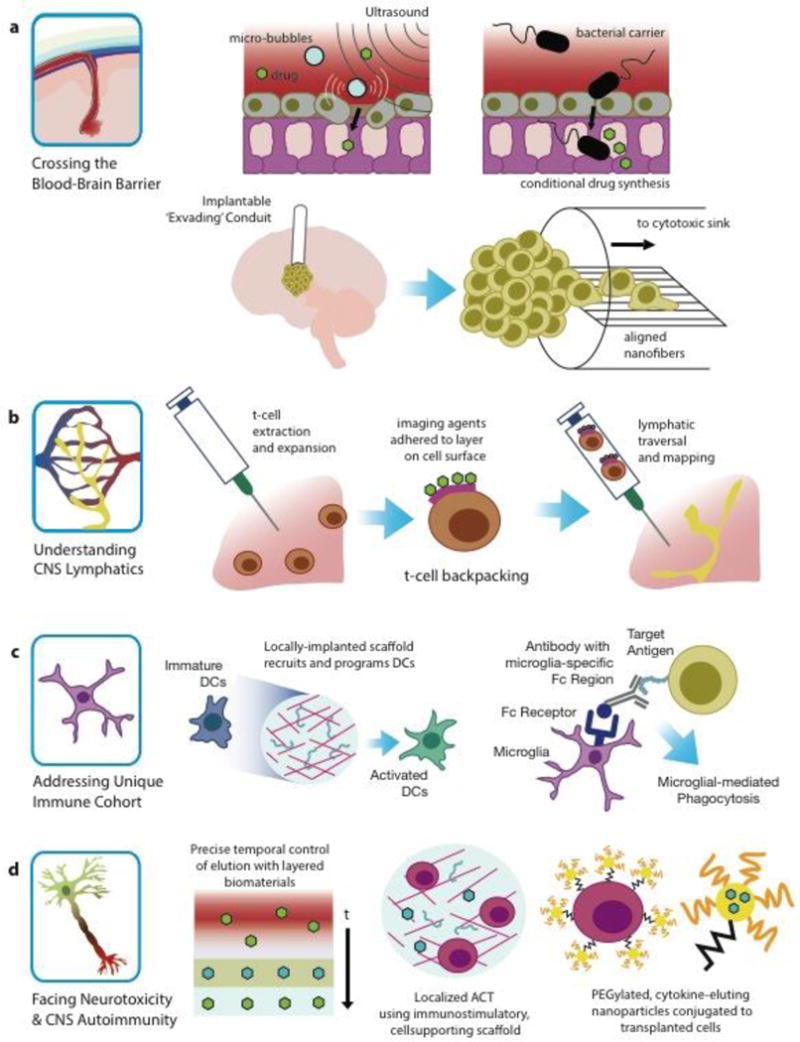
Malignant brain tumors represent one of the most devastating forms of cancer with abject survival rates that have not changed in the past 60years. This is partly because the brain is a critical organ, and poses unique anatomical, physiological, and immunological barriers. The unique interplay of these barriers also provides an opportunity for creative engineering solutions. Cancer immunotherapy, a means of harnessing the host immune system for anti-tumor efficacy, is becoming a standard approach for treating many cancers. However, its use in brain tumors is not widespread. This review discusses the current approaches, and hurdles to these approaches in treating brain tumors, with a focus on immunotherapies. We identify critical barriers to immunoengineering brain tumor therapies and discuss possible solutions to these challenges.
恶性脑肿瘤是最具毁灭性的癌症形式之一,其生存率极低,在过去60年里一直没有变化。部分原因是大脑是一个关键器官,存在独特的解剖学、生理学和免疫学屏障。这些屏障之间独特的相互作用也为创新性的工程解决方案提供了机会。癌症免疫疗法是一种利用宿主免疫系统实现抗肿瘤疗效的方法,正成为治疗许多癌症的标准方法。然而,其在脑肿瘤治疗中的应用并不广泛。本综述讨论了目前治疗脑肿瘤的方法以及这些方法所面临的障碍,重点是免疫疗法。我们确定了免疫工程脑肿瘤治疗的关键障碍,并讨论了应对这些挑战的可能解决方案。