Phung Viet-Hai, Trueman Ian, Togher Fiona, Orner Roderick, Siriwardena A Niroshan
Community and Health Research Unit, School of Health and Social Care, University of Lincoln, Brayford Campus, Lincoln, LN6 7TS, UK.
Scand J Trauma Resusc Emerg Med. 2017 Jun 19;25(1):58. doi: 10.1186/s13049-017-0403-z.
Community First Responder (CFR) schemes support lay people to respond to medical emergencies, working closely with ambulance services. They operate widely in the UK. There has been no previous review of UK literature on these schemes. This is the first systematic scoping review of UK literature on CFR schemes, which identifies the reasons for becoming a CFR, requirements for training and feedback and confusion between the CFR role and that of ambulance service staff. This study also reveals gaps in the evidence base for CFR schemes.
We conducted a systematic scoping review of the published literature, in the English language from 2000 onwards using specific search terms in six databases. Narrative synthesis was used to analyse article content.
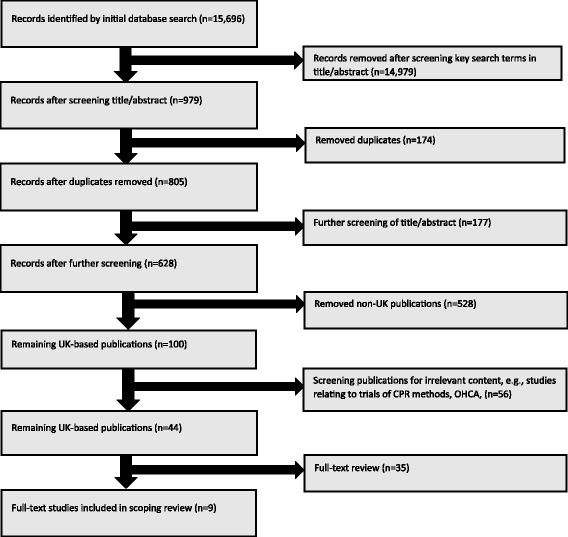
Nine articles remained from the initial search of 15,969 articles after removing duplicates, title and abstract and then full text review. People were motivated to become CFRs through an altruistic desire to help others. They generally felt rewarded by their work but recognised that the help they provided was limited by their training compared with ambulance staff. There were concerns about the possible emotional impact on CFRs responding to incidents. CFRs felt that better feedback would enhance their learning. Ongoing training and support were viewed as essential to enable CFRs to progress. They perceived that public recognition of the CFR role was low, patients sometimes confusing them with ambulance staff. Relationships with the ambulance service were sometimes ambivalent due to confusion over roles. There was support for local autonomy of CFR schemes but with greater sharing of best practice.
Most studies dated from 2005 and were descriptive rather than analytical. In the UK and Australia CFRs are usually lay volunteers equipped with basic skills for responding to medical emergencies, whereas in the US they include other emergency staff as well as lay people.
Opportunities for future research include exploring experiences and perceptions of patients who have been treated by CFRs and other stakeholders, while also evaluating the effectiveness and costs of CFR schemes.
社区急救员(CFR)计划支持非专业人员应对医疗紧急情况,并与救护车服务部门密切合作。这些计划在英国广泛开展。此前尚未对英国关于这些计划的文献进行过综述。这是首次对英国关于CFR计划的文献进行系统的范围综述,旨在确定成为CFR的原因、培训要求、反馈情况以及CFR角色与救护车服务人员角色之间的混淆。本研究还揭示了CFR计划证据基础方面的差距。
我们使用特定搜索词对2000年起以英文发表的文献在六个数据库中进行了系统的范围综述。采用叙述性综合分析文章内容。
在去除重复项、标题和摘要,然后进行全文审查后,从最初搜索的15969篇文章中筛选出9篇文章。人们出于帮助他人的利他愿望而有动力成为CFR。他们普遍觉得工作有收获,但也认识到与救护车工作人员相比,他们所提供的帮助受到培训的限制。有人担心应对事件对CFR可能产生的情感影响。CFR认为更好的反馈会促进他们的学习。持续培训和支持被视为CFR取得进步的关键。他们认为公众对CFR角色的认可度较低,患者有时会将他们与救护车工作人员混淆。由于角色混淆,与救护车服务部门的关系有时不明确。有人支持CFR计划的地方自主权,但也支持更多地分享最佳实践。
大多数研究可追溯到2005年,且多为描述性而非分析性研究。在英国和澳大利亚,CFR通常是非专业志愿者,具备应对医疗紧急情况的基本技能,而在美国,CFR还包括其他急救人员以及非专业人员。
未来研究的机会包括探索接受过CFR治疗的患者及其他利益相关者的经历和看法,同时评估CFR计划的有效性和成本。