Center for Cognitive Brain Imaging, Psychology Department, Carnegie Mellon University, Pittsburgh, PA 15213, USA.
Center for Cognitive Brain Imaging, Psychology Department, Carnegie Mellon University, Pittsburgh, PA 15213, USA.
Neuroimage. 2017 Aug 15;157:511-520. doi: 10.1016/j.neuroimage.2017.06.033. Epub 2017 Jun 17.
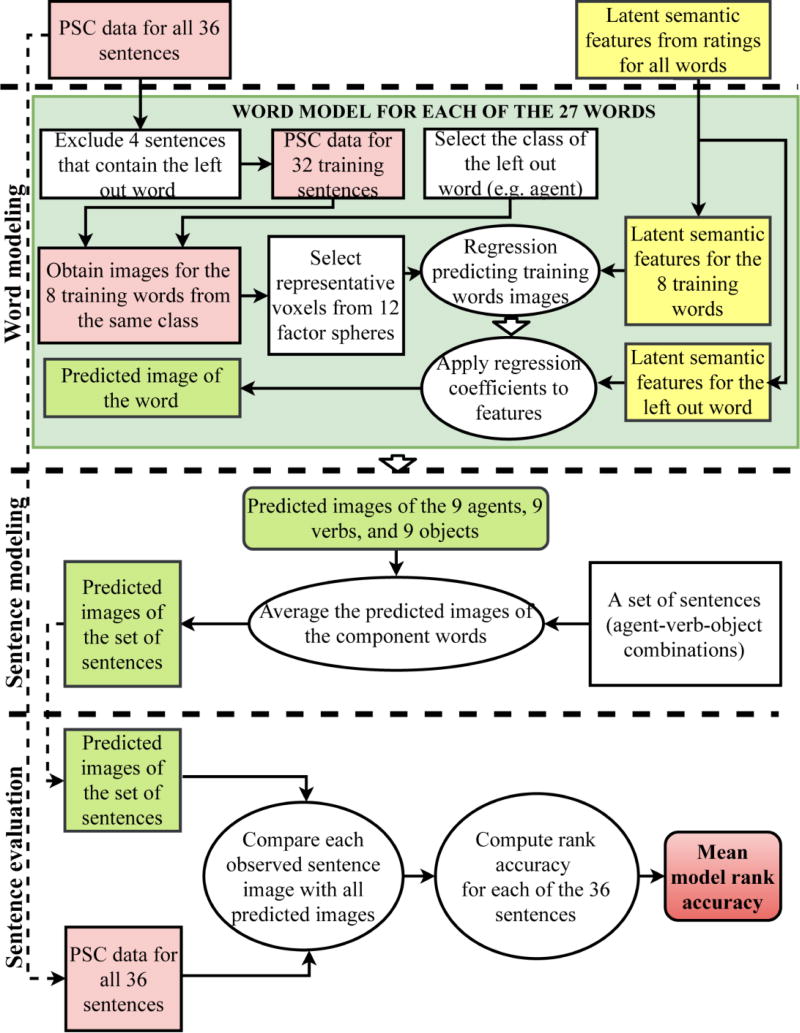
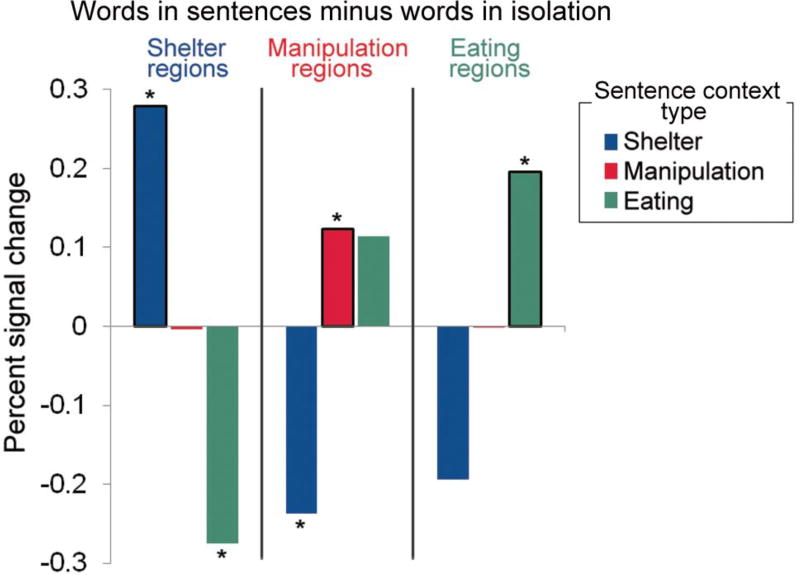
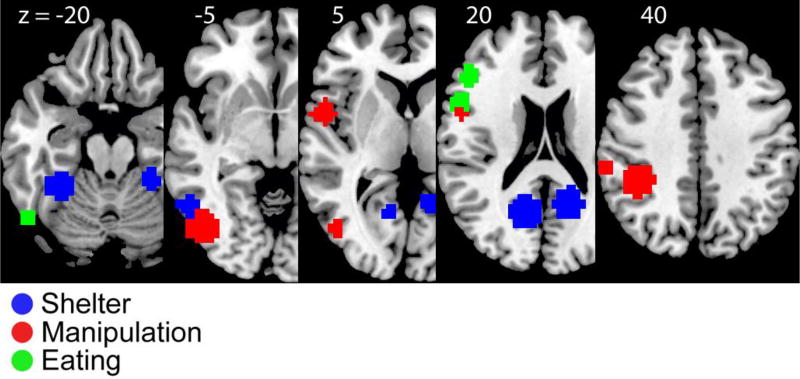
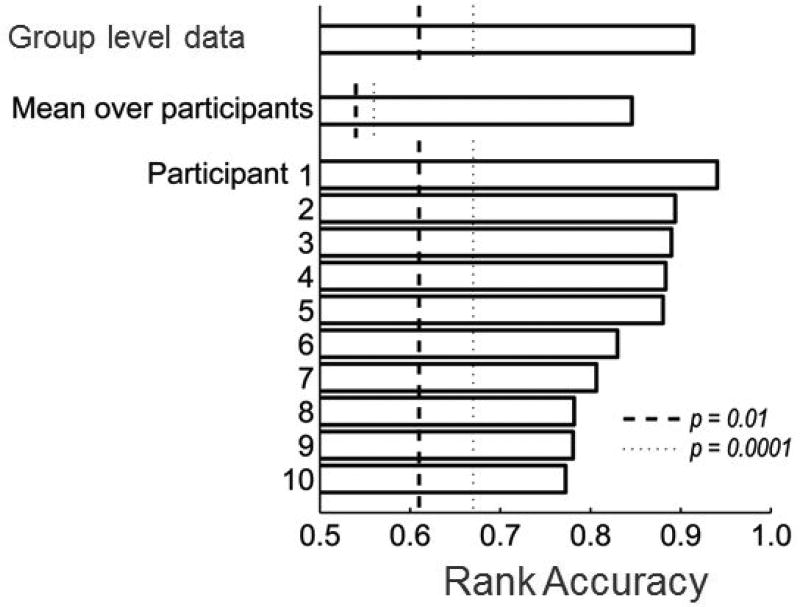
Although it has been possible to identify individual concepts from a concept's brain activation pattern, there have been significant obstacles to identifying a proposition from its fMRI signature. Here we demonstrate the ability to decode individual prototype sentences from readers' brain activation patterns, by using theory-driven regions of interest and semantic properties. It is possible to predict the fMRI brain activation patterns evoked by propositions and words which are entirely new to the model with reliably above-chance rank accuracy. The two core components implemented in the model that reflect the theory were the choice of intermediate semantic features and the brain regions associated with the neurosemantic dimensions. This approach also predicts the neural representation of object nouns across participants, studies, and sentence contexts. Moreover, we find that the neural representation of an agent-verb-object proto-sentence is more accurately characterized by the neural signatures of its components as they occur in a similar context than by the neural signatures of these components as they occur in isolation.
虽然已经可以从大脑活动模式中识别出单个概念,但要从 fMRI 特征中识别出一个命题仍然存在重大障碍。在这里,我们通过使用理论驱动的感兴趣区域和语义属性,展示了从读者大脑活动模式中解码单个原型句子的能力。有可能以可靠的高于平均水平的排名准确性来预测完全新的命题和单词的 fMRI 大脑激活模式。模型中实现的两个核心组件反映了理论,即中间语义特征的选择和与神经语义维度相关的大脑区域。这种方法还可以预测对象名词在参与者、研究和句子语境中的神经表示。此外,我们发现,与这些组件在孤立状态下的神经特征相比,在类似的上下文中出现的组件的神经特征更能准确地描述代理动词对象原型句子的神经表示。