Bocanegra-Ibarias Paola, Garza-González Elvira, Morfín-Otero Rayo, Barrios Humberto, Villarreal-Treviño Licet, Rodríguez-Noriega Eduardo, Garza-Ramos Ulises, Petersen-Morfin Santiago, Silva-Sanchez Jesus
Facultad de Ciencias Biológicas, Universidad Autónoma de Nuevo León, San Nicólas de los Garza, Nuevo León, Mexico.
Servicio de Gastroenterología, Hospital Universitario Dr. José Eleuterio González, Universidad Autónoma de Nuevo León, Monterrey, Nuevo León, Mexico.
PLoS One. 2017 Jun 21;12(6):e0179651. doi: 10.1371/journal.pone.0179651. eCollection 2017.
To characterize the microbiological, molecular and epidemiological data of an outbreak of carbapenem-resistant Enterobacteriaceae (CRE) in a tertiary-care hospital in Mexico.
From September 2014 to July 2015, all CRE clinical isolates recovered during an outbreak in the Hospital Civil "Fray Antonio Alcalde" in Jalisco, Mexico were screened for antimicrobial susceptibility, carbapenemase production, carbapenemase-encoding genes, and plasmid profiles. Horizontal transfer of imipenem resistance; and clonal diversity by pulsed-field gel electrophoresis (PFGE) and multilocus sequence typing (MLST); as well as biofilm production and the presence of 14 virulence genes were analyzed in selected isolates.
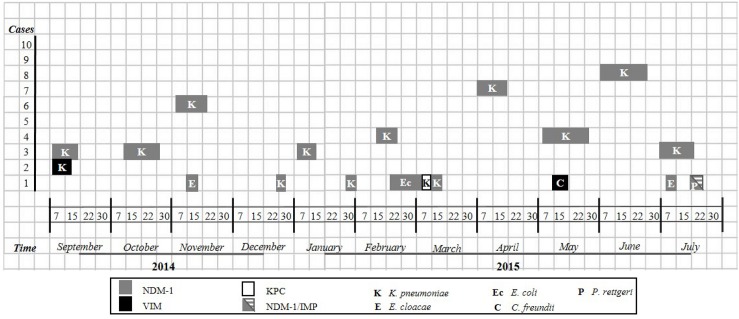
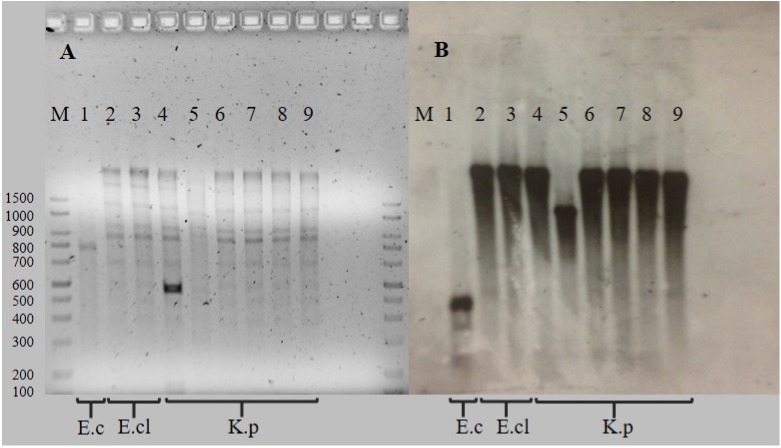
Fifty-two carbapenem-resistant isolates corresponding to 5 species were detected, i.e., Klebsiella pneumoniae (n = 46), Enterobacter cloacae (n = 3), Escherichia coli (n = 1), Providencia rettgeri (n = 1) and Citrobacter freundii (n = 1) with carbapenemase encoding genes blaNDM-1 (n = 48), blaVIM (n = 3), blaIMP (n = 1) and blaKPC (n = 1) detected in these isolates. The blaNDM-1 gene was detected in plasmids from 130- to 170-kb in K. pneumoniae (n = 46); E. cloacae (n = 3), E. coli (n = 1) and P. rettgeri (n = 1). The transfer of plasmids harboring the blaNDM-1 gene was obtained in eight transconjugants. One plasmid restriction pattern was detected, with the blaNDM-1 identified in different restriction fragments. Predominant clone A of K. pneumoniae isolates archived 28/46 (60%) isolates and belongs to ST392. Besides, ST307, ST309, ST846, ST2399, and ST2400 were detected for K. pneumoniae; as well as E. cloacae ST182 and E. coli ST10. The fimA and uge genes were more likely to be identified in K. pneumoniae carbapenem-susceptible isolates (p = <0.001) and biofilm production was more liable to be observed in carbapenem-resistant isolates (p = <0.05).
Four Enterobacteriaceae species harboring the blaNDM-1 gene were detected in a nosocomial outbreak in Mexico; horizontal transfer and strain transmission were demonstrated for the blaNDM-1 gene. Given the variation in the size of the plasmid harboring blaNDM-1, complex rearrangements must also be occurring.
对墨西哥一家三级护理医院中耐碳青霉烯类肠杆菌科细菌(CRE)暴发的微生物学、分子学和流行病学数据进行特征描述。
2014年9月至2015年7月,对墨西哥哈利斯科州“弗雷·安东尼奥·阿尔calde”市民医院暴发期间分离出的所有CRE临床分离株进行抗菌药物敏感性、碳青霉烯酶产生情况、碳青霉烯酶编码基因和质粒图谱筛查。分析亚胺培南耐药性的水平转移;通过脉冲场凝胶电泳(PFGE)和多位点序列分型(MLST)分析克隆多样性;并对选定分离株分析生物膜产生情况和14种毒力基因的存在情况。
检测到52株耐碳青霉烯类分离株,分属于5个菌种,即肺炎克雷伯菌(n = 46)、阴沟肠杆菌(n = 3)、大肠埃希菌(n = 1)、雷氏普罗威登斯菌(n = 1)和弗氏柠檬酸杆菌(n = 1),这些分离株中检测到碳青霉烯酶编码基因blaNDM-1(n = 48)、blaVIM(n = 3)、blaIMP(n = 1)和blaKPC(n = 1)。在肺炎克雷伯菌(n = 46)、阴沟肠杆菌(n = 3)、大肠埃希菌(n = 1)和雷氏普罗威登斯菌(n = 1)中,blaNDM-1基因存在于130至170 kb的质粒中。在8个接合子中获得了携带blaNDM-1基因的质粒转移。检测到一种质粒限制性图谱,blaNDM-1存在于不同的限制性片段中。肺炎克雷伯菌分离株的优势克隆A存档了28/46(60%)株分离株,属于ST392。此外,还检测到肺炎克雷伯菌的ST307, ST309, ST846, ST2399和ST2400;以及阴沟肠杆菌ST182和大肠埃希菌ST10。fimA和uge基因在肺炎克雷伯菌碳青霉烯敏感分离株中更易被鉴定(p = <0.001),而生物膜产生在耐碳青霉烯类分离株中更易观察到(p = <0.05)。
在墨西哥的一次医院暴发中检测到4种携带blaNDM-1基因的肠杆菌科细菌;证实了blaNDM-1基因的水平转移和菌株传播。鉴于携带blaNDM-1的质粒大小存在差异,必然也发生了复杂的重排。