Doustmohammadian Aazam, Omidvar Nasrin, Keshavarz-Mohammadi Nastaran, Abdollahi Morteza, Amini Maryam, Eini-Zinab Hassan
Department of Community Nutrition, National Nutrition and Food Technology Research Institute; and Faculty of Nutrition Sciences and Food Technology, Shahid Beheshti University of Medical Sciences, Tehran, Iran.
School of Public Health, Shahid Beheshti University of Medical Sciences, Tehran, Iran.
PLoS One. 2017 Jun 27;12(6):e0179196. doi: 10.1371/journal.pone.0179196. eCollection 2017.
Food and nutrition literacy is an emerging term which is increasingly used in policy and research. Though research in this area is growing, progression is limited by the lack of an accepted method to measure food and nutrition literacy. The aim of this study is to develop a valid and reliable questionnaire to assess food and nutrition literacy in elementary school children in the city of Tehran.
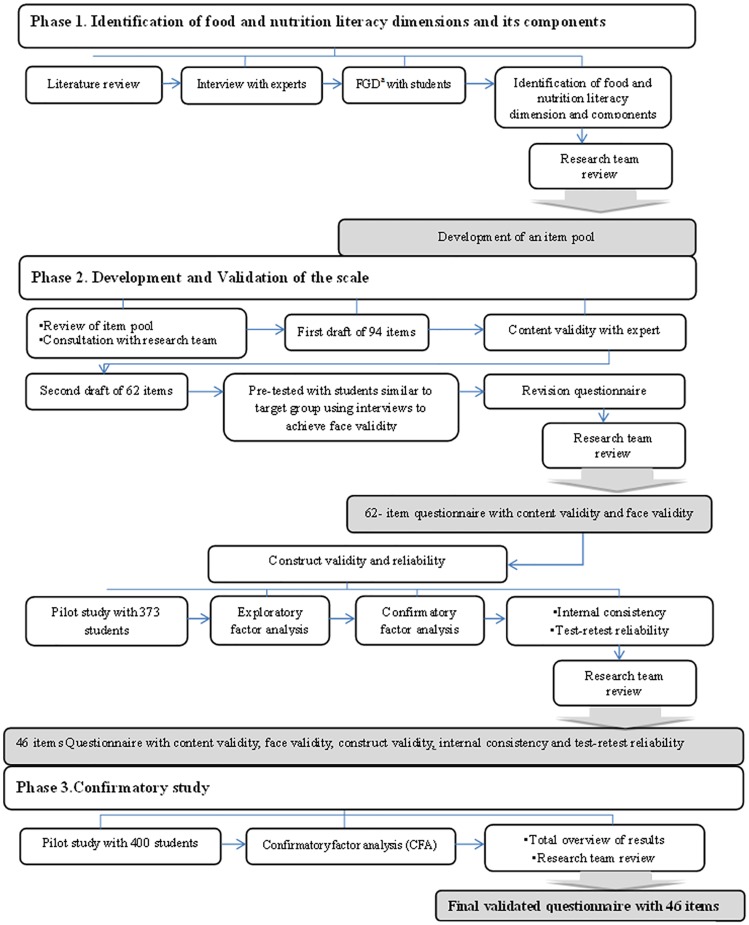
The study was conducted in three phases. To develop Food and Nutrition Literacy (FNLIT) questionnaire, a comprehensive literature review and a qualitative study were initially performed to identify food and nutrition literacy dimensions and its components. Content and face validity of the questionnaire were evaluated by an expert panel as well as students. In the second phase, construct validity of the scale was evaluated using Explanatory Factor Analyses (EFA) and Confirmatory Factor Analyses (CFA). In the last phase (confirmatory phase), the final version of the questionnaire was evaluated on 400 students.
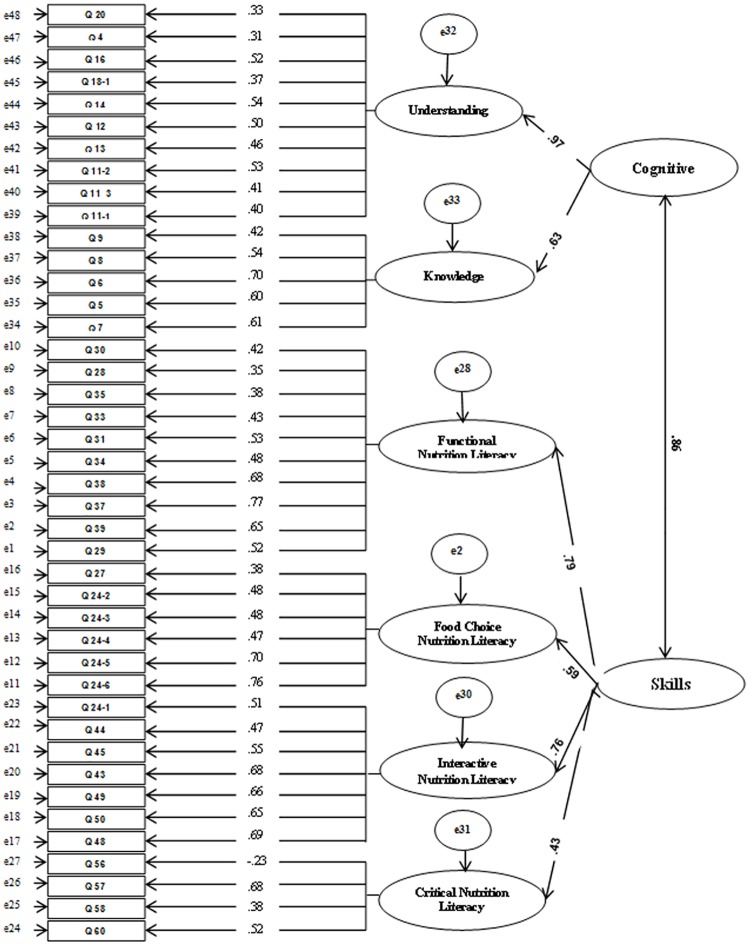
Findings show Content Validity Ratio (CVR) and Content Validity Index (CVI) of the 62-item questionnaire at acceptable levels of 0.87 and 0.92, respectively. EFA suggested a six-factor construct, namely, understanding food and nutrition information, knowledge, functional, interactive, food choice, and critical. The results of CFA indicated acceptable fit indices for the proposed models. All subscales demonstrated satisfactory internal consistency (Cronbach's alpha≥0.70), except for critical skill subscale (0.48). The intraclass correlation coefficient (ICC = 0.90, CI: 0.83-0.94) indicated that Food and Nutrition Literacy (FNLIT) scale had satisfactory stability. Each phase of development progressively improved the questionnaire, which resulted in a 46-item (42 likert-type items and 4 true-false items) Food and Nutrition Literacy (FNLIT) scale. The questionnaire measured two domains with 6 subscales, including: 1) cognitive domain: understanding and knowledge; 2) skill domain: functional, food choice, interactive, and critical skills.
The developed food and nutrition literacy scale is a valid and reliable instrument to measure food and nutrition literacy in children. This measure lays a solid empirical and theoretical foundation for future research and tailored interventions to promote food and nutrition literacy in this age group.
食品与营养素养是一个新兴术语,在政策制定和研究中使用得越来越频繁。尽管该领域的研究不断增加,但由于缺乏公认的测量食品与营养素养的方法,进展有限。本研究的目的是开发一份有效且可靠的问卷,以评估德黑兰市小学生的食品与营养素养。
该研究分三个阶段进行。为了编制食品与营养素养(FNLIT)问卷,首先进行了全面的文献综述和定性研究,以确定食品与营养素养的维度及其组成部分。问卷的内容效度和表面效度由专家小组以及学生进行评估。在第二阶段,使用探索性因素分析(EFA)和验证性因素分析(CFA)对量表的结构效度进行评估。在最后一个阶段(验证阶段),对400名学生进行了问卷的最终版本评估。
结果显示,这份62个条目的问卷的内容效度比(CVR)和内容效度指数(CVI)分别处于可接受水平,即0.87和0.92。探索性因素分析表明存在一个六因素结构,即理解食品与营养信息、知识、功能、互动、食物选择和批判性。验证性因素分析的结果表明所提出模型的拟合指数可接受。除了批判性技能子量表(0.48)外,所有子量表都显示出令人满意的内部一致性(Cronbach's alpha≥0.70)。组内相关系数(ICC = 0.90,CI:0.83 - 0.94)表明食品与营养素养(FNLIT)量表具有令人满意的稳定性。问卷编制的每个阶段都逐步改进了问卷,最终形成了一份包含46个条目的(42个李克特式条目和4个是非题)食品与营养素养(FNLIT)量表。该问卷测量了两个领域,包含6个子量表,分别为:1)认知领域:理解和知识;2)技能领域:功能、食物选择、互动和批判性技能。
所开发的食品与营养素养量表是测量儿童食品与营养素养的有效且可靠工具。这一测量方法为未来研究以及为促进该年龄组食品与营养素养而开展的针对性干预奠定了坚实的实证和理论基础。