Department of Food Science and Nutrition, Zhejiang University, Hangzhou, China.
No. 1 Department of Nutrition, Chinese People's Liberation Army General Hospital, Beijing, China.
EBioMedicine. 2017 Aug;22:200-207. doi: 10.1016/j.ebiom.2017.06.017. Epub 2017 Jun 20.
It has been suggested that the increase in carbohydrate at the expense of fat has contributed to the obesity epidemic in North America and some European countries. However, obesity rates in China have increased rapidly in parallel with a transition from the traditional low fat, high carbohydrate diet to a diet relatively high in fat and reduced in carbohydrate. Therefore, the current study aimed to determine whether the traditional Chinese diet was likely to be more effective than a diet with higher fat and lower carbohydrate — which is consumed in most Western societies, at weight control among a non-obese healthy population in China.
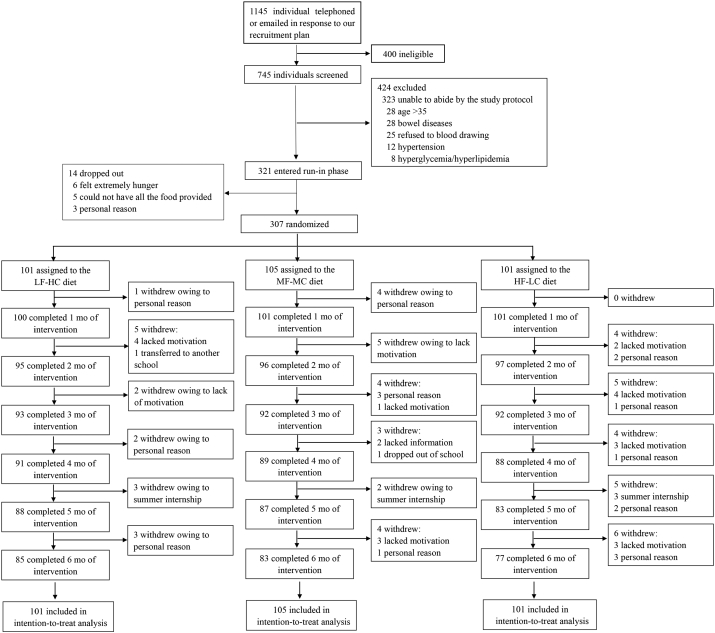
The 6-month, two-center, three-arm, randomized, parallel-group, controlled-feeding trial was conducted at People's Liberation Army General Hospital in north China and Zhejiang University in south China. We recruited healthy young adults (aged 18–35 years, body mass index < 28) who lived in the university campus or the hospital dormitory during the whole study intervention period. They were required to eat only the foods provided, and to avoid excessive or unusual strenuous exercise during the trial. Participants were simultaneously enrolled and randomized using a computer-generated number (stratified by clinic center, age, sex, and body mass index) by data manager to one of the three isocaloric diets (1:1:1): a lower fat, higher carbohydrate diet (fat 20%, carbohydrate 66% energy); a moderate fat, moderate carbohydrate diet (fat 30%, carbohydrate 56% energy); a higher fat, lower carbohydrate diet (fat 40%, carbohydrate 46% energy). Protein provided 14% energy in all diets. We provided all food and beverages throughout the 6-month intervention. Laboratory personnel were masked to treatment allocation. Body weight was the primary outcome and measured each month. Data were primarily analyzed according to an intention-to-treat approach, supplemented with per-protocol analysis. The study was approved by the Ethics Committee at Zhejiang University. Each participant provided written informed consent. The study was registered at Clinicaltrials.gov, number NCT02355795.
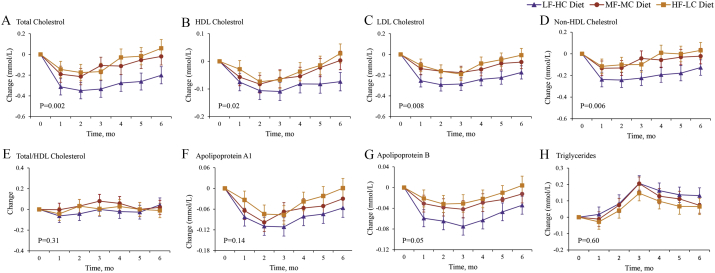
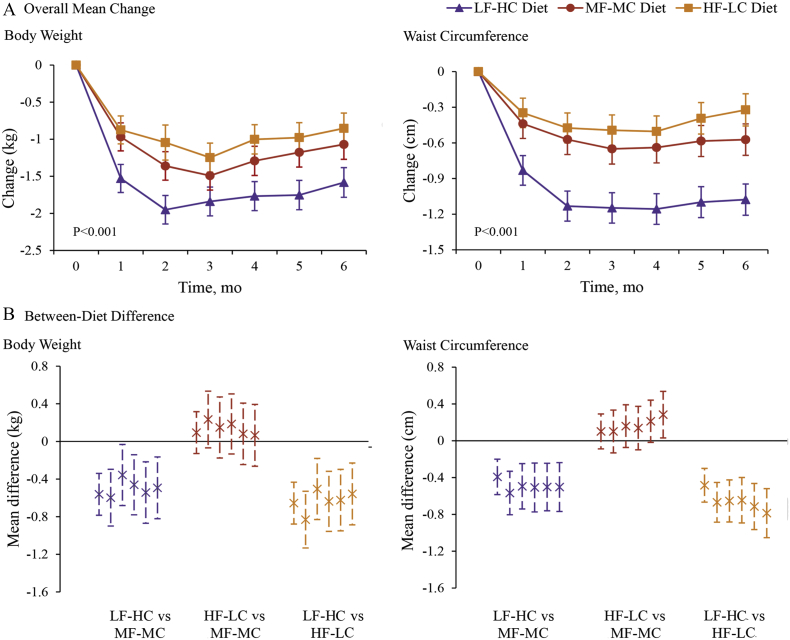
Between April 30, 2016, and October 30, 2016, 307 participants were randomly assigned to the lower fat diet (n = 101), the moderate fat diet (n = 105) and the higher fat diet (n = 101), and 245 (79.8%) participants completed the study. Reduction in body weight was significantly greater in the lower fat, higher carbohydrate group throughout the intervention (P < 0.001 for the interaction between diet group and time) than in the two other groups. Weight change at 6 months was − 1.6 kg (95% CI − 1.8 to − 1.4) in the lower fat, higher carbohydrate group; − 1.1 kg (95% CI − 1.3 to − 0.9) in the moderate fat, moderate carbohydrate group, and − 0.9 kg (95% CI − 1.1 to − 0.6) in the higher fat, lower carbohydrate group. Reduction in waist circumference, total cholesterol, low-density lipoprotein cholesterol and non-high-density lipoprotein cholesterol on the lower fat, higher carbohydrate group were greater than those observed on the other two diet groups.
A lower fat, relatively higher carbohydrate diet, similar in macronutrient composition to that traditionally eaten in China appears to be less likely to promote excessive weight gain and be associated with a lower cardiometabolic risk profile than a diet more typical of that eaten in Western countries in healthy non-obese Chinese. Findings from studies in European and North American populations suggesting possible benefits of carbohydrate restriction may not apply to people of other ethnicities.
有人认为,以碳水化合物代替脂肪会导致北美和一些欧洲国家的肥胖流行。然而,中国的肥胖率也在迅速上升,与此同时,中国传统的低脂肪、高碳水化合物饮食也在向高脂肪、低碳水化合物的饮食转变。因此,本研究旨在确定中国传统饮食是否比大多数西方国家所消耗的高脂肪、低碳水化合物饮食更能有效地控制体重。
这项为期 6 个月、在中国北方的解放军总医院和中国南方的浙江大学进行的、中心对照、三臂、随机、平行分组、对照喂养试验,招募了健康的年轻成年人(年龄 18-35 岁,体重指数 < 28),他们在整个研究干预期间居住在大学校园或医院宿舍。要求他们只吃提供的食物,并且在试验期间避免过度或异常剧烈的运动。参与者同时通过数据管理员使用计算机生成的数字(按诊所中心、年龄、性别和体重指数分层)被随机分配到三种等热量饮食之一(1:1:1):低脂肪、高碳水化合物饮食(脂肪 20%,碳水化合物 66%能量);中脂肪、中碳水化合物饮食(脂肪 30%,碳水化合物 56%能量);高脂肪、低碳水化合物饮食(脂肪 40%,碳水化合物 46%能量)。所有饮食中蛋白质提供 14%的能量。我们在整个 6 个月的干预期间提供所有的食物和饮料。实验室人员对治疗分配进行了屏蔽。体重是主要的观察指标,每月测量一次。数据主要按照意向治疗方法进行分析,并辅以方案分析。该研究得到了浙江大学伦理委员会的批准。每位参与者都提供了书面知情同意书。该研究在 Clinicaltrials.gov 注册,编号为 NCT02355795。
在 2016 年 4 月 30 日至 2016 年 10 月 30 日期间,307 名参与者被随机分配到低脂饮食组(n=101)、中脂饮食组(n=105)和高脂饮食组(n=101),245 名(79.8%)参与者完成了研究。整个干预期间,低脂、高碳水化合物组的体重减轻明显大于其他两组(饮食组与时间之间的交互作用 P<0.001)。6 个月时的体重变化在低脂、高碳水化合物组为-1.6kg(95%CI -1.8 至-1.4);在中脂、中碳水化合物组为-1.1kg(95%CI -1.3 至-0.9);在高脂、低碳水化合物组为-0.9kg(95%CI -1.1 至-0.6)。低脂、高碳水化合物组的腰围、总胆固醇、低密度脂蛋白胆固醇和非高密度脂蛋白胆固醇的降低幅度大于其他两组。
与西方典型饮食相比,类似于中国传统饮食的低脂肪、相对高碳水化合物饮食似乎不太可能导致体重过度增加,并与较低的心血管代谢风险特征相关。在欧洲和北美人群中进行的研究表明,碳水化合物限制可能具有益处,但这些发现可能不适用于其他种族的人群。