Chinese Center for Disease Control and Prevention, National Institute for Nutrition and Health, Beijing 100050, China.
Department of Nutrition and Carolina Population Center, University of North Carolina at Chapel Hill, Chapel Hill, NC 27599, USA.
Nutrients. 2021 Dec 21;14(1):13. doi: 10.3390/nu14010013.
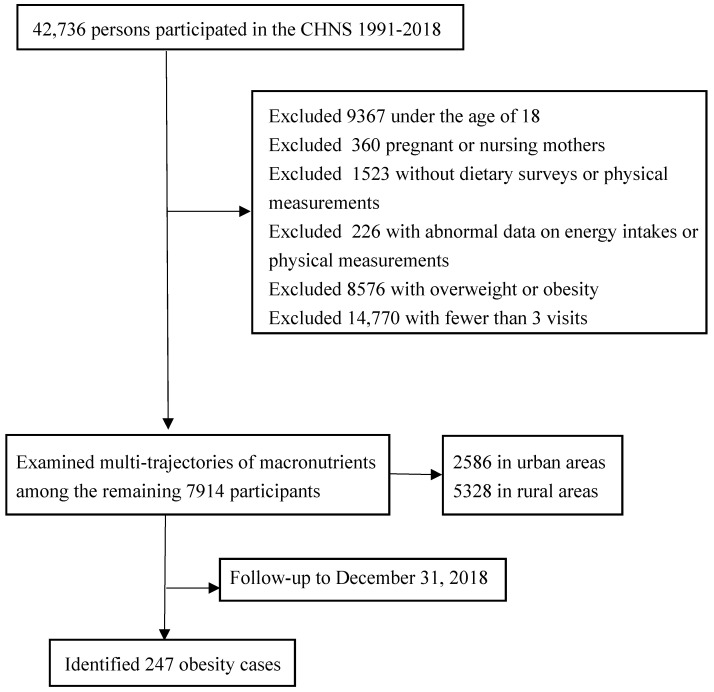
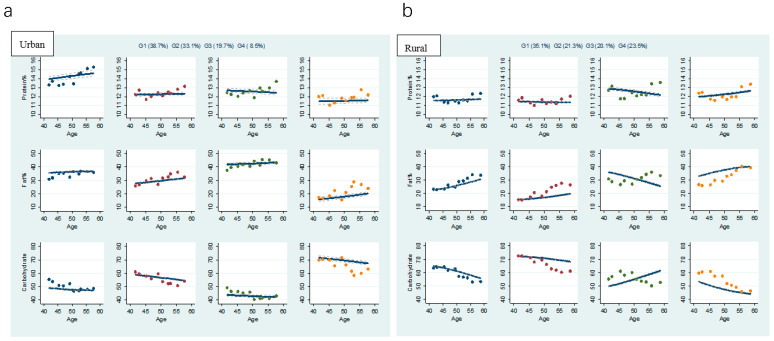
Studies on macronutrient intake and obesity have been inconclusive. This study examined the associations between multi-trajectories of macronutrients and the risk of obesity in China. We used data from 7914 adults who participated in the China Health and Nutrition Survey at least three times from 1991 to 2018. We collected detailed dietary data by conducting three 24 h dietary recalls and weighing foods and condiments in household inventories. We identified multi-trajectories using group-based multi-trajectory models and examined their associations with the risk of obesity with multiple Cox regression models. We found four multi-trajectories in rural areas: balanced macronutrient intake (BM), moderate protein, increasing low fat, and decreasing high carbohydrate (MP&ILF&DHC); decreasing moderate protein, decreasing high fat, and increasing moderate carbohydrate (DMP&DHF&IMC); increasing moderate protein, increasing high fat, and decreasing low carbohydrate (IMP&IHF&DLC)-35.1%, 21.3%, 20.1%, and 23.5% of our rural participant population, respectively. Compared with the BM trajectory, the hazard ratios of obesity in the DMP&DHF&IMC and the IMP&IHF&DLC groups were 0.50 (95% confidence interval (CI): 0.27-0.95) and 0.48 (95% CI: 0.28-0.83), respectively, in rural participants. Relatively low carbohydrate and high fat intakes with complementary dynamic trends are associated with a lower risk of obesity in rural Chinese adults.
关于宏量营养素摄入与肥胖的研究尚无定论。本研究旨在探讨中国人群中多种宏量营养素轨迹与肥胖风险之间的关系。我们使用了来自中国健康与营养调查(CHNS)的数据,该调查于 1991 年至 2018 年期间至少进行了三次,共纳入 7914 名成年人。我们通过三次 24 小时膳食回忆和称重家庭食品库存中的食物和调味品收集了详细的膳食数据。我们使用基于群组的多轨迹模型识别多种轨迹,并使用多因素 Cox 回归模型来检验它们与肥胖风险的关系。我们在农村地区发现了四种多轨迹:均衡的宏量营养素摄入(BM)、适度蛋白质增加、低脂肪增加和高碳水化合物减少(MP&ILF&DHC);适度蛋白质减少、高脂肪减少和中等碳水化合物增加(DMP&DHF&IMC);中等蛋白质增加、高脂肪增加和低碳水化合物减少(IMP&IHF&DLC)。分别占农村参与者人群的 35.1%、21.3%、20.1%和 23.5%。与 BM 轨迹相比,DMP&DHF&IMC 和 IMP&IHF&DLC 组的肥胖风险比分别为 0.50(95%置信区间:0.27-0.95)和 0.48(95%置信区间:0.28-0.83)。相对低的碳水化合物和高脂肪摄入以及互补的动态趋势与中国农村成年人较低的肥胖风险相关。