Guizard Anne-Valerie N, Dejardin Olivier J, Launay Ludivine C, Bara Simona, Lapôtre-Ledoux Bénédicte M, Babin Emmanuel B, Launoy Guy D, Ligier Karine A
Registre général des tumeurs du Calvados, Centre F Baclesse, U1086 Inserm - Université Caen Basse Normandie "Cancers et preventions," av Général-Harris, Caen Pôle de Recherche, Centre Hospitalo-universitaire de Caen, U1086 Inserm - Université Caen Basse Normandie, "Cancers et préventions", Centre F Baclesse, av Général-Harris, Caen U1086 Inserm - Université Caen Basse Normandie Registre des cancers de la Manche, Centre Hospitalier Public du Cotentin, Cherbourg-Octeville Registre du cancer de la Somme, Hôpital Nord, CHU Amiens, Place Victor Pauchet, Amiens Service ORL et chirurgie cervico-faciale, Centre Hospitalo-universitaire de Caen, U1086 Inserm - Université Caen Basse Normandie, "Cancers et préventions", Centre F Baclesse, av Général-Harris, Caen Registre général des cancers de Lille et sa région, GCS Centre de Référence Régional en Cancérologie, CHRU de LILLE - Hôpital Calmette, Boulevard du Professeur Jules Leclercq, Lille, France.
Medicine (Baltimore). 2017 Jun;96(26):e7285. doi: 10.1097/MD.0000000000007285.
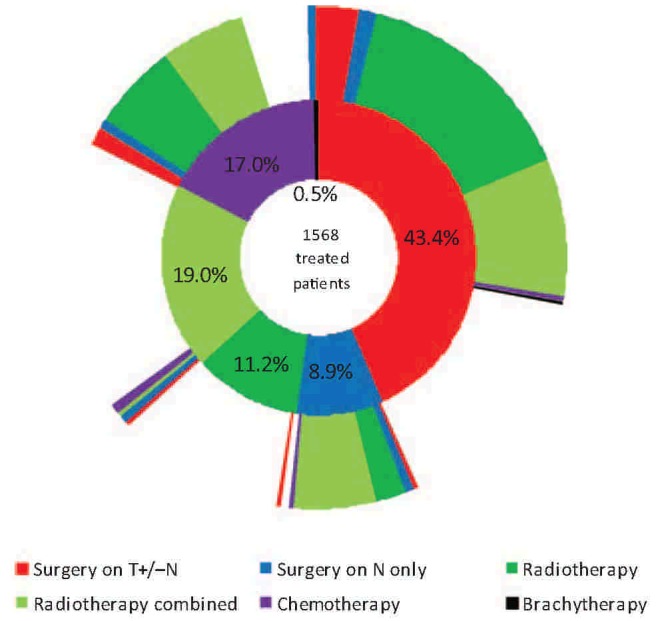
Head and neck cancers have a very poor prognosis and are common in France. They are subject to various recommendations for early detection and management, but there is no detailed data in the French general population to fuel the public health debate on it.A high-resolution population-based study about cancer management was conducted, using cancers registries in the north-west of France, on 1729 tumors diagnosed between 2008 and 2010.The tumors were diagnosed late (70.3% stage III-IV), mainly after the onset of symptoms (93.2%). After adjustment, advanced stages were more frequent in patients with hypopharyngeal [adjusted odds ratio (ORa): 4.68; 95% confidence interval [CI] 3.11-7.05] and oropharyngeal tumors (ORa: 2.84; 95% CI 2.02-3.99) compared with oral cavity ones. They were also more frequent in patients with moderate (ORa 1.68; 95% CI 1.12-2.52) or severe comorbidities (ORa 1.86; 95% CI: 1.23-2.80). A multidisciplinary meeting (MM) had taken place in 96.9% of cases. The assessment included a panendoscopy in 80.3% of cases, a cervical computerized tomography (CT) scan in 89.3% and a chest CT scan in 87.3%. The vast majority of patients (90.7%) had received treatment, with surgery in 48.7% of cases and/or radiotherapy in 76.9%.Despite the recommendations for early detection, diagnoses are often made late, even for tumors that can be detected by a direct visual and tactile examination of the oral cavity. However, the major risk of advanced stage concerns deep tumors and the most weakened subjects. Otherwise, diagnostic assessment is broadly consistent with the recommendations, and multidisciplinary treatment decisions are widespread.
头颈部癌症预后很差,在法国很常见。针对头颈部癌症有各种早期检测和管理的建议,但法国普通人群中没有详细数据来推动关于这方面的公共卫生辩论。利用法国西北部的癌症登记处,开展了一项基于人群的高分辨率癌症管理研究,涉及2008年至2010年期间诊断出的1729例肿瘤。这些肿瘤诊断较晚(70.3%为III-IV期),主要在出现症状后(93.2%)。调整后,下咽癌患者(调整后的优势比[ORa]:4.68;95%置信区间[CI] 3.11-7.05)和口咽肿瘤患者(ORa:2.84;95% CI 2.02-3.99)的晚期阶段比口腔癌患者更常见。在患有中度(ORa 1.68;95% CI 1.12-2.52)或重度合并症的患者中也更常见(ORa 1.86;95% CI:1.23-2.80)。96.9%的病例进行了多学科会诊(MM)。评估包括80.3%的病例进行了全内镜检查,89.3%的病例进行了颈部计算机断层扫描(CT),87.3%的病例进行了胸部CT扫描。绝大多数患者(90.7%)接受了治疗,48.7%的病例进行了手术和/或76.9%的病例进行了放疗。尽管有早期检测的建议,但即使是通过口腔直接视觉和触觉检查可以检测到的肿瘤,诊断也往往较晚。然而,晚期的主要风险涉及深部肿瘤和身体最虚弱的患者。否则,诊断评估与建议基本一致,多学科治疗决策很普遍。