Genetic Epidemiology Research Branch,National Institute of Mental Health,Bethesda, MD,USA.
NCRR-National Center for Register-Based Research,Business and Social Sciences,Aarhus University,Aarhus,Denmark.
Psychol Med. 2018 Jan;48(2):305-314. doi: 10.1017/S0033291717001696. Epub 2017 Jun 29.
Studies have indicated that the association of urbanicity at birth and during upbringing with schizophrenia may be driven by familial factors such as genetic liability. We used a population-based nested case-control study to assess whether polygenic risk score (PRS) for schizophrenia was associated with urbanicity at birth and at age 15, and to assess whether PRS and parental history of mental disorder together explained the association between urbanicity and schizophrenia.
Data were drawn from Danish population registries. Cases born since 1981 and diagnosed with schizophrenia between 1994 and 2009 were matched to controls with the same sex and birthdate (1549 pairs). Genome-wide data were obtained from the Danish Neonatal Screening Biobank and PRSs were calculated based on results of a separate, large meta-analysis.
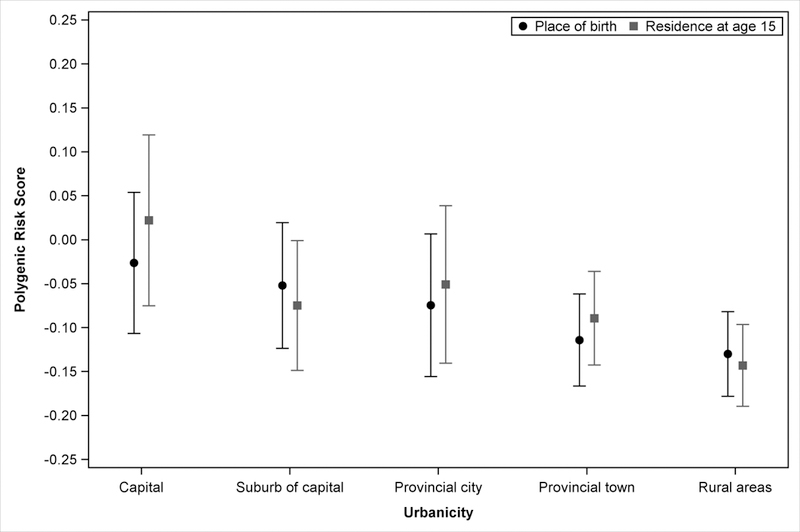
Those with higher PRS were more likely reside in the capital compared with rural areas at age 15 [odds ratio (OR) 1.19, 95% confidence interval (CI) 1.01-1.40], but not at birth (OR 1.09, 95% CI 0.95-1.26). Adjustment for PRS produced almost no change in relative risks of schizophrenia associated with urbanicity at birth, but slightly attenuated those for urban residence at age 15. Additional adjustment for parental history led to slight attenuation of relative risks for urbanicity at birth [incidence rate ratio (IRR) for birth in capital = 1.54, 95% CI 1.18-2.02; overall p = 0.016] and further attenuation of relative risks for urbanicity at age 15 (IRR for residence in capital = 1.32, 95% CI 0.97-1.78; overall p = 0.148).
While results regarding urbanicity during upbringing were somewhat equivocal, genetic liability as measured here does not appear to explain the association between urbanicity at birth and schizophrenia.
研究表明,出生和成长过程中的城市化与精神分裂症的关联可能是由遗传易感性等家族因素驱动的。我们使用基于人群的巢式病例对照研究来评估精神分裂症多基因风险评分(PRS)是否与出生时和 15 岁时的城市化程度相关,并评估 PRS 和父母精神障碍史是否共同解释了城市化与精神分裂症之间的关联。
数据来自丹麦人口登记处。1981 年以后出生并在 1994 年至 2009 年期间被诊断为精神分裂症的病例与具有相同性别和出生日期的对照(1549 对)相匹配。全基因组数据来自丹麦新生儿筛查生物库,PRS 是根据单独的大型荟萃分析的结果计算得出的。
与农村地区相比,PRS 较高的人在 15 岁时更有可能居住在首都地区(优势比[OR]1.19,95%置信区间[CI]1.01-1.40),但在出生时并非如此(OR 1.09,95%CI 0.95-1.26)。调整 PRS 后,与出生时城市化相关的精神分裂症相对风险几乎没有变化,但略微减弱了 15 岁时的城市化相对风险。对父母病史进行额外调整略微减弱了出生时城市化的相对风险[首都出生的发病率比(IRR)=1.54,95%CI 1.18-2.02;总体 p=0.016],并进一步减弱了 15 岁时城市化的相对风险(首都居住的 IRR=1.32,95%CI 0.97-1.78;总体 p=0.148)。
虽然关于成长过程中城市化的结果有些模棱两可,但这里测量的遗传易感性似乎并不能解释出生时的城市化程度与精神分裂症之间的关联。