Faculty of Social Sciences, Tampere University, Tampere, Finland, Arvo Ylpön katu 34 (Arvo 1), 33014.
National Institute for Health and Welfare, Helsinki, Finland.
Soc Psychiatry Psychiatr Epidemiol. 2024 Jan;59(1):37-49. doi: 10.1007/s00127-023-02516-x. Epub 2023 Jun 13.
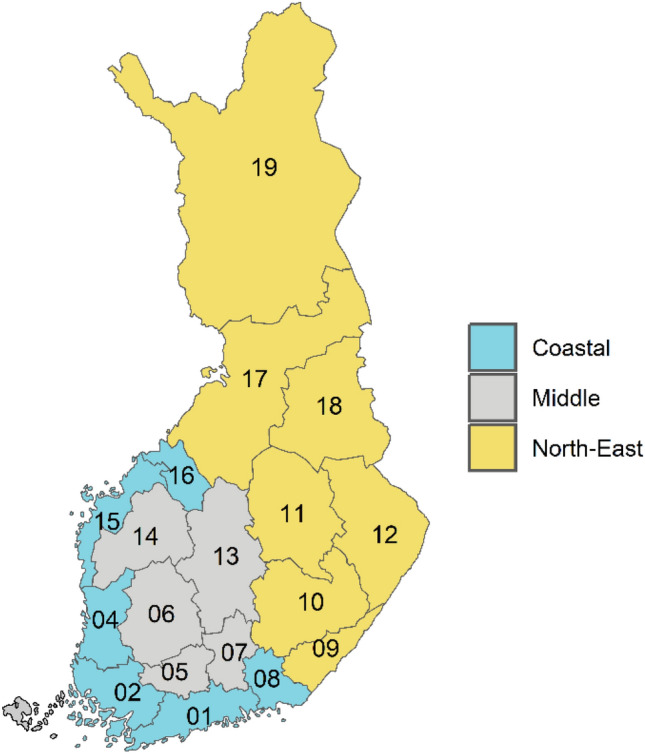
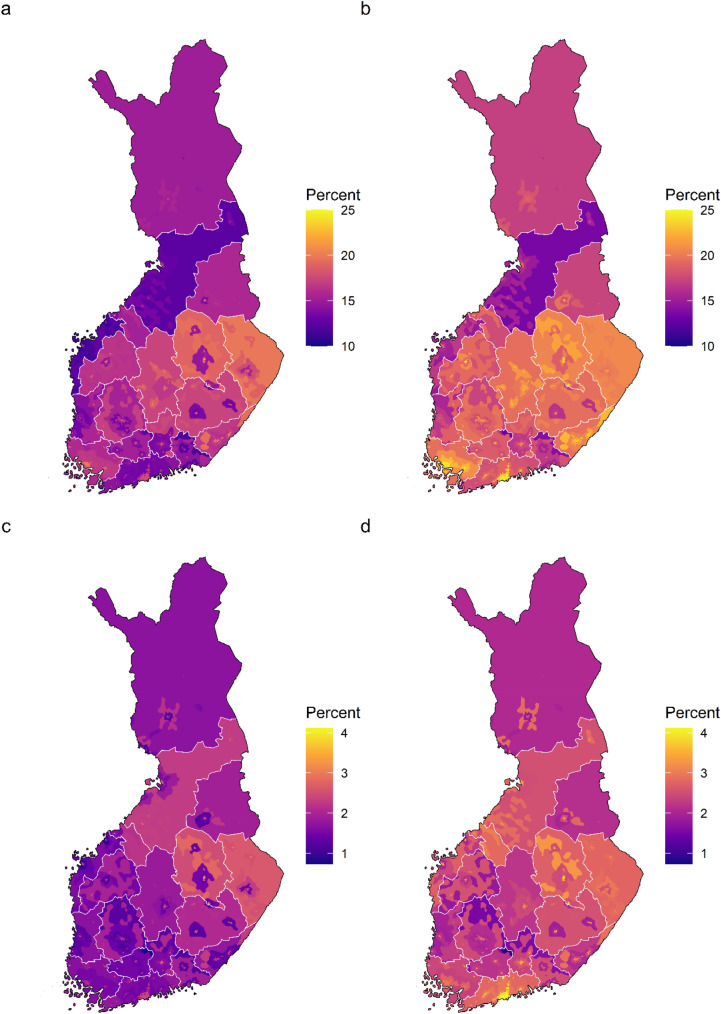
In Finland, prevalence of schizophrenia is higher in the eastern and northern regions and co-occurs with the distribution of schizophrenia polygenic risk scores. Both genetic and environmental factors have been hypothesized to contribute to this variation. We aimed to examine the prevalence of psychotic and other mental disorders by region and degree of urbanicity, and the impacts of socio-economic adjustments on these associations.
Nationwide population registers from 2011 to 2017 and healthcare registers from 1975 to 2017. We used 19 administrative and three aggregate regions based on the distribution of schizophrenia polygenic risk scores, and a seven-level urban-rural classification. Prevalence ratios (PRs) were calculated by Poisson regression models and adjusted for gender, age, and calendar year (basic adjustments), and Finnish origin, residential history, urbanicity, household income, economic activity, and physical comorbidity (additional adjustments) on an individual level. Average marginal effects were used to visualize interaction effects between region and urbanicity.
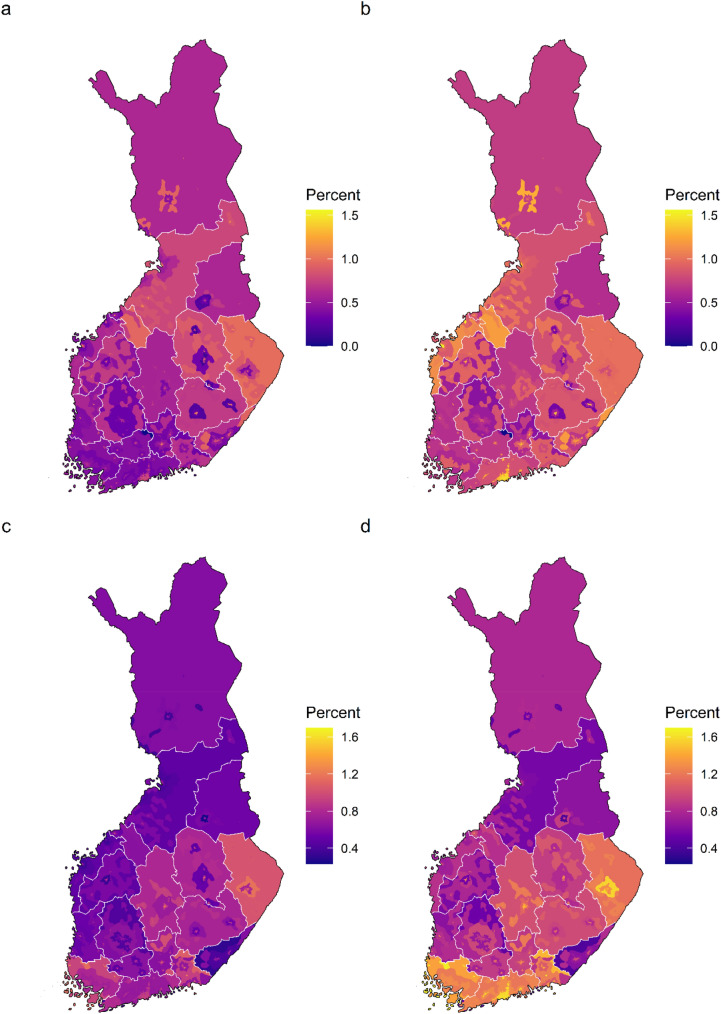
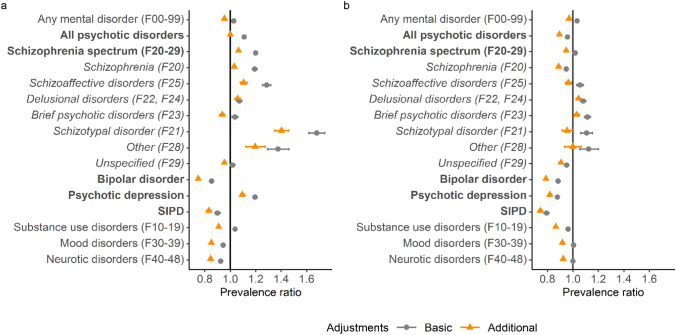
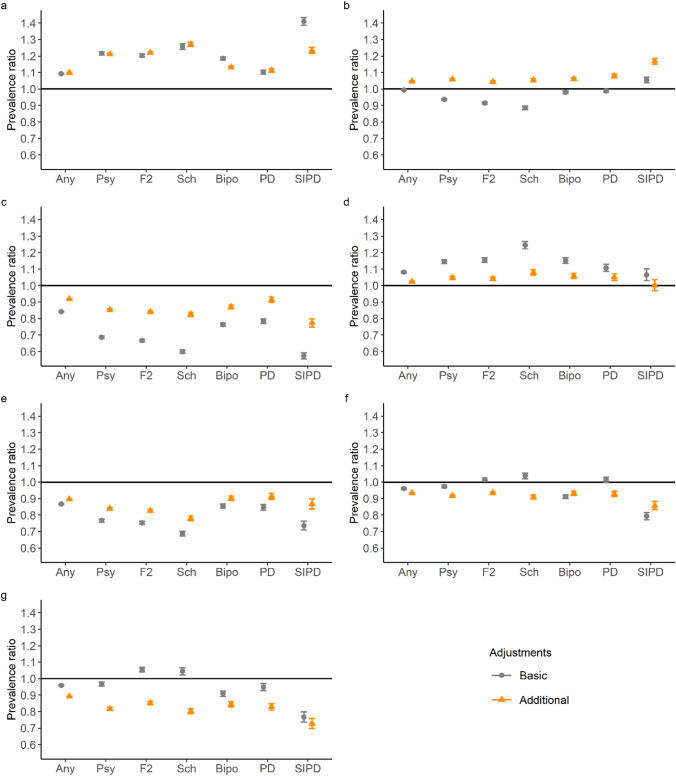
A total of 5,898,180 individuals were observed. All mental disorders were slightly more prevalent (PR 1.03 [95% CI, 1.02-1.03]), and psychotic disorders (1.11 [1.10-1.12]) and schizophrenia (1.19 [1.17-1.21]) considerably more prevalent in eastern and northern than in western coastal regions. After the additional adjustments, however, the PRs were 0.95 (0.95-0.96), 1.00 (0.99-1.01), and 1.03 (1.02-1.04), respectively. Urban residence was associated with increased prevalence of psychotic disorders across all regions (adjusted PR 1.21 [1.20-1.22]).
After adjusting for socioeconomic and sociodemographic factors, the within-country distribution of mental disorders no longer followed the traditional east-west gradient. Urban-rural differences, on the other hand, persisted after the adjustments.
在芬兰,东部和北部地区的精神分裂症患病率较高,且与精神分裂症多基因风险评分的分布相吻合。遗传和环境因素都被假设为导致这种差异的原因。我们旨在通过地区和城市化程度检查精神病和其他精神障碍的患病率,并研究社会经济调整对这些关联的影响。
利用 2011 年至 2017 年的全国人口登记和 1975 年至 2017 年的医疗保健登记数据。我们根据精神分裂症多基因风险评分的分布使用 19 个行政区域和三个聚合区域,以及七级城乡分类。使用泊松回归模型计算患病率比(PR),并根据性别、年龄和日历年份(基本调整),以及芬兰血统、居住史、城市化程度、家庭收入、经济活动和身体合并症(个体水平的附加调整)进行调整。平均边际效应用于可视化地区和城市化程度之间的交互效应。
共观察到 5898180 人。所有精神障碍的患病率都略有增加(PR1.03[95%CI1.02-1.03]),东部和北部地区的精神病(1.11[1.10-1.12])和精神分裂症(1.19[1.17-1.21])的患病率明显更高。然而,在进行附加调整后,PR 分别为 0.95(0.95-0.96)、1.00(0.99-1.01)和 1.03(1.02-1.04)。城市居住与所有地区精神病患病率的增加有关(调整后的 PR1.21[1.20-1.22])。
在调整了社会经济和社会人口因素后,精神障碍的国内分布不再遵循传统的东西梯度。然而,调整后城乡差异仍然存在。