School of Medicine, University of St Andrews, St Andrews, Fife, Scotland, UK.
Int J Public Health. 2018 Jan;63(1):69-80. doi: 10.1007/s00038-017-0997-y. Epub 2017 Jul 1.
This paper explores trends in Scottish adolescents' body size perceptions and associated mental well-being outcomes.
Data were collected on Scottish 11-, 13-, and 15-year-olds by the Health Behaviour in School-aged Children study between 1990 and 2014 (n = 42,312). Logistic regression was used to examine changes in the prevalence of over- and underweight perceptions. Ordinal and linear regressions were used to examine changes in the association between body perception and mental well-being.
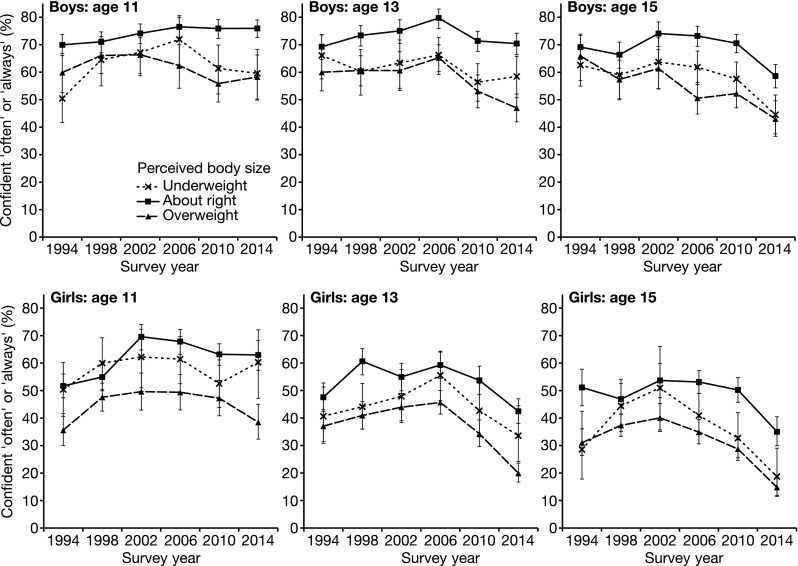
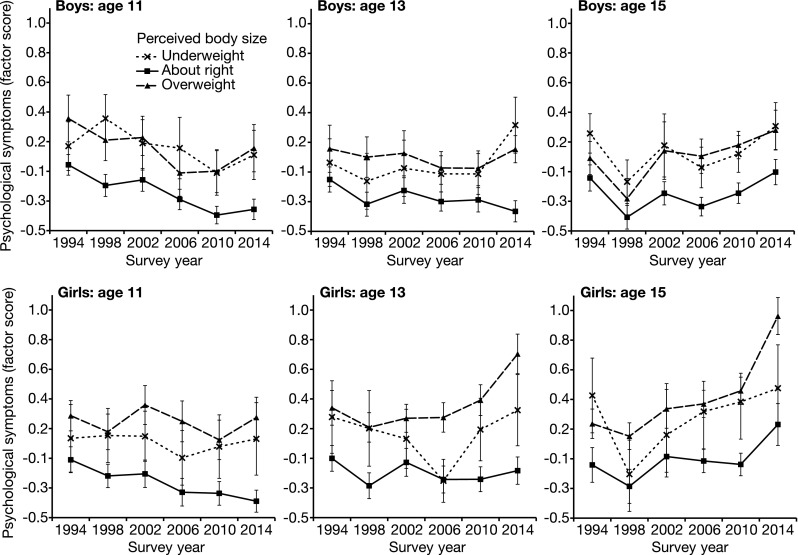
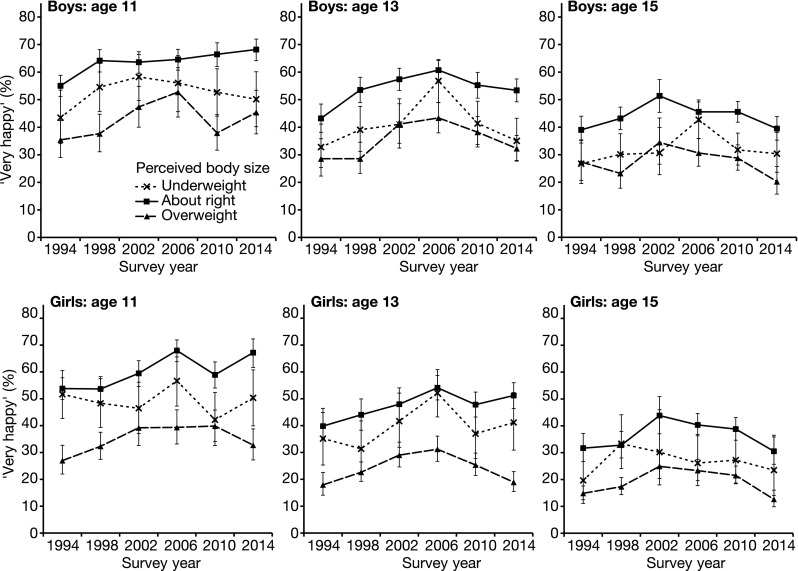
Little change was observed in over- or underweight perceptions. However, relative to those perceiving their body as 'about right', those perceiving themselves as overweight reported decreasing confidence (all groups), decreasing happiness (11- and 13-year-old girls), and increasing psychological health symptoms (all girls and 15-year-old boys). Perceived underweight is associated with poor well-being, especially in males, but we present little evidence that this is a recent phenomenon.
We present evidence suggesting that the association between body size perception and poor mental health in adolescence is changing over time. This may play a role in the recently observed worsening of mental well-being in Scottish adolescents.
本文探讨了苏格兰青少年对体型的认知趋势及其与心理健康的关联。
健康行为在学龄儿童研究(Health Behaviour in School-aged Children study)在 1990 年至 2014 年期间收集了苏格兰 11、13 和 15 岁青少年的数据(n=42312)。使用逻辑回归检验超重和体重不足认知的流行率变化。使用有序和线性回归检验身体认知与心理健康之间关联的变化。
超重或体重不足认知几乎没有变化。然而,与那些认为自己身体“恰到好处”的人相比,那些认为自己超重的人报告自信心下降(所有群体)、幸福感下降(11 岁和 13 岁女孩)和心理健康症状增加(所有女孩和 15 岁男孩)。体重不足与较差的健康有关,尤其是男性,但我们几乎没有证据表明这是最近才出现的现象。
我们提供的证据表明,青少年时期体型认知与心理健康不良之间的关联随着时间的推移而发生变化。这可能是苏格兰青少年心理健康状况最近恶化的原因之一。