Fan Ming-Jen, Yeh Ping-Hsuan, Lin Jing-Pin, Huang An-Cheng, Lien Jin-Cherng, Lin Hui-Yi, Chung Jing-Gung
Department of Biotechnology, Asia University, Taichung 41354, Taiwan, R.O.C.
Department of Medical Research, China Medical University Hospital, Taichung 40402, Taiwan, R.O.C.
Exp Ther Med. 2017 Jul;14(1):59-64. doi: 10.3892/etm.2017.4467. Epub 2017 May 17.
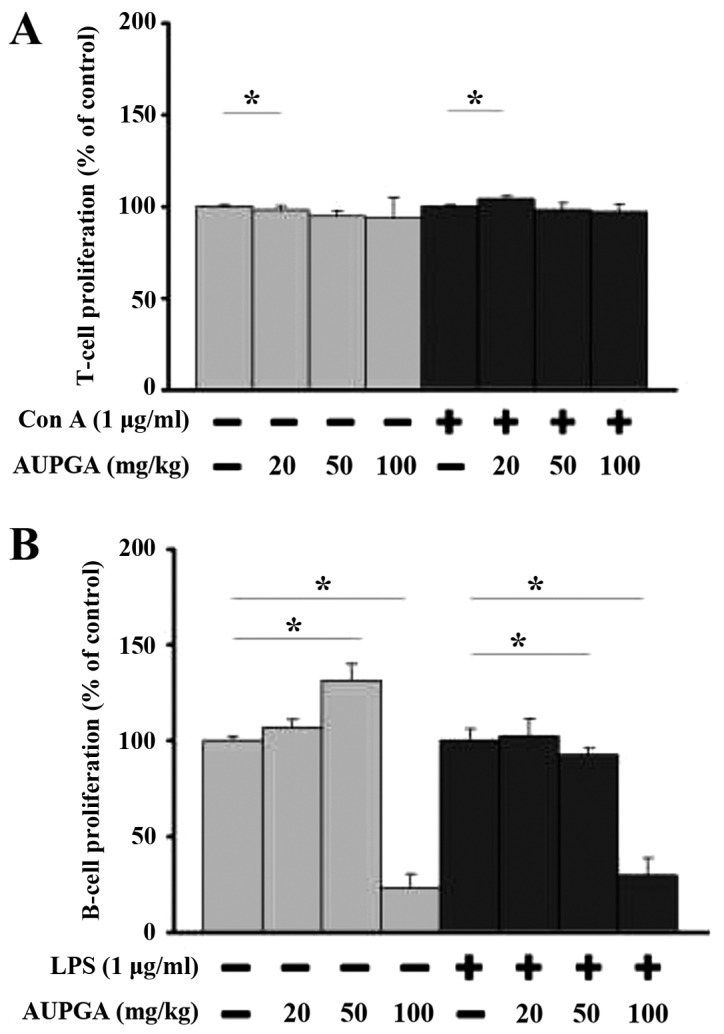
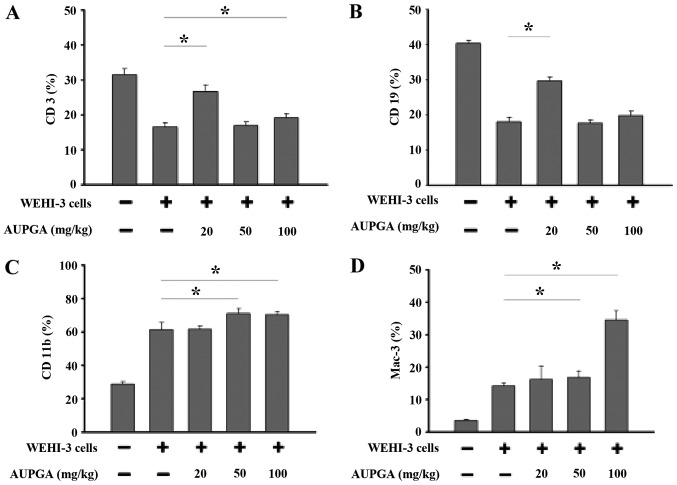
Rice is a staple food in numerous countries around the world. Anthocyanins found in black rice have been reported to reduce the risk of certain diseases, but the effects of crude extract of anthocyanins from Asia University-selected purple glutinous indica rice (AUPGA) on immune responses have not yet been demonstrated. The current study aimed to investigate whether AUPGA treatment could affect immune responses in murine leukemia cells . Murine acute myelomonocytic leukemia WEHI-3 cells were intraperitoneally injected into normal BALB/c mice to generate leukemia mice. A total of 50 mice were randomly divided into five groups (n=10 in each group) and were fed a diet supplemented with AUPGA at 0, 20, 50 or 100 mg/kg for three weeks. All mice were weighed and the blood, liver and spleen were collected for further experiments. The results indicated that AUPGA did not significantly affect animal body weight, but significantly increased spleen weight (P<0.05) and decreased liver weight (P<0.05) when compared with the control group. AUPGA significantly increased the T cell (CD3) population at treatments of 20 and 100 mg/kg (P<0.05). However, it only significantly increased the B cell (CD19) population at a treatment of 20 mg/kg (P<0.05). Furthermore, AUPGA at 50 and 100 mg/kg significantly increased the monocyte (CD11b) population and the level of macrophages (Mac-3; P<0.05 for both). AUPGA at 50 and 100 mg/kg significantly promoted macrophage phagocytosis in peripheral blood mononuclear cells (P<0.05), and all doses of AUPGA treatment significantly promoted macrophage phagocytotic activity in the peritoneum (P<0.05). AUPGA treatment significantly decreased natural killer cell activity from splenocytes (P<0.05). Finally, AUPGA treatment at 20 mg/kg treatment significantly promoted T cell proliferation (P<0.05), and treatment at 50 and 100 mg/kg significantly decreased B cell proliferation compared with the control group (P<0.05).
大米是世界上许多国家的主食。据报道,黑米中含有的花青素可降低某些疾病的风险,但亚洲大学所选紫糯籼稻(AUPGA)花青素粗提物对免疫反应的影响尚未得到证实。本研究旨在调查AUPGA处理是否会影响小鼠白血病细胞的免疫反应。将小鼠急性粒单核细胞白血病WEHI-3细胞腹腔注射到正常BALB/c小鼠体内以建立白血病小鼠模型。总共50只小鼠被随机分为五组(每组n = 10),并分别喂食添加了0、20、50或100 mg/kg AUPGA的饲料,持续三周。对所有小鼠进行称重,并采集血液、肝脏和脾脏用于进一步实验。结果表明,与对照组相比,AUPGA对动物体重没有显著影响,但显著增加了脾脏重量(P<0.05)并降低了肝脏重量(P<0.05)。在20和100 mg/kg处理时,AUPGA显著增加了T细胞(CD3)群体(P<0.05)。然而,仅在20 mg/kg处理时,AUPGA显著增加了B细胞(CD19)群体(P<0.05)。此外,50和100 mg/kg的AUPGA显著增加了单核细胞(CD11b)群体和巨噬细胞水平(Mac-3;两者均P<0.05)。50和100 mg/kg的AUPGA显著促进了外周血单核细胞中的巨噬细胞吞噬作用(P<0.05),并且所有剂量的AUPGA处理均显著促进了腹膜中的巨噬细胞吞噬活性(P<0.05)。AUPGA处理显著降低了脾细胞中的自然杀伤细胞活性(P<0.05)。最后,与对照组相比,20 mg/kg处理的AUPGA显著促进了T细胞增殖(P<0.05),而50和100 mg/kg处理显著降低了B细胞增殖(P<0.05)。