Gebreyohannes Eyob Alemayehu, Bhagavathula Akshaya Srikanth, Seid Mohammed Assen, Tegegn Henok Getachew
Department of Clinical Pharmacy, School of Pharmacy, University of Gondar-College of Medicine and Health Sciences, Gondar, Ethiopia.
Malar J. 2017 Jul 3;16(1):269. doi: 10.1186/s12936-017-1922-9.
Ethiopia is among countries with a high malaria burden. There are several studies that assessed the efficacy of anti-malarial agents in the country and this systematic review and meta-analysis was performed to obtain stronger evidence on treatment outcomes of malaria from the existing literature in Ethiopia.
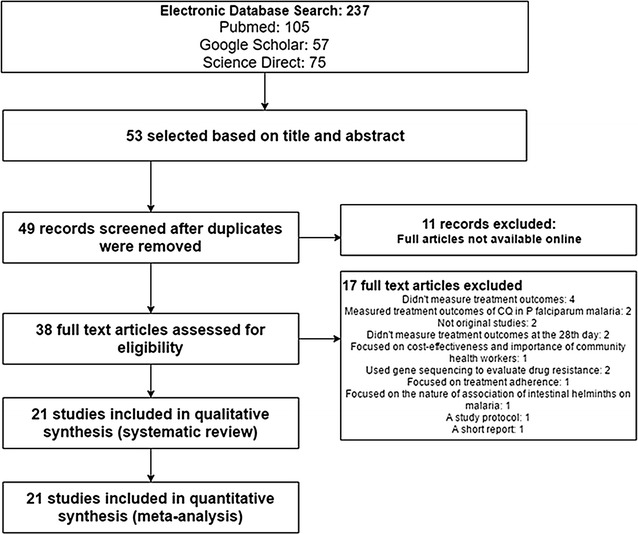
A systematic literature search using the preferred reporting items for systematic review and meta-analysis (PRISMA) statement was conducted on studies from Pubmed, Google Scholar, and ScienceDirect databases to identify published and unpublished literature. Comprehensive meta-analysis software was used to perform all meta-analyses. The Cochrane Q and the I were used to evaluate heterogeneity of studies. Random effects model was used to combine studies showing heterogeneity of Cochrane Q p < 0.10 and I > 50.
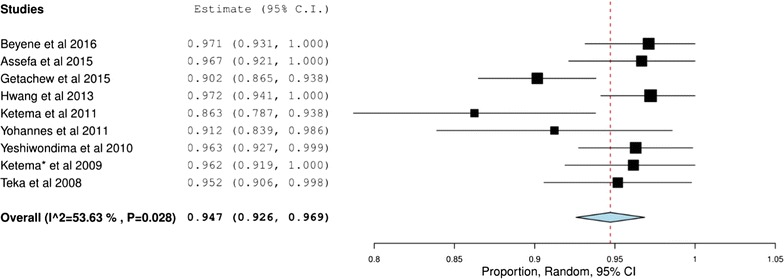
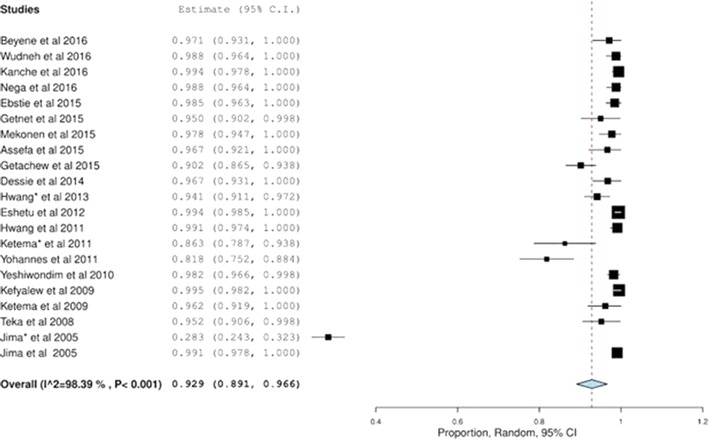
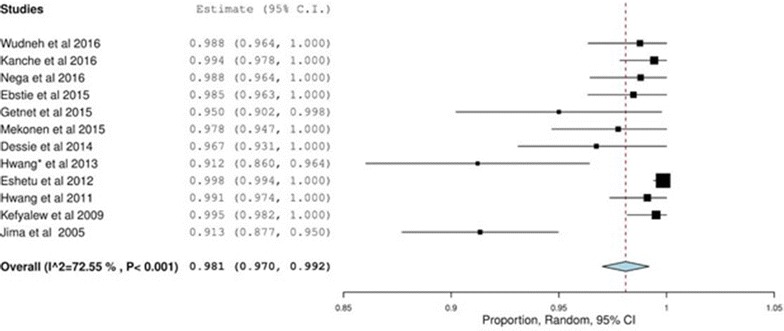
Twenty-one studies were included in the final analysis with a total number of 3123 study participants. Treatment outcomes were assessed clinically and parasitologically using World Health Organization guidelines. Adequate clinical and parasitological response was used to assess treatment success at the 28th day. Overall, a significant high treatment success of 92.9% (95% CI 89.1-96.6), p < 0.001, I = 98.39% was noticed. However, treatment success was higher in falciparum malaria patients treated with artemether-lumefantrine than chloroquine for Plasmodium vivax patients [98.1% (97.0-99.2), p < 0.001, I = 72.55 vs 94.7% (92.6-96.2), p < 0.001, I = 53.62%]. Seven studies reported the adverse drug reactions to anti-malarial treatment; of 822 participants, 344 of them were exposed to adverse drug reactions with a pooled event rate of 39.8% (14.1-65.5), p = 0.002.
On the basis of this review, anti-malarial treatment success was high (92.9%) and standard regimens showed good efficacy against Plasmodium falciparum (98.1%) and P. vivax (94.7%) infections in Ethiopia, but associated with high rates of adverse drug reactions (ADRs). However, these ADRs were not serious enough to discontinue anti-malarial treatment. The results of this study suggest that the current anti-malarial medications are effective and safe; however, greater priority should be placed on the discovery of new anti-malarial drugs to achieve successful outcomes as resistance seems inevitable since cases of anti-malarial drug resistance have been reported from other areas of the world.
埃塞俄比亚是疟疾负担较重的国家之一。该国已有多项研究评估了抗疟药物的疗效,本系统评价和荟萃分析旨在从埃塞俄比亚现有文献中获取有关疟疾治疗结果的更有力证据。
按照系统评价和荟萃分析的首选报告项目(PRISMA)声明,对来自PubMed、谷歌学术和科学Direct数据库的研究进行系统文献检索,以识别已发表和未发表的文献。使用综合荟萃分析软件进行所有荟萃分析。采用Cochrane Q和I²评估研究的异质性。对于Cochrane Q p < 0.10且I² > 50显示异质性的研究,使用随机效应模型进行合并。
最终分析纳入了21项研究,共有3123名研究参与者。根据世界卫生组织指南,从临床和寄生虫学方面评估治疗结果。在第28天,使用充分的临床和寄生虫学反应来评估治疗成功率。总体而言,观察到显著高的治疗成功率为92.9%(95%CI 89.1 - 96.6),p < 0.001,I² = 98.39%。然而,与间日疟原虫患者使用氯喹相比,蒿甲醚 - 本芴醇治疗恶性疟原虫患者的治疗成功率更高[98.1%(97.0 - 99.2),p < 0.001,I² = 72.55% 对比 94.7%(92.6 - 96.2),p < 0.001,I² = 53.62%]。七项研究报告了抗疟治疗的药物不良反应;在822名参与者中,344人出现药物不良反应,合并事件发生率为39.8%(14.1 - 65.5),p = 0.002。
基于本综述,埃塞俄比亚抗疟治疗成功率较高(92.9%),标准方案对恶性疟原虫(98.1%)和间日疟原虫(94.7%)感染显示出良好疗效,但药物不良反应发生率较高。然而,这些不良反应并不严重到足以停止抗疟治疗。本研究结果表明,目前的抗疟药物有效且安全;然而,由于世界其他地区已报告抗疟药物耐药病例,耐药似乎不可避免,因此应更加重视发现新的抗疟药物以取得成功的治疗效果。