Lee Yun Sun, Park Hyun-Seung, Lee Dong-Kyu, Jayakodi Murukarthick, Kim Nam-Hoon, Koo Hyun Jo, Lee Sang-Choon, Kim Yeon Jeong, Kwon Sung Won, Yang Tae-Jin
Department of Plant Science, Plant Genomics and Breeding Institute, Research Institute of Agriculture and Life Sciences, College of Agriculture and Life Sciences, Seoul National UniversitySeoul, South Korea.
College of Pharmacy and Research Institute of Pharmaceutical Sciences, Seoul National UniversitySeoul, South Korea.
Front Plant Sci. 2017 Jun 19;8:1048. doi: 10.3389/fpls.2017.01048. eCollection 2017.
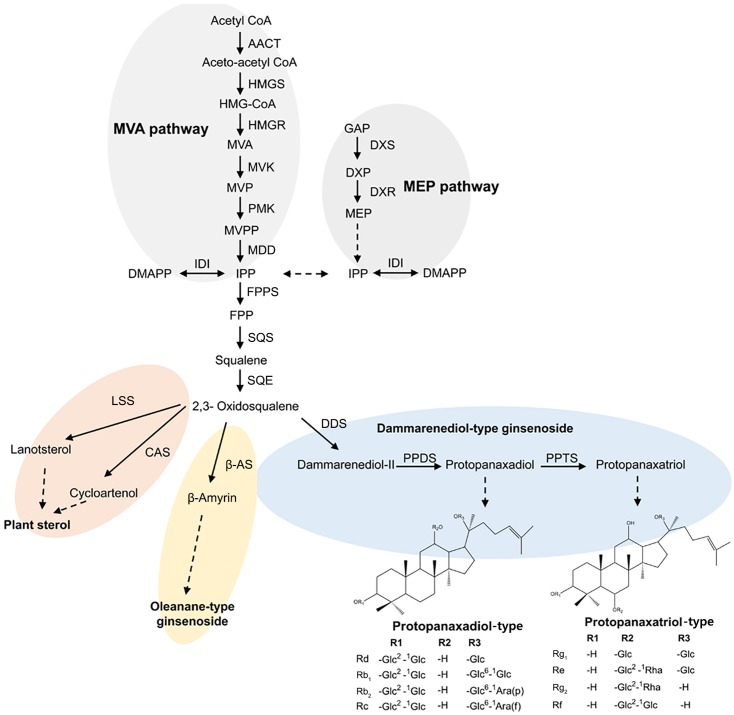
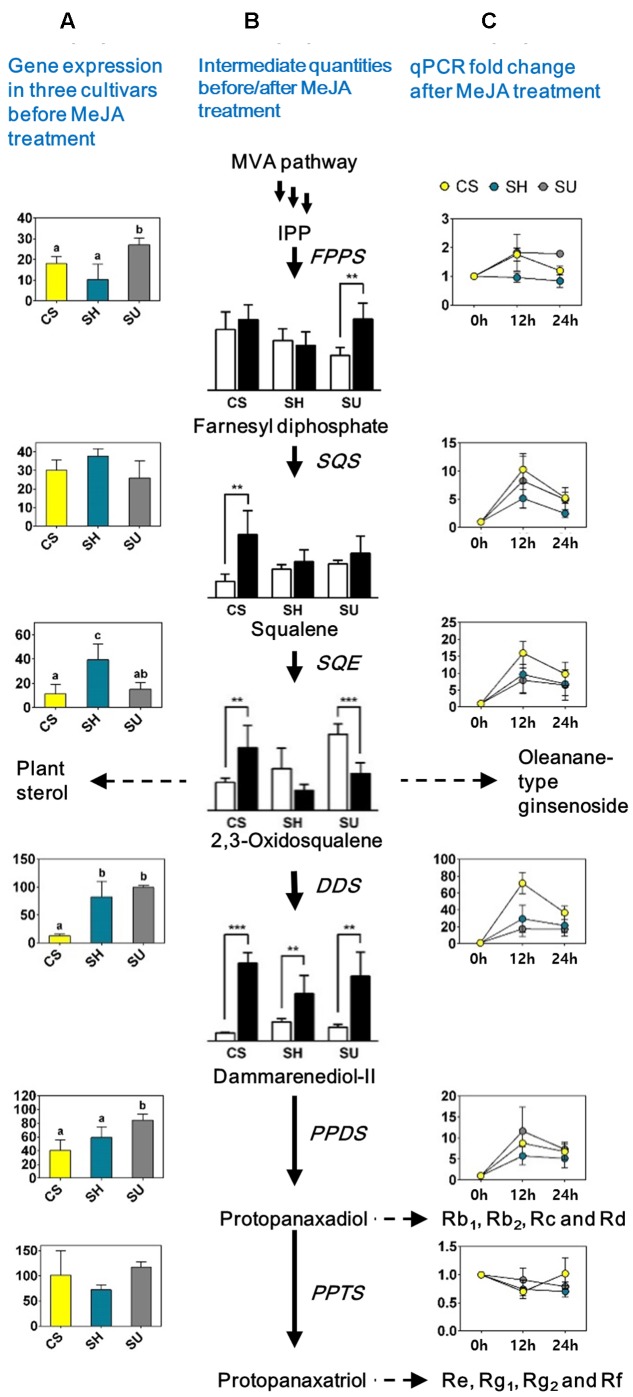
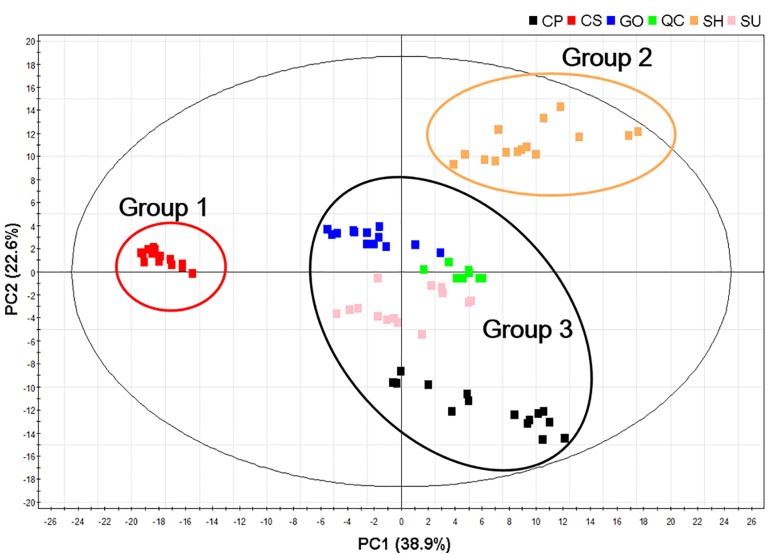
C.A. Meyer is a traditional medicinal herb that produces bioactive compounds such as ginsenosides. Here, we investigated the diversity of ginsenosides and related genes among five genetically fixed inbred ginseng cultivars (Chunpoong [CP], Cheongsun [CS], Gopoong [GO], Sunhyang [SH], and Sunun [SU]). To focus on the genetic diversity related to ginsenoside biosynthesis, we utilized cultured adventitious roots from the five cultivars grown under controlled environmental conditions. PCA loading plots based on secondary metabolite composition classified the five cultivars into three groups. We selected three cultivars (CS, SH, and SU) to represent the three groups and conducted further transcriptome and gas chromatography-mass spectrometry analyses to identify genes and intermediates corresponding to the variation in ginsenosides among cultivars. We quantified ginsenoside contents from the three cultivars. SH had more than 12 times the total ginsenoside content of CS, with especially large differences in the levels of panaxadiol-type ginsenosides. The expression levels of genes encoding squalene epoxidase (SQE) and dammarenediol synthase (DDS) were also significantly lower in CS than SH and SU, which is consistent with the low levels of ginsenoside produced in this cultivar. Methyl jasmonate (MeJA) treatment increased the levels of panaxadiol-type ginsenosides up to 4-, 13-, and 31-fold in SH, SU, and CS, respectively. MeJA treatment also greatly increased the quantity of major intermediates and the expression of the underlying genes in the ginsenoside biosynthesis pathway; these intermediates included squalene, 2,3-oxidosqualene, and dammarenediol II, especially in CS, which had the lowest ginsenoside content under normal culture conditions. We conclude that and are the most important genetic factors for ginsenoside biosynthesis with diversity among ginseng cultivars.
C.A. Meyer是一种能产生人参皂苷等生物活性化合物的传统药草。在此,我们研究了五个遗传固定的人参自交系品种(春棚[CP]、青山[CS]、果丰[GO]、新香[SH]和苏农[SU])中人参皂苷及相关基因的多样性。为聚焦与人参皂苷生物合成相关的遗传多样性,我们利用了在可控环境条件下生长的这五个品种的培养不定根。基于次生代谢物组成的主成分分析(PCA)载荷图将这五个品种分为三组。我们选择了三个品种(CS、SH和SU)来代表这三组,并进行了进一步的转录组和气相色谱 - 质谱分析,以鉴定与品种间人参皂苷变异相对应的基因和中间体。我们对这三个品种的人参皂苷含量进行了定量。SH的总人参皂苷含量是CS的12倍多,尤其是在人参二醇型人参皂苷水平上差异巨大。编码鲨烯环氧酶(SQE)和达玛烯二醇合酶(DDS)的基因表达水平在CS中也显著低于SH和SU,这与该品种中产生的人参皂苷水平较低一致。茉莉酸甲酯(MeJA)处理分别使SH、SU和CS中的人参二醇型人参皂苷水平提高了4倍、13倍和31倍。MeJA处理还极大地增加了人参皂苷生物合成途径中主要中间体的量以及相关基因的表达;这些中间体包括鲨烯、2,3 - 氧化鲨烯和达玛烯二醇II,尤其是在正常培养条件下人参皂苷含量最低的CS中。我们得出结论,[此处原文缺失相关内容]和[此处原文缺失相关内容]是人参皂苷生物合成中最重要的遗传因素,且在人参品种间存在多样性。