Kapoor Neera, Ciuffreda Kenneth Joseph
New York University's School of Medicine's Department of Rehabilitation Medicine, New York University's Langone Medical Center's RUSK Rehabilitation, 240 East 38th Street, Room 15-32, New York, NY 10016, United States.
State University of New York, State College of Optometry, 33 West 42nd Street, New York, NY 10036, United States.
J Optom. 2018 Apr-Jun;11(2):103-112. doi: 10.1016/j.optom.2017.01.001. Epub 2017 Jul 1.
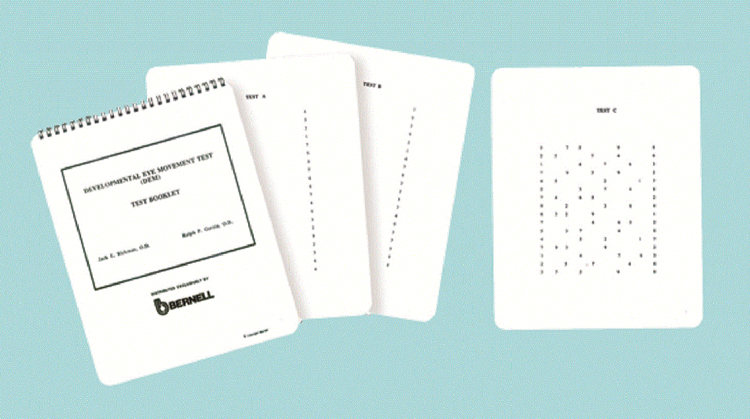
This pilot study sought to determine the efficacy of using the Developmental Eye Movement (DEM) test in the adult, acquired brain injury (ABI) population to quantify clinically the effects of controlled, laboratory-performed, oculomotor-based vision therapy/vision rehabilitation.
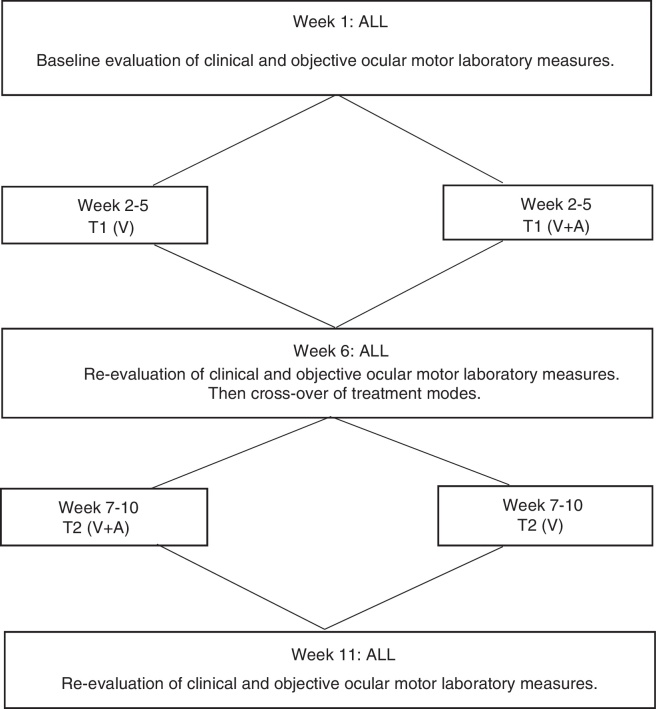
Nine adult subjects with mild traumatic brain injury (mTBI) and five with stroke were assessed before and after an eight-week, computer-based, versional oculomotor (fixation, saccades, pursuit, and simulated reading) training program (9.6h total). The protocol incorporated a cross-over, interventional design with and without the addition of auditory feedback regarding two-dimensional eye position. The clinical outcome measure was the Developmental Eye Movement (DEM) test score (ratio, errors) taken before, midway, and immediately following training.
For the DEM ratio parameter, improvements were found in 80-89% of the subjects. For the DEM error parameter, improvements were found in 100% of the subjects. Incorporation of the auditory feedback component revealed a trend toward enhanced performance. The findings were similar for both DEM parameters, as well as for incorporation of the auditory feedback, in both diagnostic groups.
The results of the present study demonstrated considerable improvements in the DEM test scores following the oculomotor-based training, thus reflecting more time-optimal and accurate saccadic tracking after the training. The DEM test should be considered as another clinical test of global saccadic tracking performance in the ABI population.
本初步研究旨在确定在成人获得性脑损伤(ABI)人群中使用发育性眼动(DEM)测试的效果,以便从临床角度量化基于实验室操作的、以眼动为基础的视觉治疗/视觉康复的效果。
对9名轻度创伤性脑损伤(mTBI)成人受试者和5名中风患者在进行为期8周的基于计算机的版本化眼动(注视、扫视、跟踪和模拟阅读)训练计划(总计9.6小时)前后进行评估。该方案采用交叉介入设计,有或没有添加关于二维眼位的听觉反馈。临床结局指标是在训练前、训练中期和训练结束后立即进行的发育性眼动(DEM)测试得分(比率、误差)。
对于DEM比率参数,80 - 89%的受试者有改善。对于DEM误差参数,100%的受试者有改善。纳入听觉反馈部分显示出表现增强的趋势。两个诊断组在两个DEM参数以及纳入听觉反馈方面的结果相似。
本研究结果表明,基于眼动的训练后,DEM测试得分有显著改善,从而反映出训练后扫视跟踪更具时间最优性和准确性。DEM测试应被视为ABI人群中整体扫视跟踪性能的另一种临床测试。