Zhang Yumin, Zhang Jin, Liu Qingju
School of Physics and Astronomy, Yunnan University, 650091 Kunming, China.
School of Materials Science and Engineering, Yunnan Key Laboratory for Micro/Nano Materials & Technology, Yunnan University, 650091 Kunming, China.
Sensors (Basel). 2017 Jul 4;17(7):1567. doi: 10.3390/s17071567.
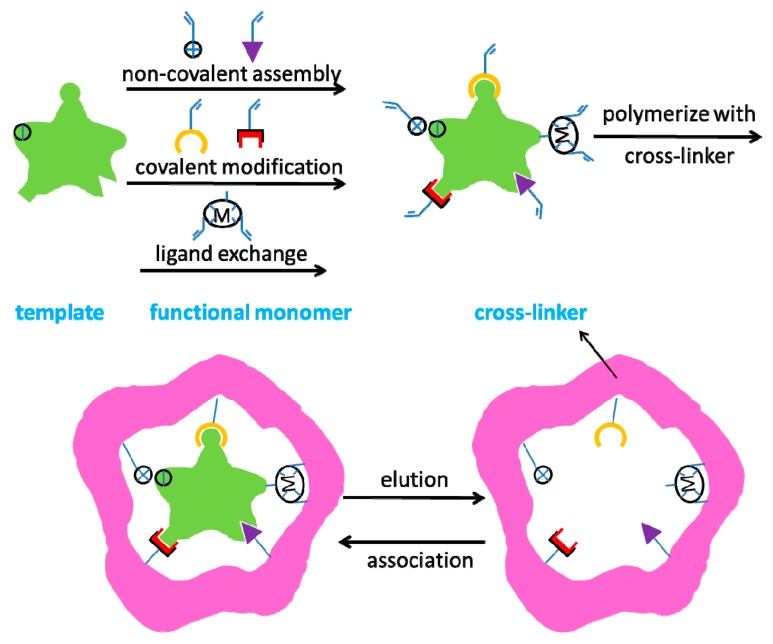
Molecular imprinting technology (MIT); often described as a method of designing a material to remember a target molecular structure (template); is a technique for the creation of molecularly imprinted polymers (MIPs) with custom-made binding sites complementary to the target molecules in shape; size and functional groups. MIT has been successfully applied to analyze; separate and detect macromolecular organic compounds. Furthermore; it has been increasingly applied in assays of biological macromolecules. Owing to its unique features of structure specificity; predictability; recognition and universal application; there has been exploration of the possible application of MIPs in the field of highly selective gas sensors. In this present study; we outline the recent advances in gas sensors based on MIT; classify and introduce the existing molecularly imprinted gas sensors; summarize their advantages and disadvantages; and analyze further research directions.
分子印迹技术(MIT);通常被描述为一种设计材料以记住目标分子结构(模板)的方法;是一种用于创建分子印迹聚合物(MIP)的技术,其定制的结合位点在形状、大小和官能团方面与目标分子互补。分子印迹技术已成功应用于分析、分离和检测大分子有机化合物。此外,它在生物大分子分析中应用越来越广泛。由于其结构特异性、可预测性、识别性和广泛适用性等独特特性,人们一直在探索分子印迹聚合物在高选择性气体传感器领域的可能应用。在本研究中,我们概述了基于分子印迹技术的气体传感器的最新进展,对现有的分子印迹气体传感器进行分类和介绍,总结其优缺点,并分析进一步的研究方向。