Lau Stephan, Hiemisch Anette
Department of Psychology, Florida State University, 1107 Call Street, Tallahassee, FL 32306, USA.
Department of Psychology, University of Greifswald, Franz-Mehring-Straße 47, Greifswald D-17487, Germany.
Behav Sci (Basel). 2017 Jul 5;7(3):41. doi: 10.3390/bs7030041.
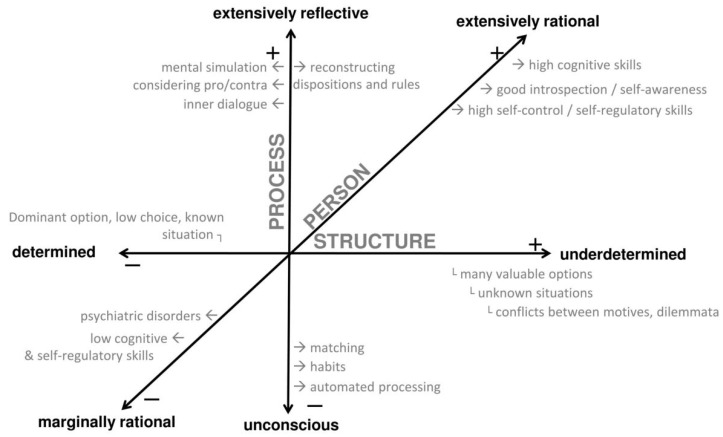
The freedom of a decision is not yet sufficiently described as a psychological variable. We present a model of functional decision freedom that aims to fill that role. The model conceptualizes functional freedom as a capacity of people that varies depending on certain conditions of a decision episode. It denotes an inner capability to consciously shape complex decisions according to one's own values and needs. Functional freedom depends on three compensatory dimensions: it is greatest when the decision-maker is highly rational, when the structure of the decision is highly underdetermined, and when the decision process is strongly based on conscious thought and reflection. We outline possible research questions, argue for psychological benefits of functional decision freedom, and explicate the model's implications on current knowledge and research. In conclusion, we show that functional freedom is a scientific variable, permitting an additional psychological foothold in research on freedom, and that is compatible with a deterministic worldview.
决策的自由度作为一种心理变量尚未得到充分描述。我们提出了一个功能性决策自由度模型,旨在填补这一空白。该模型将功能性自由概念化为一种因人而异的能力,具体取决于决策过程中的某些条件。它表示一种内在能力,即根据自身价值观和需求有意识地塑造复杂决策。功能性自由取决于三个补偿维度:当决策者高度理性、决策结构高度不确定以及决策过程强烈基于有意识的思考和反思时,功能性自由最大。我们概述了可能的研究问题,论证了功能性决策自由度的心理益处,并阐述了该模型对现有知识和研究的影响。总之,我们表明功能性自由是一个科学变量,为自由研究提供了一个额外的心理学立足点,并且与决定论的世界观相容。