Program in Biophysics and ‡Departments of Biochemistry and §Chemistry University of Wisconsin-Madison , Madison, Wisconsin 53706, United States.
J Am Chem Soc. 2017 Jul 26;139(29):9885-9894. doi: 10.1021/jacs.7b03261. Epub 2017 Jul 17.
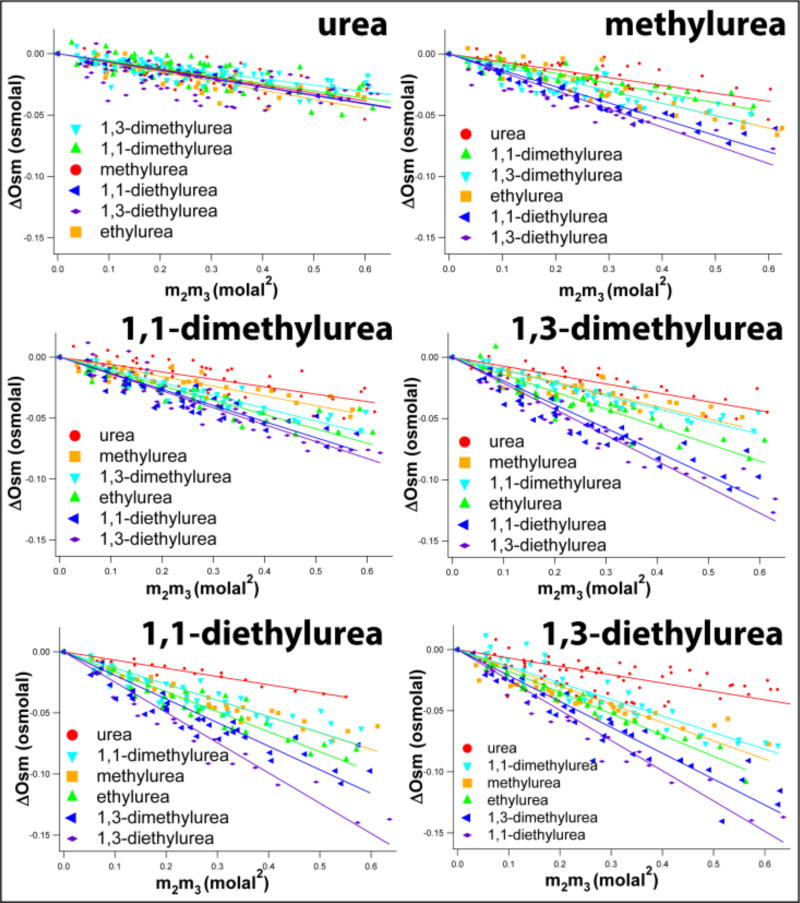
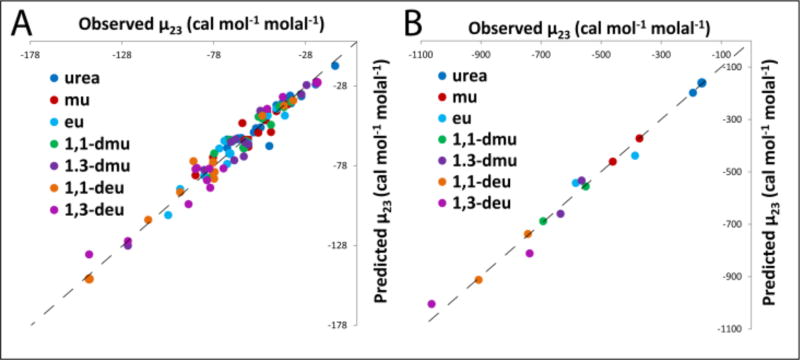
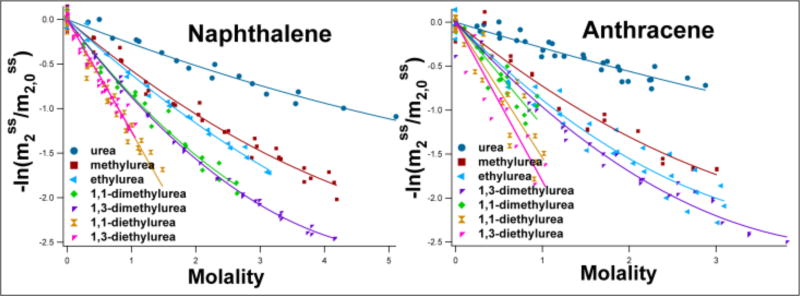
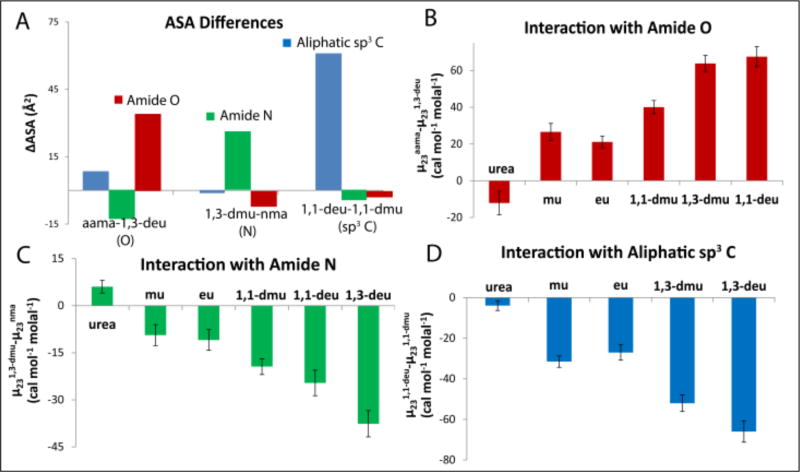
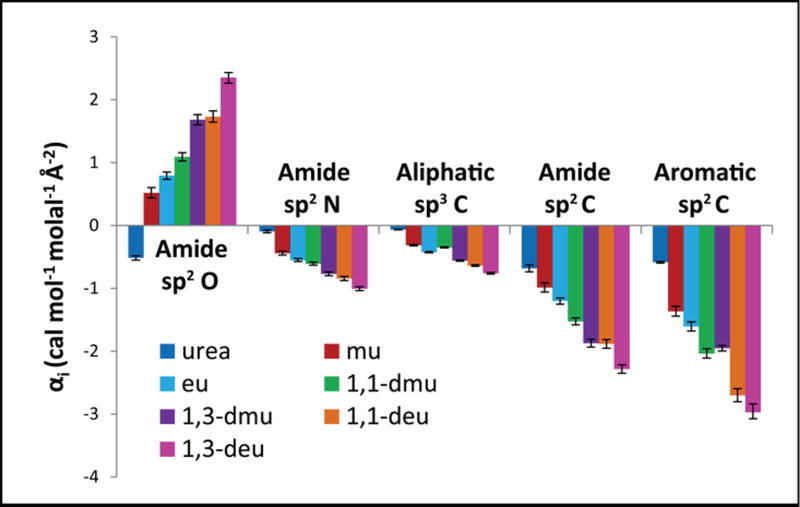
Quantitative information about amide interactions in water is needed to understand their contributions to protein folding and amide effects on aqueous processes and to compare with computer simulations. Here we quantify interactions of urea, alkylated ureas, and other amides by osmometry and amide-aromatic hydrocarbon interactions by solubility. Analysis of these data yields strengths of interaction of ureas and naphthalene with amide spO, amide spN, aliphatic spC, and amide and aromatic spC unified atoms in water. Interactions of amide spO with urea and naphthalene are favorable, while amide spO-alkylurea interactions are unfavorable, becoming more unfavorable with increasing alkylation. Hence, amide spO-amide spN interactions (proposed n-σ* hydrogen bond) and amide spO-aromatic spC (proposed n-π*) interactions are favorable in water, while amide spO-spC interactions are unfavorable. Interactions of all ureas with spC and amide spN are favorable and increase in strength with increasing alkylation, indicating favorable spC-amide spN and spC-spC interactions. Naphthalene results show that aromatic spC-amide spN interactions in water are unfavorable while spC-spC interactions are favorable. These results allow interactions of amide and hydrocarbon moieties and effects of urea and alkylureas on aqueous processes to be predicted or interpreted in terms of structural information. We predict strengths of favorable urea-benzene and N-methylacetamide interactions from experimental information to compare with simulations and indicate how amounts of hydrocarbon and amide surfaces buried in protein folding and other biopolymer processes and transition states can be determined from analysis of urea and diethylurea effects on equilibrium and rate constants.
定量了解酰胺相互作用在水中的信息对于理解其对蛋白质折叠的贡献,以及酰胺对水相过程的影响,并与计算机模拟进行比较是必要的。在这里,我们通过渗透压法定量测量了尿素、烷基化脲和其他酰胺的相互作用,通过溶解度法测量了酰胺-芳烃烃相互作用。对这些数据的分析得出了脲和萘与酰胺 spO、酰胺 spN、脂肪族 spC 和酰胺及芳香族 spC 统一原子在水中相互作用的强度。酰胺 spO 与尿素和萘的相互作用是有利的,而酰胺 spO-烷基脲的相互作用是不利的,随着烷基化程度的增加而变得更加不利。因此,酰胺 spO-酰胺 spN 相互作用(拟议的 n-σ氢键)和酰胺 spO-芳烃 spC(拟议的 n-π)相互作用在水中是有利的,而酰胺 spO-spC 相互作用是不利的。所有脲与 spC 和酰胺 spN 的相互作用都是有利的,并且随着烷基化程度的增加而增强,表明 spC-酰胺 spN 和 spC-spC 相互作用是有利的。萘的结果表明,水中芳烃 spC-酰胺 spN 相互作用是不利的,而 spC-spC 相互作用是有利的。这些结果使得可以根据结构信息预测或解释酰胺和烃基部分的相互作用以及脲和烷基脲对水相过程的影响。我们根据实验信息预测了有利的脲-苯和 N-甲基乙酰胺相互作用的强度,以与模拟结果进行比较,并指出如何从分析脲和二乙基脲对平衡常数和速率常数的影响来确定在蛋白质折叠和其他生物聚合物过程以及过渡态中烃和酰胺表面的埋藏量。