Nishimura Issei, Kurokawa Masaomi, Liu Liu, Ying Bei-Wen
Graduate School of Life and Environmental Sciences, University of Tsukuba, Ibaraki, Japan.
Graduate School of Life and Environmental Sciences, University of Tsukuba, Ibaraki, Japan
mBio. 2017 Jul 5;8(4):e00676-17. doi: 10.1128/mBio.00676-17.
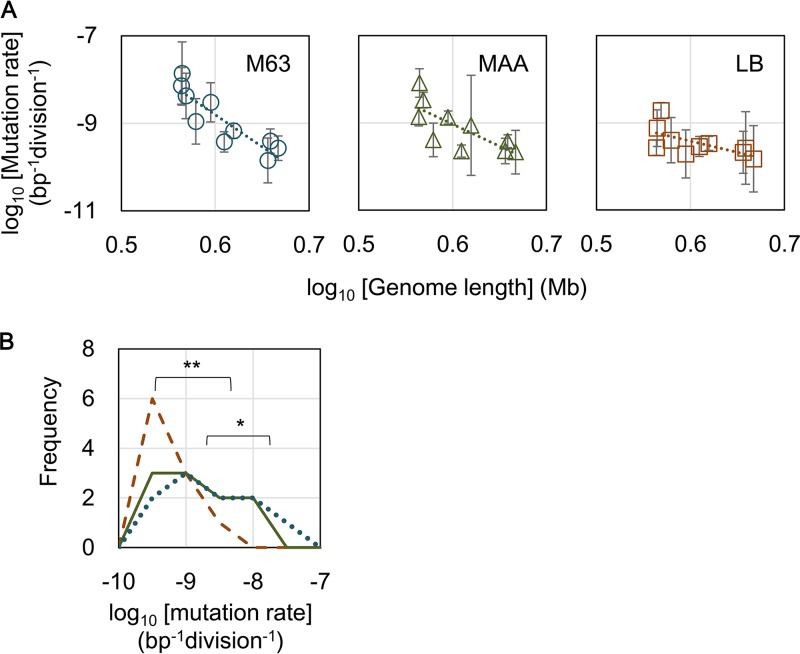
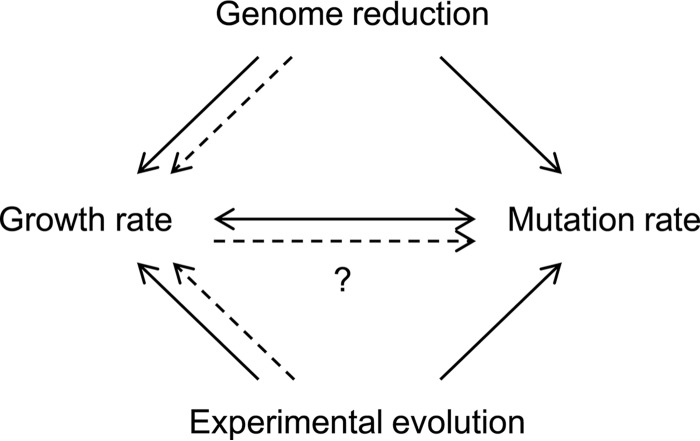
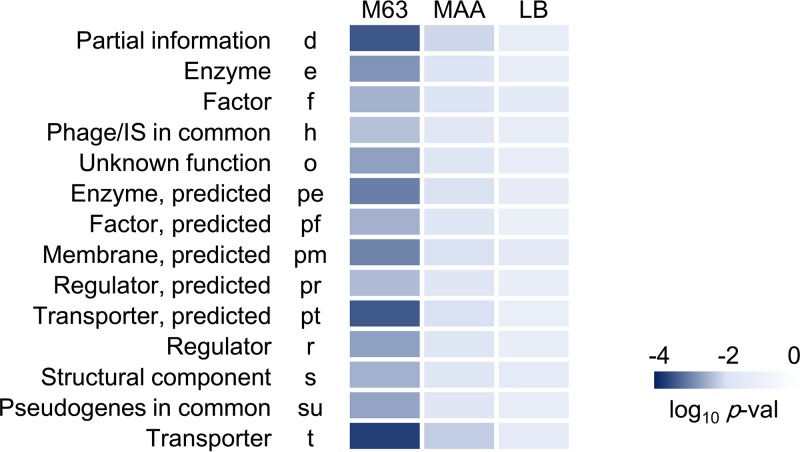
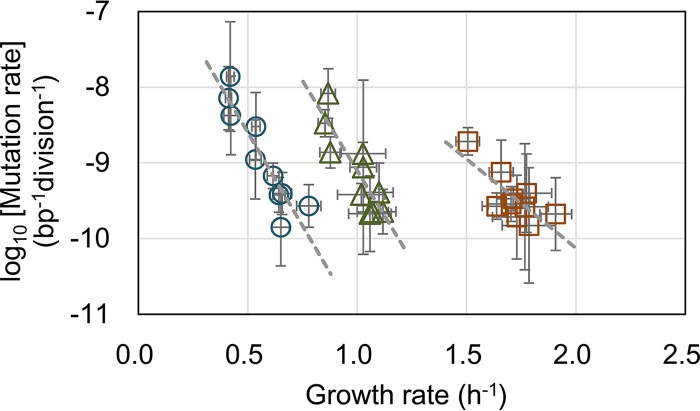
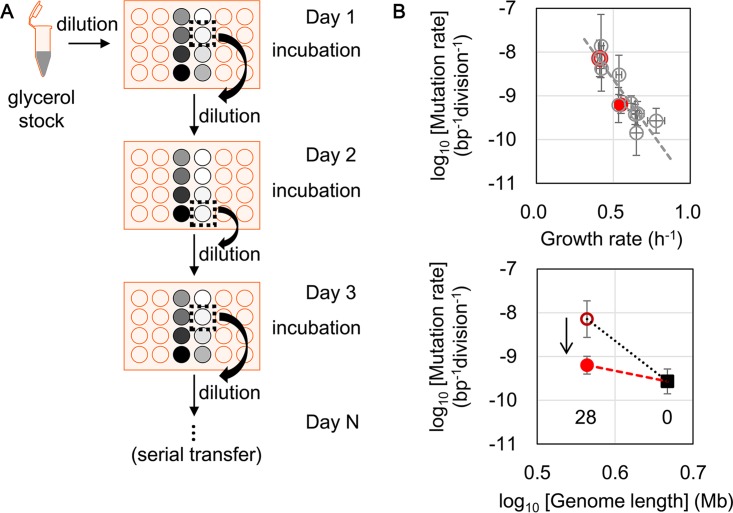
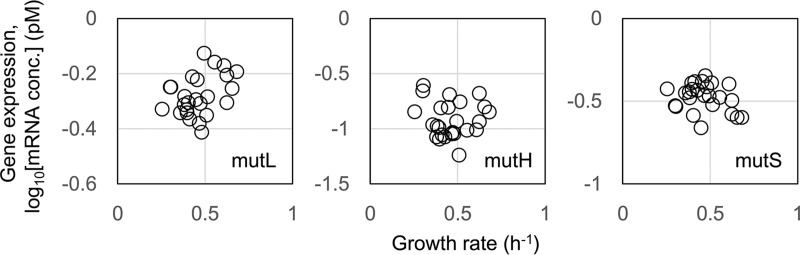
Genome size is determined during evolution, but it can also be altered by genetic engineering in laboratories. The systematic characterization of reduced genomes provides valuable insights into the cellular properties that are quantitatively described by the global parameters related to the dynamics of growth and mutation. In the present study, we analyzed a small collection of W3110 derivatives containing either the wild-type genome or reduced genomes of various lengths to examine whether the mutation rate, a global parameter representing genomic plasticity, was affected by genome reduction. We found that the mutation rates of these cells increased with genome reduction. The correlation between genome length and mutation rate, which has been reported for the evolution of bacteria, was also identified, intriguingly, for genome reduction. Gene function enrichment analysis indicated that the deletion of many of the genes encoding membrane and transport proteins play a role in the mutation rate changes mediated by genome reduction. Furthermore, the increase in the mutation rate with genome reduction was highly associated with a decrease in the growth rate in a nutrition-dependent manner; thus, poorer media showed a larger change that was of higher significance. This negative correlation was strongly supported by experimental evidence that the serial transfer of the reduced genome improved the growth rate and reduced the mutation rate to a large extent. Taken together, the global parameters corresponding to the genome, growth, and mutation showed a coordinated relationship, which might be an essential working principle for balancing the cellular dynamics appropriate to the environment. Genome reduction is a powerful approach for investigating the fundamental rules for living systems. Whether genetically disturbed genomes have any specific properties that are different from or similar to those of natively evolved genomes has been under investigation. In the present study, we found that cells with reduced genomes showed accelerated nucleotide substitution errors (mutation rates), although these cells retained the normal DNA mismatch repair systems. Intriguingly, this finding of correlation between reduced genome size and a higher mutation rate was consistent with the reported evolution of mutation rates. Furthermore, the increased mutation rate was quantitatively associated with a decreased growth rate, indicating that the global parameters related to the genome, growth, and mutation, which represent the amount of genetic information, the efficiency of propagation, and the fidelity of replication, respectively, are dynamically coordinated.
基因组大小在进化过程中得以确定,但在实验室中也可通过基因工程改变。对简化基因组的系统表征为细胞特性提供了有价值的见解,这些特性由与生长和突变动态相关的全局参数进行定量描述。在本研究中,我们分析了一小批W3110衍生物,它们包含野生型基因组或各种长度的简化基因组,以研究突变率(一个代表基因组可塑性的全局参数)是否受基因组简化的影响。我们发现这些细胞的突变率随着基因组简化而增加。有趣的是,在基因组简化中也发现了细菌进化过程中所报道的基因组长度与突变率之间的相关性。基因功能富集分析表明,许多编码膜蛋白和转运蛋白的基因的缺失在基因组简化介导的突变率变化中起作用。此外,随着基因组简化,突变率的增加与生长速率以营养依赖的方式高度相关;因此,较差的培养基显示出更大且更显著的变化。这一负相关得到了实验证据的有力支持,即简化基因组的连续传代在很大程度上提高了生长速率并降低了突变率。综上所述,与基因组、生长和突变相对应的全局参数呈现出一种协调关系,这可能是平衡适合环境的细胞动态的基本工作原理。基因组简化是研究生命系统基本规则的有力方法。基因干扰的基因组是否具有与天然进化基因组不同或相似的任何特定特性,目前正在研究中。在本研究中,我们发现基因组简化的细胞表现出加速的核苷酸替代错误(突变率),尽管这些细胞保留了正常的DNA错配修复系统。有趣的是,基因组大小减小与较高突变率之间的这种相关性发现与所报道的突变率进化一致。此外,增加的突变率与降低的生长速率在数量上相关,表明分别代表遗传信息量、繁殖效率和复制保真度的与基因组、生长和突变相关的全局参数是动态协调的。